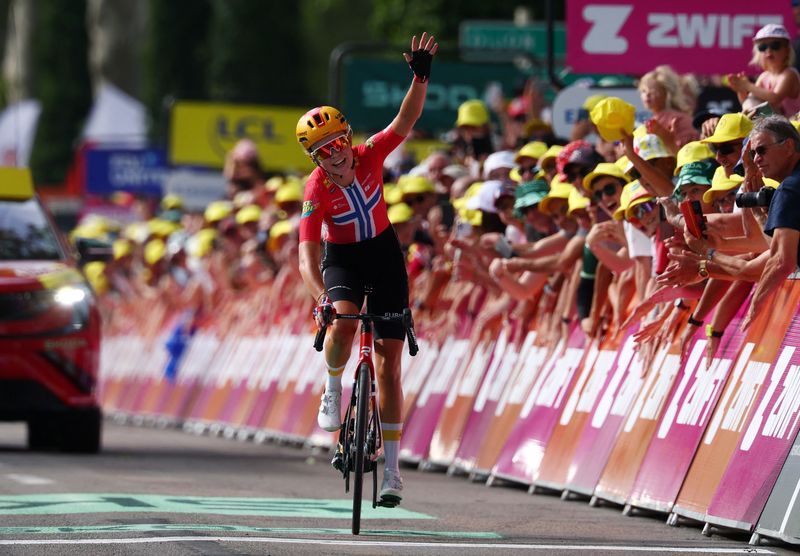
Sigrid Haugset of Norway etched her name into cycling history on Monday, delivering a solo breakthrough performance that saw her capture the day's honours at the Tour de France Femmes and seize overall leadership of the 156.5-kilometre stage. The 27-year-old's triumph marks a watershed moment for Norwegian women's cycling, as she became the first rider from her country to claim both a stage victory and the coveted yellow jersey at the tournament. Her Uno-X Mobility teammate's efforts proved sufficiently commanding to dislodge Dutchwoman Lorena Wiebes from the general classification summit, signalling a dramatic shift in the race dynamics.
Haugset's path to victory was neither straightforward nor comfortable. Having launched her decisive break during the climb towards Col de la Savine, she found herself pursued relentlessly by Belgium's Lotte Kopecky, who mounted a determined challenge in the latter portions of the stage. The gap between the two narrowed to mere seconds as the penultimate kilometres unfolded, with Kopecky threatening to reel in the Norwegian leader. However, Haugset's mental fortitude proved decisive. Drawing on reserves of energy when exhaustion threatened to overtake her, she surged ahead in the final three kilometres, eventually crossing the line with Kopecky finishing 1:24 in arrears. Dutch rider Marianne Vos completed the podium in third place, the stage finishing in the eastern French town of Poligny.
The dramatic nature of the stage was amplified by treacherous conditions earlier in the day. As the race ventured into hillier terrain for the first time, a significant crash disrupted the proceedings during the category one ascent of Col de la Faucille. The incident claimed several notable casualties, including defending world champion Magdeleine Vallieres and Demi Vollering, a former Tour de France Femmes winner. Despite the severity of the incident, all affected riders remounted their bicycles without prolonged delay, and the peloton regrouped to continue without further breakaway attempts during the remainder of the arduous 11.4-kilometre climb.
Haugset's overall advantage now stands at a commanding 2:22 ahead of Kimberly Le Court of Mauritius, positioning the Norwegian firmly in control of the race's destiny. The shift in leadership represents a significant development in the tournament structure, as Le Court's second-place standing came into the stage, alongside Vollering who occupied third, but neither could mount sufficient resistance to Haugset's accelerations during the crucial climbing sections. Wiebes, who had entered the final twenty kilometres still wearing yellow but trailing Haugset by thirteen minutes, ultimately finished well outside the podium positions for the day.
The emotional weight of her achievement was evident in Haugset's post-race reflections. She candidly expressed disbelief at her own accomplishment, describing the moment as surreal and acknowledging that she had harboured significant doubts about her capacity to hold off Kopecky's advances. The psychological battle she fought during the final kilometres revealed itself in her commentary on her own thought process—at one point considering whether settling for second place might be the prudent option, before thoughts of supporters back home in Norway reinvigorated her determination to push through the physical pain barrier.
Haugset's newfound role as the yellow jersey wearer carries substantial historical significance for Norwegian cycling. Her nation has produced numerous accomplished cyclists over the decades, yet the Tour de France Femmes remains a relatively young competition in its current format. The fact that she has become the first Norwegian to wear the yellow jersey speaks to both her individual achievement and the evolving competitiveness of Scandinavian women's cycling on the world stage. This breakthrough performance may catalyse increased interest and investment in women's cycling development within Norway.
The intensity of the final kilometres showcased Haugset's exceptional mental resilience and tactical acuity. Rather than celebrating prematurely as she approached the finish line, she maintained her focus entirely on the racing task at hand, crossing with her energy completely spent. Her candid admission that she could barely lift her arms from the handlebars, combined with her humorous acknowledgement that her boyfriend would chastise her for failing to celebrate, provided a human dimension to her victory and illustrated the extraordinary physical demands of professional cycling competition.
For Malaysian and Southeast Asian cycling enthusiasts, Haugset's rise represents the globalisation of professional women's cycling excellence. The presence of riders from diverse geographical backgrounds competing at the highest levels demonstrates the sport's expanding reach beyond its traditional European strongholds. The Le Court and Vollering competition narrative also underscores the increasing depth of talent at the Tour de France Femmes, where riders from across the world are now capable of contending for overall honours.
Kopecky's valiant second-place finish, though ultimately unsuccessful, reinforced Belgium's continued strength in women's cycling and demonstrated that the race remains fiercely competitive throughout the field. Her sustained chase of Haugset over multiple kilometres exemplified the calibre of competition now evident at the Tour de France Femmes, where stage winners must possess not merely excellent climbing ability or sprint power, but the capacity to absorb and repel world-class opposition across extended durations.
As the race moves forward into subsequent stages, Haugset's two-minute-plus buffer provides her with strategic flexibility whilst simultaneously establishing her as a primary target for rival teams seeking to unseat her. Her capacity to deliver under pressure and maintain composure during decisive moments will be tested repeatedly as stronger climbing specialists challenge her leadership in the mountains ahead. The narrative of a Norwegian taking the yellow jersey in this prestigious competition adds another compelling chapter to women's cycling's continuing evolution.

