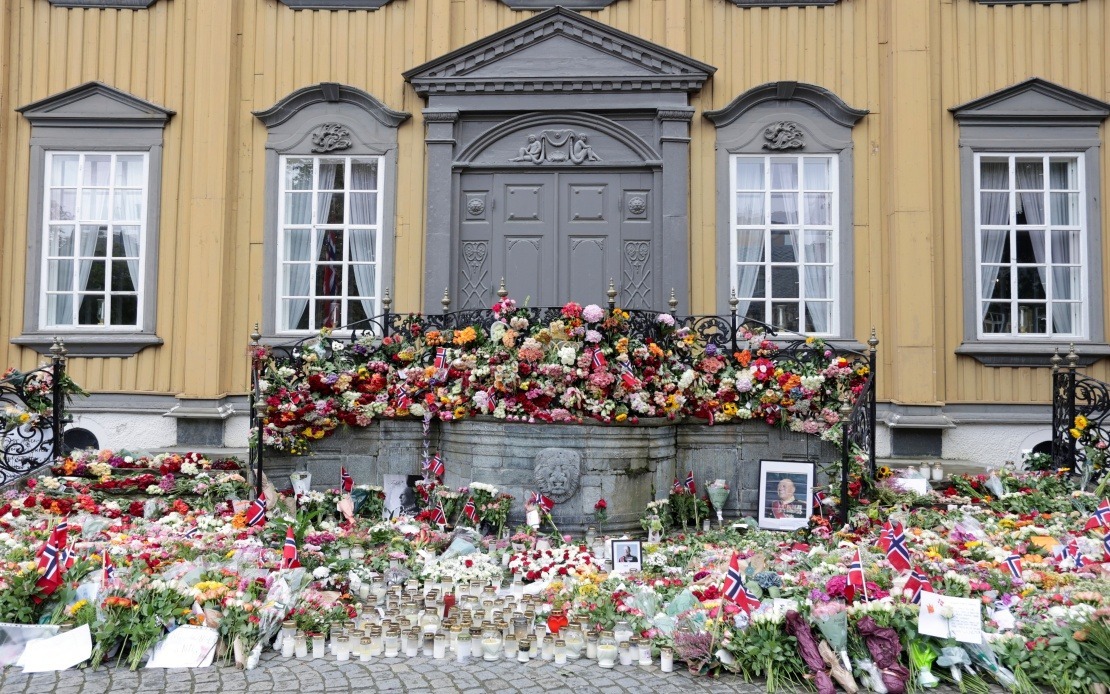
Norway observed a period of national mourning on Sunday as churches and cathedrals throughout the kingdom held memorial services for King Harald V, who died on Friday at the age of 89. The Norwegian Royal House confirmed that the late monarch's funeral will take place on 9 September, providing the nation's people with a formal occasion to bid farewell to a ruler who had reigned since 1991.
The outpouring of public grief was evident across Norway's major population centres and smaller communities alike. Tens of thousands of citizens made their way to places of worship to pay their respects, reflecting the deep connection many Norwegians felt towards their sovereign. The spontaneous memorials that emerged outside the Royal Palace in Oslo—where flowers, candles, and handwritten tributes accumulated—underscored the personal nature of mourning in a country where the monarchy maintains close ties with ordinary people.
Under Norway's constitutional succession laws, the transfer of power occurred immediately and without interruption. Harald V's son, now aged 53, ascended to the throne and assumed the regnal name Haakon VIII. This smooth transition represents the functioning of Norway's hereditary monarchy system, whereby the crown passes directly to the eldest male heir upon the reigning monarch's death. The succession ensures governmental continuity during a period when the nation processes a significant loss.
King Harald V's long reign left an indelible mark on modern Norwegian identity. Having guided the country through decades of social change, economic prosperity driven by oil revenues, and evolving European relationships, the late king witnessed Norway's transformation into one of the world's wealthiest nations. His approach to monarchy—marked by relative informality and accessibility—contributed to the high regard in which the Norwegian royal family is generally held by the public.
The establishment of a formal funeral date allows for comprehensive state arrangements befitting a reigning monarch. The ceremony on 9 September will likely draw dignitaries from across Europe and beyond, reflecting Norway's international standing and the widespread respect commanded by the Norwegian Crown. For many Scandinavian and European observers, the funeral represents an important ceremonial moment in the region's political calendar.
For Malaysian and Southeast Asian audiences, the Norwegian succession offers a studied example of how established constitutional monarchies manage transitions of power. Like Malaysia, Norway maintains a system in which the crown is central to national identity and governance, though the mechanics differ considerably. The orderly passage of authority from Harald V to Haakon VIII demonstrates how institutional frameworks and public understanding of succession can facilitate smooth transfers without constitutional crisis or uncertainty.
The timing of the succession—occurring during a period when many democracies face polarization and institutional strain—highlights the stabilizing role that well-established monarchical systems can play. Haakon VIII inherits not only a throne but also a legacy of Norwegian kingship that emphasizes duty, continuity, and connection to the nation's citizens. His accession occurs against the backdrop of complex international challenges, including energy security concerns and the broader geopolitical realignment affecting Europe.
As Norway processes its collective grief through memorial services and preparation for the state funeral, the nation's institutions and people are demonstrating the resilience that characterizes long-standing constitutional arrangements. The spontaneous gatherings at churches reflect a society united in acknowledging loss while simultaneously looking forward to the reign of a new sovereign who carries forward centuries of Norwegian royal tradition.
For regional observers interested in how stable democracies with strong institutions manage major transitions, Norway's response provides instructive lessons. The contrast between the measured, ceremonial approach evident in Scandinavia and the sometimes turbulent successions witnessed elsewhere underscores the value of clear constitutional frameworks and public consensus around the legitimacy of established governance structures. Haakon VIII's reign begins with the advantage of institutional stability and widespread public acceptance.

