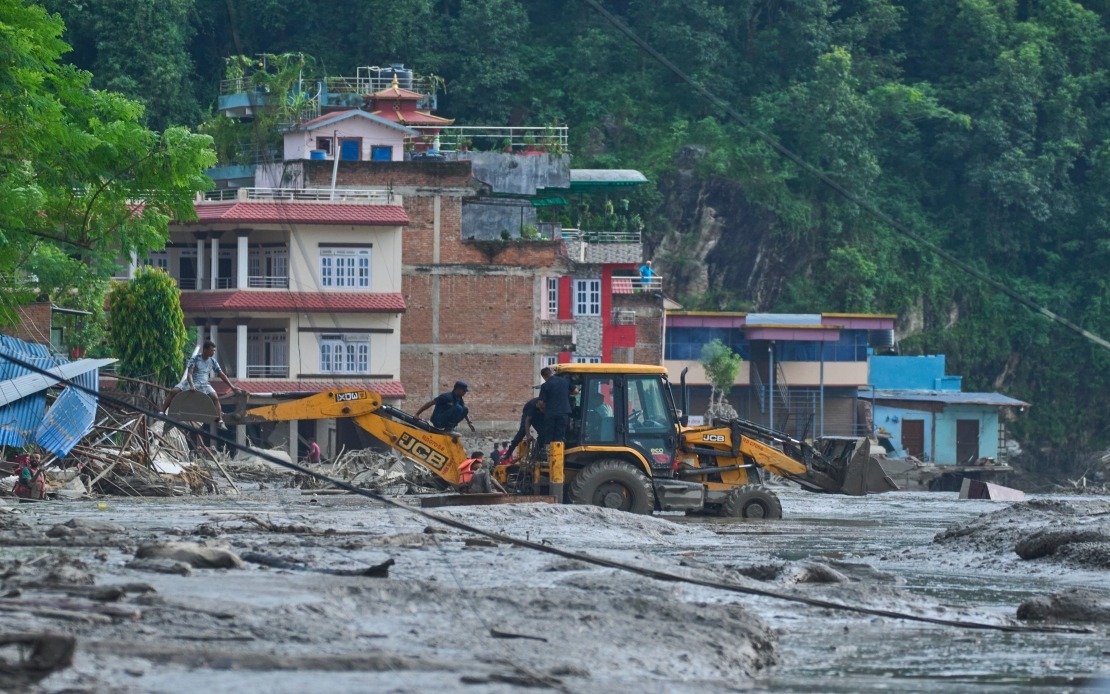
Nine South Korean citizens have disappeared in the aftermath of catastrophic flooding that swept through Nepal's mountainous Rasuwa district on Wednesday, prompting an urgent diplomatic and humanitarian response from Seoul. The missing individuals—six employed by engineering firm Doosan Enerbility Co. and three by state-owned utility Korea South-East Power Co.—were stationed at a hydropower construction project when the disaster struck. Their loss represents a significant blow to both the corporate entities involved and their families, who now face an agonising wait for news from a remote region devastated by one of the season's most destructive natural calamities.
The scale of the catastrophe extends well beyond the Korean nationals directly affected. Initial reports indicate that over 160 people have perished across the wider region near the Nepal-Tibet border, with hundreds more reported missing—predominantly foreign nationals drawn to the area for large-scale infrastructure development work. The disaster has exposed the vulnerability of construction workforces operating in geographically challenging and weather-prone locations across South and Southeast Asia, regions where monsoon season flooding regularly claims lives and disrupts major projects.
In response to the emergency, South Korea's government has mobilised a comprehensive crisis management apparatus. Foreign Minister Cho Hyun convened an emergency response meeting on Wednesday and announced that Seoul would dispatch a joint rapid response team comprising representatives from the foreign ministry, national police agency, and fire services. This delegation was scheduled to arrive in Kathmandu by Thursday evening, positioning South Korean officials to coordinate with Nepalese authorities and bolster on-site search and rescue capabilities. The composition of the team reflects Seoul's determination to leverage both diplomatic channels and specialised emergency response expertise.
President Lee Jae Myung has personally intervened in the crisis, issuing direct instructions to subordinate agencies to exhaust all available resources in locating and rescuing the missing nationals. The presidential directive carries significant weight in South Korea's bureaucratic hierarchy, signalling top-level commitment and ensuring that departmental boundaries do not impede coordinated response efforts. Such high-level engagement also serves a secondary but important function: reassuring South Korean families and domestic constituencies that their government is taking decisive action in the face of international tragedy.
Parallel to official government channels, the affected South Korean companies have activated their own emergency protocols. Both Doosan Enerbility and Korea South-East Power have established dedicated crisis response teams and are preparing field units to deploy to the accident site. This dual-track approach—combining state resources with corporate emergency capabilities—maximises the practical search and rescue capacity available on the ground. These companies maintain sophisticated supply chains and logistical networks across Asia, assets that can be rapidly redeployed for humanitarian purposes during crises.
The situation carries an additional dimension of complexity: ten other South Korean personnel affiliated with Doosan had become stranded in the flooded zone but have since been confirmed as safe. These individuals were among approximately 200 foreign workers who successfully evacuated from the construction project as the disaster unfolded. While their survival is encouraging, their presence in the affected region underscores the concentration of South Korean industrial and technical expertise in major infrastructure projects across the Himalayan region—a presence that, while economically significant, inevitably creates exposure to natural hazards endemic to the area.
For Malaysia and the broader Southeast Asian region, this incident carries instructive implications. Many multinational firms operate hydroelectric and power generation facilities across terrain as challenging as Nepal's, from Myanmar to Indonesia to Bhutan. The Nepal flooding exemplifies how rapidly and catastrophically monsoon conditions can overwhelm construction sites and worker safety protocols, even when operated by experienced international contractors with established safety records. The incident should prompt Malaysian companies and regional governments to re-evaluate disaster preparedness standards for infrastructure projects in mountainous and flood-prone zones.
The diplomatic dimension of Seoul's response also warrants attention. Foreign Minister Cho committed to direct engagement with Nepal's foreign minister to secure cooperation from Kathmandu's authorities and ensure that South Korean rescue assets receive necessary administrative and logistical support. This represents standard practice in international humanitarian crises but also reflects how natural disasters can strengthen bilateral relationships through coordinated crisis response. For Malaysia, maintaining robust formal channels with neighbouring governments—particularly Thailand, Brunei, and Indonesia—becomes critical when Malaysian nationals face emergencies across borders.
The scale and location of the flood—originating in the unstable terrain near the Nepal-Tibet border, where glacial melt combines with monsoon precipitation to create flash flood conditions—highlights a geographical reality affecting multiple Asian regions. Climate change models predict intensification of extreme precipitation events across mountain ranges throughout Asia, suggesting that incidents of this severity may become increasingly frequent. Infrastructure planners and construction firms must integrate this trajectory into their risk assessments when undertaking projects in vulnerable zones.
As search and rescue operations intensify over the coming days, the focus for South Korea will be preventing additional loss of life and locating survivors. The presence of a government response team in Kathmandu will enable Seoul to maintain real-time situational awareness and coordinate with international rescue efforts. Media coverage will remain intense, and the families of missing individuals will continue pressing authorities for updates. Should any of the missing be located, the recovery and repatriation process will involve further diplomatic coordination between Seoul and Kathmandu.
The broader implications extend beyond the immediate tragedy. For multinational corporations operating across Asia's complex terrain, the Nepal incident reinforces that even rigorous safety protocols and international standards cannot entirely eliminate the hazards posed by extreme natural events. For governments including Malaysia's, the episode demonstrates the importance of maintaining rapid-response diplomatic and consular capabilities to support nationals facing emergencies abroad. As regional economic integration deepens and more Asian professionals work across borders, comprehensive emergency coordination mechanisms become increasingly vital to protecting citizens and preserving bilateral relationships during moments of crisis.

