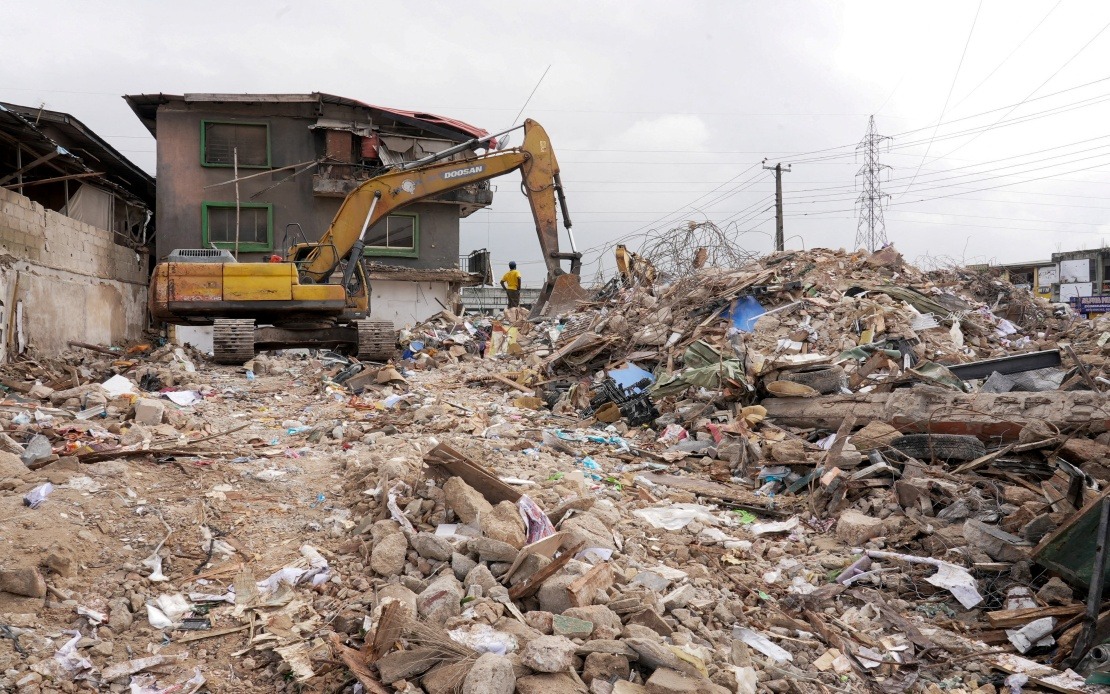
A three-story shopping complex in the Alakija district of Lagos state collapsed Thursday morning, claiming nine lives and leaving 27 others injured, according to Lagos State Emergency Management Agency officials who announced the conclusion of rescue efforts Friday. The incident unfolded in one of Nigeria's fastest-growing satellite towns positioned along the heavily trafficked Lagos-Badagry Expressway, a major commercial corridor serving the region.
Rescue teams mobilized immediately after the structure gave way, launching a coordinated multi-agency operation to extricate victims from the rubble. Olufemi Oke-Osanyintolu, permanent secretary at the Lagos State Emergency Management Agency, explained that rescue workers operated continuously throughout Thursday night and into Friday morning to locate and extract trapped individuals. The operation ultimately recovered nine fatalities while successfully evacuating 27 survivors who sustained injuries of varying severity.
The rescued victims were transported to nearby medical facilities for treatment and observation. Officials noted that those trapped represented a cross-section of the building's occupants at the time of collapse—primarily shop proprietors and their customers who had begun their daily commercial activities. Additionally, several residents from adjoining residential areas found themselves caught in the disaster, expanding the scope of the rescue effort beyond the commercial space itself.
Oke-Osanyintolu confirmed that rescue operations concluded early Friday once all accessible victims had been recovered and evacuated from the debris field. Notably, the China Civil Engineering Construction Corporation, an entity actively involved in executing a railway infrastructure project in the vicinity, mobilized equipment and personnel to support the emergency response, demonstrating how major construction enterprises in the region contribute to crisis management when disasters strike neighbouring communities.
The fundamental cause of the structural failure remains undetermined at present, with authorities launching a formal investigation to establish how the building failed so catastrophically. Initial assessments suggest the collapse occurred suddenly without prior warning, providing occupants little opportunity to evacuate voluntarily. Understanding the mechanism of failure will be critical for informing future safety protocols in Lagos's expanding commercial districts.
Building collapses represent a persistent challenge across Nigeria, with Lagos particularly vulnerable given its rapid urbanization and dense commercial development. Structural engineers and safety experts consistently identify three primary culprits: deteriorating infrastructure inadequately maintained over decades, widespread disregard for established building codes and safety regulations during construction, and the pervasive use of substandard or counterfeit materials by contractors seeking cost reductions. These systemic issues have created a precarious built environment where catastrophic failures occur with troubling regularity.
For Malaysia and Southeast Asia, the Lagos incident underscores universal challenges confronting rapidly urbanizing nations. While Malaysia has strengthened building regulations and enforcement mechanisms substantially over recent decades, emerging markets throughout the region grapple with the same pressures that compromise construction safety in Nigeria—pressure to develop quickly, cost-cutting incentives, inadequate inspection regimes, and corruption that permits violations to proceed unchecked. The pattern of collapses in Lagos serves as a cautionary example of what occurs when regulatory frameworks weaken or enforcement becomes inconsistent.
The Alakija location along the Lagos-Badagry Expressway marks this area as a critical commercial node where infrastructure development has outpaced safety oversight. As satellite towns flourish around major cities throughout Africa and Asia, they frequently become laboratories for poor construction practices, as developers exploit relative regulatory laxity and insufficient municipal oversight. The concentration of commercial activity in such zones without corresponding investment in building inspections and safety compliance creates environments vulnerable to disasters like Thursday's collapse.
Future implications of this incident will likely extend beyond immediate investigation and prosecution of responsible parties. Lagos authorities will face pressure to implement enhanced inspection protocols for aging commercial structures, enforce stricter compliance with building codes, and penalize contractors and building owners who cut corners. Such responses, if implemented rigorously, could prevent similar tragedies. However, Nigeria's track record suggests that enforcement momentum often dissipates once media attention fades, a pattern that has enabled repeated building failures across Nigerian cities.
The broader context reveals that structural safety in rapidly developing urban centres depends fundamentally on three interrelated factors: robust regulatory frameworks that remain current with building science and risk assessment; consistent, well-resourced enforcement mechanisms that inspect construction and maintain oversight of existing structures; and genuine consequences for violations that create sufficient deterrence. When any component weakens, disaster becomes inevitable. The nine lives lost in Alakija represent the human cost of these systemic failures, a toll that multiplies across Nigeria and threatens populations throughout the developing world wherever similar conditions persist.

