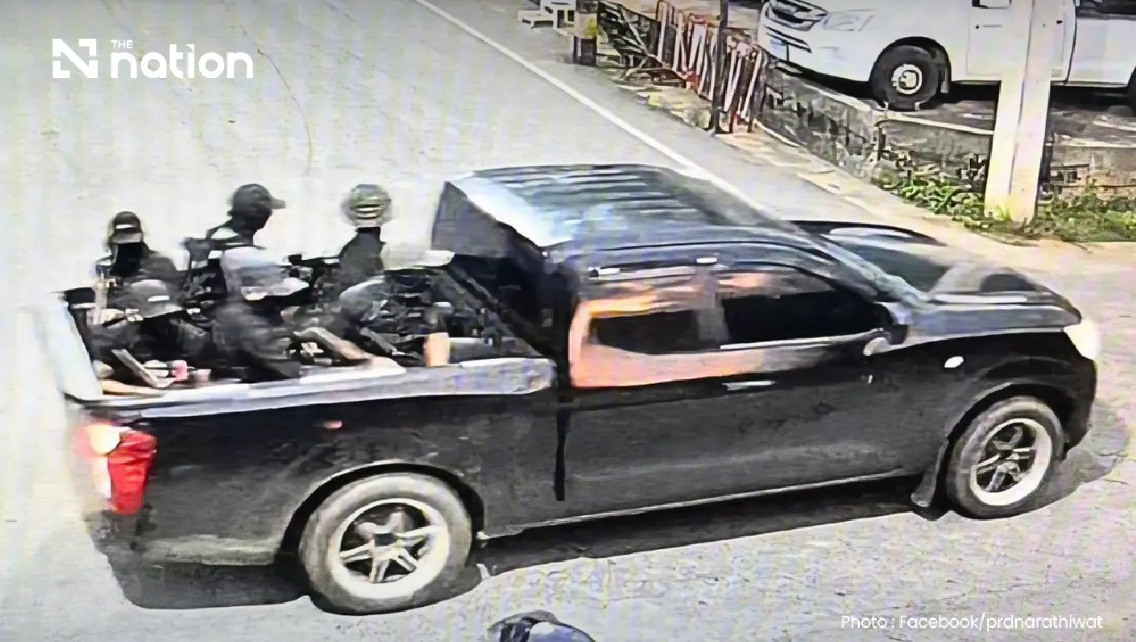
A meticulously coordinated assault on a paramilitary checkpoint in Narathiwat province has prompted a major investigation after security camera footage revealed the full scope of the operation. The attack, which unfolded in just 90 seconds on Wednesday evening at approximately 6.45pm, left five members of the 4509th Ranger Company dead and six civilians injured. The incident represents a significant security incident in Thailand's volatile deep south, where insurgent groups have waged a decades-long conflict against state forces.
Initial assessments by investigators suggested six perpetrators were involved, but comprehensive review of CCTV recordings from multiple angles around the Bukeh Sami checkpoint in Village 7 of Tanyong Mat subdistrict revealed a nine-member operation split into two distinct teams. The first contingent, numbering seven individuals, travelled in a black Nissan pickup truck bearing a Songkhla registration. Inside the vehicle's bed, six figures dressed in military-style black clothing and wide-brimmed hats that obscured their identities sat ready for action. A single driver guided the pickup toward the target. A secondary unit arrived on a red-and-white Honda Wave motorcycle, with the driver in a white shirt and helmet and a passenger disguised in a black women's hijab carrying an assault rifle.
The checkpoint itself was operated by personnel from the 45th Ranger Regiment Task Force, a paramilitary force that has borne much of the burden in Thailand's counterinsurgency operations across the southern provinces. Three rangers initially positioned at the roadside perimeter became the first targets when the pickup vehicle slowed and occupants in the truck bed unleashed a barrage of small arms fire using M16 and AK-pattern rifles. Within moments of the initial fusillades, all three officers at the roadside fell, providing the assault team an opening to advance further into the compound. The vehicle halted, disgorging additional attackers who maintained suppressive fire toward the fortified bunker position where two additional rangers were sheltering.
The tactical nature of the assault suggested considerable planning and familiarity with the checkpoint layout. Attackers methodically swept through the post, systematically collecting weapons and equipment before withdrawing. As the assault force retreated to their transport vehicles, one member hurled a pipe bomb toward an elevated structure adjacent to a nearby bridge, adding explosive force to the attack's destructive capacity. The pickup and motorcycle then accelerated toward Dusongyo subdistrict, vanishing into the provincial terrain. All five rangers—Sergeant Major First Class Theerayut Somakerd, volunteers Sakiriya Jena, Wimon Dabthong, Nattasit Kaewsena, and Salahudin Pi—were pronounced dead at the scene.
The assault's impact extended beyond the security personnel directly targeted. Six civilians suffered wounds in the assault, including a ten-year-old child, with conflicting early reports suggesting casualty figures ranging from two to five before authorities settled on six injured. The variety in casualty reporting underscores the initial chaos following such assaults and the challenges faced by emergency responders operating in active conflict zones. All injured civilians received medical treatment at regional hospitals, though the exact nature and severity of their injuries remained unclear.
The overnight investigation deployed substantial resources to the checkpoint vicinity. Narathiwat Governor Boonchuay Homyamyen coordinated response efforts alongside senior police and military commanders, including Provincial Police Region 9 Commissioner Pol Lt Gen Piyawat Chalermsri, Narathiwat Police Chief Pol Maj Gen Prayong Khot Sakha, and Col Witthaya Sariya, who heads the 45th Ranger Regiment Task Force. Forensic teams, bomb-disposal specialists, and tactical police units worked through the night gathering evidence from the attack scene. Investigators recovered more than 100 spent cartridge cases scattered across roadways, including rounds corresponding to M16 rifles, AK-pattern weapons, and 11mm pistols. Additional ammunition apparently ejected during weapons malfunctions provided further forensic material.
Damage assessment of the checkpoint infrastructure revealed extensive ballistic impacts on the bunker structure, with the breach marks suggesting intense, sustained fire directed at the fortified position. Evidence related to the pipe bomb explosion was collected near the elevated structure beside the bridge crossing. The attackers made off with four AK-pattern rifles featuring folding stocks, one 11mm pistol, four ammunition magazines, and four ballistic vests—a haul suggesting either operational supply needs or an intent to equip additional insurgent personnel. Authorities acknowledged uncertainties in the complete inventory of stolen items, as early reports contained conflicting details regarding quantities and classifications of missing equipment.
Efforts to eliminate forensic evidence appeared evident when security forces discovered the black Nissan pickup abandoned and intentionally burned in what authorities interpreted as an attempt to destroy identifying information and forensic material. Despite this destruction, the vehicle's registration and CCTV surveillance of its approach provided investigators with tangible leads. Security forces responded swiftly by establishing checkpoints and roadblocks along likely escape routes throughout the district and neighboring areas, attempting to intercept the fleeing assailants or recover additional weapons and equipment.
For Malaysia and the broader Southeast Asian region, the Narathiwat checkpoint attack carries significant implications regarding insurgent capabilities in Thailand's southern provinces. The coordination, tactical execution, and apparent pre-planning evident in this assault demonstrate organizational sophistication among anti-state elements operating in the border regions. The incident reinforces long-standing security concerns in the Malay-Muslim majority provinces of Thailand's deep south, where separatist and jihadist-aligned groups have maintained active operations despite sustained government countermeasures. Malaysian security agencies maintain close monitoring of cross-border movements and weapons trafficking along the Thailand-Malaysia frontier, making incidents of this magnitude relevant to regional security assessments and cooperation frameworks.
The attack's implications for Thailand's broader counterinsurgency strategy remain consequential. The loss of five paramilitary rangers in a single incident represents significant personnel attrition for the 45th Ranger Regiment Task Force, which has already suffered extensive casualties over nearly two decades of conflict. The attackers' apparent knowledge of checkpoint procedures, personnel positioning, and response times suggests intelligence gathering capabilities or detailed reconnaissance by the assault unit. As investigations continue, Thai authorities will focus on identifying the nine individuals involved, determining their organizational affiliation, and tracing the weapons recovered to understand supply chains supporting insurgent operations. The incident underscores the persistent challenges facing state security forces in maintaining control over disputed territories in Thailand's southernmost regions.

