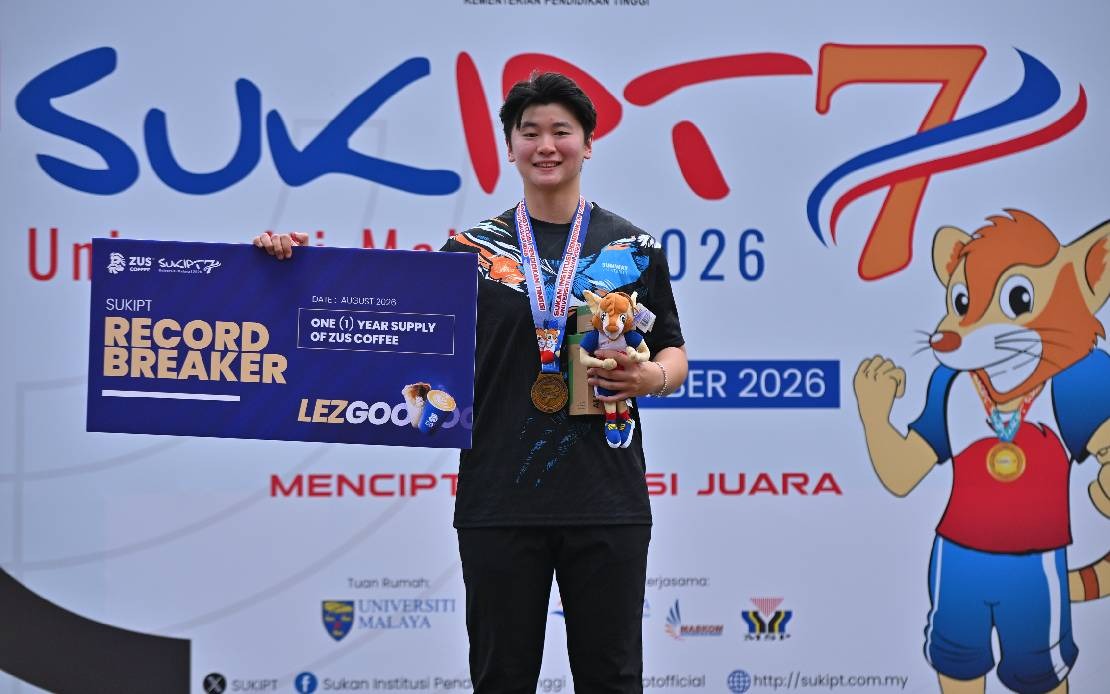
Twenty-two-year-old javelin star Ng Jing Xuan delivered a timely performance for Sunway University by shattering the longstanding SUKIPT meet record during the 2026 Higher Education Institutions Sports Games, held at UM Arena on Malaysia's National Day. Her throw of 46.92 metres surpassed the previous benchmark of 44.41 metres, which had stood unchallenged since Nur Fatin Adibah Suharman of Universiti Malaysia Perlis set it a decade earlier in 2016. The achievement carries symbolic weight beyond mere sporting success, representing a fresh national narrative of female athletic excellence at a time when Malaysian universities compete for institutional prestige and sporting honours.
The record-breaking moment came during a competitive field that saw Farisha Athirah Wai of Universiti Pendidikan Sultan Idris claim the silver medal with 36.21 metres, while Tai Yu Tian from Universiti Putra Malaysia rounded out the podium in third place with 32.74 metres. The decisive margin between first and second place underscored Jing Xuan's clear dominance in the discipline, establishing her as a formidable force within the university sports ecosystem. Her separation from the competition demonstrates the quality gap that intensive elite training and accumulated experience at the international level can produce.
Yet beneath the surface of her record-setting achievement lies a narrative of measured ambition and professional pragmatism. Jing Xuan candidly acknowledged that the SUKIPT victory, while gratifying, fell short of her primary objective heading into these games. Her personal national record stands at 52.17 metres, and she had harboured genuine hopes of eclipsing that mark during today's competition. The five-metre gap between her meet record and her personal best illustrates the challenging trajectory that elite athletes navigate as they pursue incremental improvements in their craft.
The athlete attributed her inability to reach for her national record to several convergent factors that disrupted her preparation and execution. A compressed training calendar following her participation in the Asian U23 Athletics Championships had given her only a month to sharpen her technique and build competitive sharpness. More immediately, a last-minute scheduling adjustment that shifted her events from the afternoon to the morning session unsettled her throwing rhythm and left her sensation during execution feeling laboured and sluggish. These logistical complications underscore how variables beyond pure athletic capacity can influence performance outcomes, particularly in technical sports where consistency of environment and mental readiness prove critical.
Jing Xuan's philosophical approach to disappointment offers insight into the mentality required for sustained athletic development. Rather than dwelling on the national record that escaped her grasp, she framed the SUKIPT record as a meaningful consolation prize and a platform for continued progress. Her comments to media reflected a maturity often absent from younger competitors, acknowledging both the frustration of unmet ambitions and the necessity of accepting circumstances beyond complete control. This balance between aspiration and acceptance positions her well for the high-pressure competitions ahead.
The timing of her success carries particular significance for Malaysian sports observers. Competing during Merdeka Week celebrations, Jing Xuan's gold medal and record performance offer a welcome narrative of national sporting achievement and institutional pride for Sunway University. For a country that has invested considerably in developing elite athletic pathways, witnessing a young female athlete break decade-old records and pursue world-class standards provides validation of those investments while inspiring younger cohorts to pursue javelin and throwing sports more broadly.
Looking forward, Jing Xuan has already pivoted her focus toward two critical international competitions that will define her trajectory. The ASEAN University Games in December presents an immediate opportunity to test her capabilities against regional peers and gain valuable competitive experience. More substantially, next year's SEA Games remains the flagship competition where Malaysian athletes seek to enhance national standing and personal legacies. Her commitment to maintaining intensive preparation for these competitions suggests that the SUKIPT record, while satisfying, functions primarily as a waypoint rather than a destination in her athletic journey.
The broader context of women's athletics in Southeast Asia suggests that Jing Xuan's success reflects a regional trend toward strengthening female participation and performance in traditionally male-dominated throwing disciplines. Countries across ASEAN have systematically developed talent identification and coaching structures for javelin, discus, and shot put, creating a more competitive environment than existed a decade earlier. Jing Xuan's presence among these rising talents positions Malaysia competitively within regional athletics hierarchies, though sustained excellence will require continued institutional support and personal dedication.
For Malaysian university sports specifically, Jing Xuan's achievement validates the continuing relevance of SUKIPT as a developmental platform for athletes pursuing elite pathways. The competition serves dual functions: providing a competitive arena where university athletes can test their readiness while generating institutional pride and media attention. Her record-breaking performance may also inspire greater investment from Sunway University and peer institutions in athletic scholarships and coaching resources, particularly for field events that have historically received less public visibility than track disciplines.
The athlete's acknowledgement of the schedule change affecting her performance highlights practical challenges within competitive sports management. Accommodating scores of events across multiple venues and hundreds of competitors inevitably creates friction between athletes' preferences and organizational requirements. Future editions of SUKIPT might benefit from greater advance notice regarding event scheduling, allowing athletes to adjust warm-up protocols and mental preparation accordingly. These seemingly minor administrative considerations can meaningfully impact performance outcomes, particularly among elite-level competitors.
Jing Xuan's pathway exemplifies the modern Malaysian athlete's experience: balancing intensive national training commitments with university study, managing jet lag and recovery cycles from international competitions, and maintaining focus amid scheduling uncertainties. Her success despite these pressures demonstrates resilience and adaptability, qualities that will serve her well as she progresses toward SEA Games competition. Her trajectory also suggests that Malaysian javelin enjoys a bright future, with multiple high-performing athletes emerging across the university system and creating a deeper talent pool than existed in previous generations.
As Jing Xuan channels her competitive energy toward December's ASEAN University Games and next year's SEA Games, the SUKIPT record will likely recede into the background as a stepping stone rather than a defining moment. However, for the thousands of young Malaysians watching her progress, her combination of excellence, humility about unmet goals, and unwavering commitment to improvement offers a compelling model of athletic professionalism. Her performance during Merdeka Week celebrations reminded observers that Malaysia's sporting future rests increasingly on the shoulders of dedicated young athletes willing to pursue excellence regardless of obstacles.

