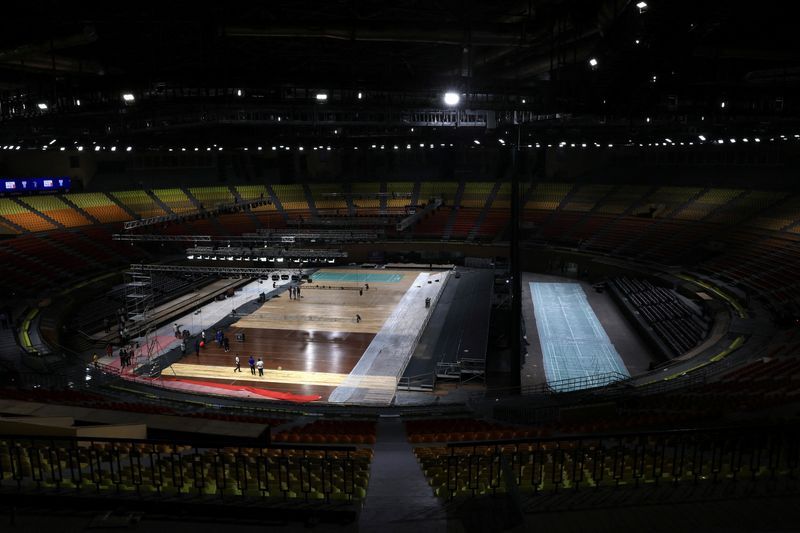
Preparations for the Badminton World Federation championships commencing next week in New Delhi have taken an unconventional turn, with the Badminton Association of India recruiting a specialist team trained in an ancient craft: the mimicry of langur monkey vocalizations. This unusual workforce represents a pragmatic response to the persistent wildlife management challenges that have plagued India's capital and threatened to undermine the nation's credentials as a host of major sporting events.
The decision reflects recurring problems that plagued the Indian Open badminton tournament earlier this year at the Indira Gandhi Indoor Stadium, when a rhesus monkey was observed wandering through spectator galleries, causing significant embarrassment for organisers. Rhesus monkeys remain a notorious urban menace throughout Delhi, regularly infiltrating government buildings and commercial offices, where they pose genuine risks to staff through aggressive behaviour and property damage. Their unpredictability has long frustrated authorities seeking to host international-standard sporting competitions.
The langur, a substantially larger primate distinguished by its distinctive black face and imposing presence, has emerged as nature's own deterrent against rhesus monkey incursions. These primates are now routinely stationed or their presence encouraged in government offices throughout the capital, capitalising on the deep-seated territorial fear that rhesus monkeys harbour towards their larger cousins. The Badminton Association of India recognised this biological reality and sought to harness it through human expertise.
Entering this domain is Zafar, one of the hired monkey mimics, who represents the third generation of his family to practise this specialised profession. During a media demonstration at the stadium, Zafar showcased his hooting abilities—carefully calibrated vocalizations that replicate the sounds produced by langur monkeys. According to Zafar, these mimicked calls prove extraordinarily effective because rhesus monkeys experience genuine terror when confronted with what they perceive as langur presence. His approach emphasises animal welfare; the objective is not to harm the monkeys but simply to discourage their approach to the venue.
Zafar's background in government office deployment provides relevant experience for the current assignment. His career trajectory illustrates how traditional knowledge systems persist within modern urban environments, even as India positions itself as a technology-forward nation capable of hosting premier international competitions. The monkey whisperer profession, while ancient in origin, now finds contemporary application in supporting India's ambitions to demonstrate world-class event hosting capabilities.
Beyond simian complications, pigeon overpopulation presents an equally vexing operational challenge for the world championships organisers. During the Indian Open earlier this year, matches faced disruption when birds fouled the playing surface, creating hygiene concerns that prompted player complaints and forced referee interventions. The reputational damage from such incidents—particularly visible to international broadcast audiences—threatened to undermine confidence in India's ability to manage global sporting showcases.
Responding to these avian challenges, stadium authorities have applied non-toxic gel coating across the facility's roofing and ducting systems. This particular substance, commonly deployed on railway infrastructure throughout India to prevent bird roosting, provides an effective deterrent without harming the pigeon population. The measure represents a middle-ground approach that addresses practical operational needs whilst maintaining environmental responsibility.
Badminton Association of India secretary general Sanjay Mishra has publicly acknowledged the shortcomings evident during the Indian Open and affirmed comprehensive remediation efforts. The sports ministry invested substantially in facility improvements, and Mishra claims the Badminton World Federation has expressed complete satisfaction with current arrangements. These assurances carry particular weight given that the championship serves as a testing ground for India's broader Olympic hosting ambitions.
India's positioning as potential host for the 2036 Olympic Games, combined with its confirmed role in organising the 2030 Commonwealth Games, means that international sporting events now constitute a critical avenue for demonstrating institutional capacity. Each tournament functions as a high-stakes performance evaluation, broadcast globally and scrutinised by International Olympic Committee assessments. The apparent attention to granular details—from monkey management to pigeon control—signals that Indian organisers understand how such ostensibly minor operational matters carry outsized significance in shaping international perceptions of institutional competence.
The monkey mimic deployment also reflects deeper realities about urban wildlife management in South Asia's megacities. As human populations expand into previously undeveloped areas and infrastructure proliferates, conflict between humans and animals intensifies. Rather than pursuing conventional culling or exclusion strategies, the approach adopted here acknowledges that coexistence requires understanding animal behaviour and leveraging natural hierarchies within wildlife ecosystems. For Malaysia and other Southeast Asian nations facing comparable urban wildlife challenges, India's pragmatic methodology offers potential lessons.
The Badminton World Federation championships represent a convergence of traditional ecological knowledge and modern event management. Zafar and his fellow monkey mimics embody continuity with India's ancestral relationship with its surrounding fauna, whilst simultaneously serving contemporary administrative requirements. Whether this unusual workforce proves sufficient to ensure disruption-free matches will become evident once competition commences, but the preparatory investment already demonstrates how seriously Indian authorities regard their international reputation as event organisers.

