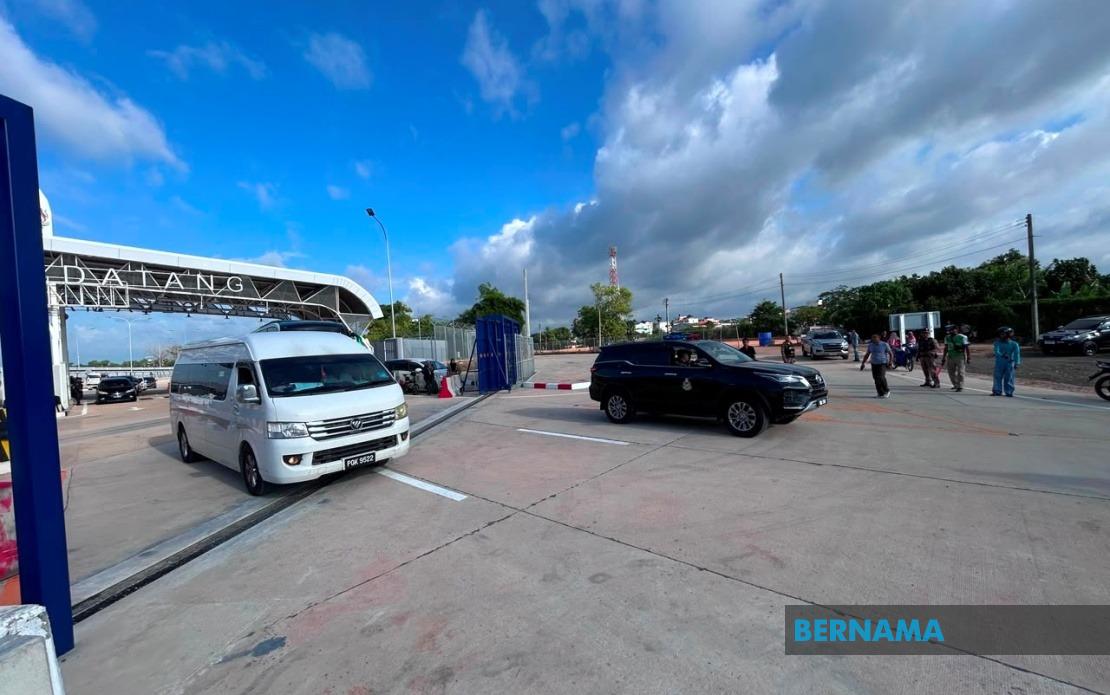
Malaysia's gateway to Thailand gained a significant infrastructure upgrade today with the official opening of a new road linking the Bukit Kayu Hitam Immigration, Customs, Quarantine and Security Complex in Kedah directly to the Sadao Customs, Immigration and Quarantine Complex across the border. The route, which commenced operations at 6 am, represents a landmark development in facilitating seamless cross-border connectivity and addressing long-standing traffic management challenges at one of Southeast Asia's busiest land borders.
The initiative was jointly inaugurated yesterday by Malaysian Prime Minister Datuk Seri Anwar Ibrahim and Thai counterpart Anutin Charnvirakul, underscoring the bilateral commitment to enhancing regional integration and economic cooperation. The project addresses decades of congestion problems that have plagued weekend and holiday travel, particularly affecting Malaysian tourists heading to Thailand and cross-border traders whose operations have been hampered by bottlenecks at the conventional entry points.
Early observations from the first day of operations suggest the infrastructure is delivering on its promise. Traffic flow along the newly constructed corridor remained stable throughout the day, with multiple motorists and commercial drivers reporting marked improvements compared to traditional routes. The expanded capacity and redesigned layout appear to be functioning as intended, offering a more orderly transition between Malaysian and Thai customs facilities.
Mohd Faizal Ahmad, a 42-year-old motorist from Penang interviewed at the site, highlighted the organizational improvements that differentiate this facility from its predecessors. He noted that the new arrangement eliminates the chaotic merging of vehicles that previously characterised the Bukit Kayu Hitam-Danok corridor. For leisure travellers like Ahmad, whose family frequently visits Thailand during school holidays, the streamlined process promises tangible time savings and reduced stress during peak travel periods, which typically see vehicles queued for hours at conventional checkpoints.
Heavy vehicle operators appear particularly satisfied with the reconfigured system. Wan Muhammad Shahid Wan Mohd Desa, a 28-year-old lorry driver, emphasised how the new road physically separates commercial trucks from passenger vehicles, allowing each category to navigate customs procedures without the conflicts that previously erupted when articulated vehicles jostled for space alongside motorcycles and cars. This segregation addresses a persistent friction point in cross-border logistics, where the mixing of different vehicle classes created unpredictable delays and safety hazards. Trucking companies, which form the backbone of Malaysia-Thailand trade flows, stand to benefit substantially from more predictable border crossing times.
The expanded Thai customs facility itself represents a architectural and administrative upgrade. Mat Li Daman, a 59-year-old Thai national who regularly crosses into Malaysia, observed that the Sadao CIQ's increased physical dimensions and improved documentation infrastructure provide a more dignified and efficient experience for travellers from both nations. The larger building accommodates more processing windows simultaneously, while the dedicated vehicle entry declaration areas reduce the informal queueing and confusion that characterised the old checkpoint building.
Beyond immediate convenience, the new corridor carries strategic significance for Malaysia-Thailand economic relations. Cross-border trade between the two countries exceeds billions of ringgit annually, encompassing agricultural products, manufactured goods, and raw materials. Customs officials have long identified border congestion as a hidden tax on commerce, extending logistics chains and increasing costs for traders who could otherwise move goods more swiftly. The new road promises to marginally but meaningfully reduce these hidden costs, potentially making Malaysian and Thai businesses more competitive regionally.
Tourism flows should also strengthen. Thailand remains one of Malaysia's top tourist destinations, with hundreds of thousands of Malaysians crossing the border annually for shopping, dining, and sightseeing. Conversely, Thai tourists visiting Malaysia constitute a valuable source of foreign exchange and hotel occupancy. Previous bottlenecks during peak seasons discouraged spontaneous tourism and deterred families from making frequent, short-duration visits. Smoother border crossings typically stimulate such discretionary travel, benefiting hospitality sectors on both sides of the frontier.
The infrastructure investment reflects broader regional thinking about connectivity as an economic multiplier. Both governments recognise that Southeast Asian integration depends not merely on trade agreements but on physical infrastructure that makes commerce and movement actually convenient. The Malaysia-Thailand border, long a critical artery for mainland Southeast Asian flows, had deteriorated into a bottleneck despite its strategic importance. This project begins addressing that asymmetry between the border's role in regional commerce and its capacity to handle traffic flows.
However, the new road's success ultimately depends on complementary improvements within both countries' checkpoint operations. Infrastructure alone cannot eliminate delays if customs procedures remain cumbersome or if staffing levels prove inadequate. Malaysian and Thai authorities will need to invest in training, digitisation of processes, and adequate personnel deployment to ensure that the new physical corridor translates into genuine time savings rather than merely relocating congestion points.
The immediate outlook appears positive, with early reports of smooth operations encouraging. Malaysian commuters and businesses dependent on Thailand connectivity, along with Thai nationals and firms trading with Malaysia, appear to have embraced the opening. Yet the real test arrives during the next major holiday period or school break, when traffic volumes surge and operational challenges typically emerge. If the facility maintains performance during peak seasons, it could indeed become a model for other points along Southeast Asia's land borders.

