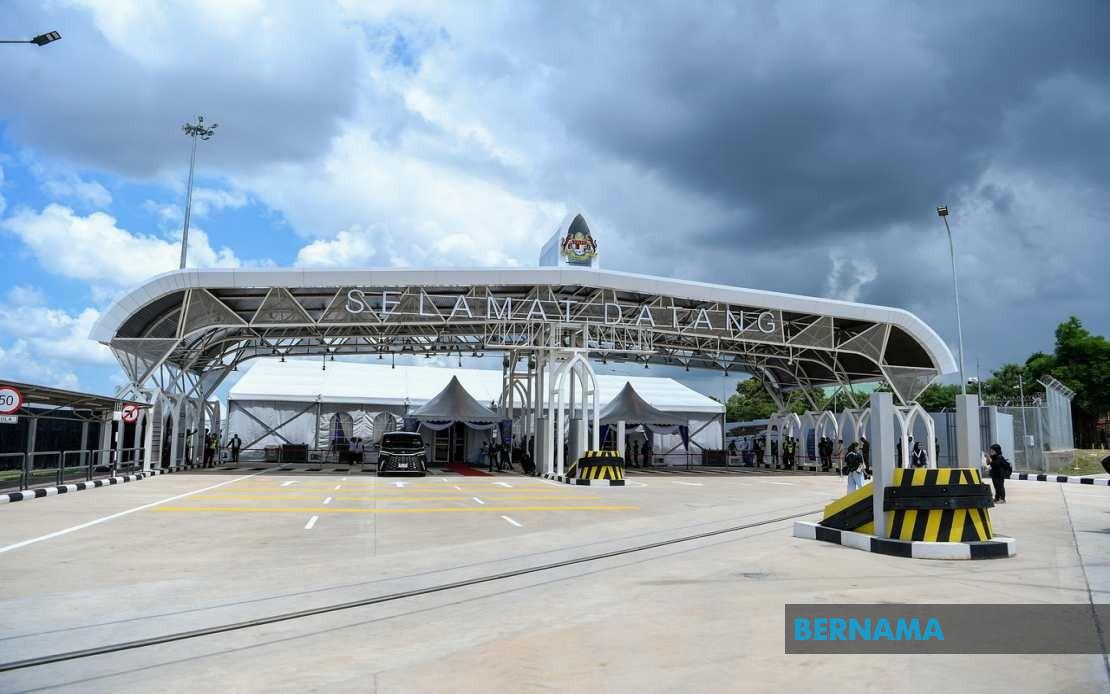
The Bukit Kayu Hitam-Sadao border crossing, which commenced operations in mid-July, is already delivering measurable gains for regional logistics and commerce after just four weeks of functioning. The 900-metre connection links Malaysia's Bukit Kayu Hitam Immigration, Customs, Quarantine and Security complex in Kedah directly with Thailand's Sadao Customs, Immigration and Quarantine facility, establishing what officials describe as a seamless corridor for cross-border movement. The inauguration by Thai Prime Minister Anutin Charnvirakul and Malaysian Prime Minister Datuk Seri Anwar Ibrahim on July 10, followed by the official opening on July 11, represents a significant infrastructure achievement for both nations seeking to deepen economic integration and reduce bottlenecks along this heavily-trafficked route.
The impact on logistics movement has been striking. According to Sadao Customs director Buntoon Oucharoen, nearly every commercial vehicle—lorries, buses and vans—has migrated to the new route within weeks of opening, effectively emptying the parallel older crossing of congestion. The facility now processes in excess of 1,000 logistics vehicles daily, a volume that underscores the region's dependence on efficient Malaysia-Thailand trade channels. This wholesale shift in traffic patterns suggests that businesses and operators recognised immediately that the new infrastructure offered tangible operational advantages over established alternatives.
Central to this efficiency gain is the deployment of advanced inspection technology. The Fast Scan X-ray system has compressed container scanning from a five-minute procedure to under one minute, a tenfold acceleration that eliminates a previously severe bottleneck. More substantially, the integration of cargo information directly into the computer systems means vehicles no longer require extended queuing periods for manual documentation verification. This digital integration—moving from paper-based to system-based clearance—represents not merely a speed improvement but a structural modernisation of cross-border procedures that reduces human processing steps and associated delays.
The commercial impact has materialised swiftly and substantially. Trade data for the first three weeks of July reveals striking growth compared with the identical period in 2024. Import values reached 19 billion baht (RM2.35 billion), nearly 60 percent higher than the 12 billion baht (RM1.48 billion) recorded in July 2024. Export values proved even more dramatic, surging to over 24 billion baht (RM2.97 billion) against 13 billion baht (RM1.61 billion) the previous year. These figures, though only preliminary and covering a brief window, suggest that operational improvements translate rapidly into increased bilateral commerce as businesses exploit the newly accessible capacity and speed.
For Malaysia specifically, this development carries substantial economic implications. As a major regional exporter of manufactured goods, agricultural products, and components destined for Thailand and further ASEAN markets, any reduction in border processing friction directly enhances competitiveness and margins. Thai importers similarly benefit from faster access to Malaysian supplies and finished goods. The pharmaceutical, petrochemical, automotive component, and food sectors—traditional pillars of Malaysia-Thailand bilateral trade—stand to gain measurable cost savings and improved supply chain predictability through the accelerated crossing.
The broader Malaysia-Thailand bilateral trade relationship provides important context. For the January-to-March 2026 period, two-way commerce totalled RM31.33 billion (US$7.90 billion), marking growth from RM27.35 billion (US$6.15 billion) during the same quarter in 2025. This upward trajectory, combined with both governments' declared commitment to reaching a bilateral trade target of US$30 billion (RM122.6 billion) by 2027, indicates that infrastructure improvements such as the Bukit Kayu Hitam-Sadao crossing serve as essential enablers of these growth objectives. Without reduced friction at borders, achieving such targets becomes increasingly difficult regardless of underlying market demand.
Tourist traffic has also responded positively to the expanded crossing infrastructure. The new facility features eleven inbound and eleven outbound lanes dedicated to passenger movement, a substantial increase that has visibly benefited cross-border tourism particularly during weekends and holiday periods. The Hatyai-Songkhla Hotel Association, representing accommodation and hospitality businesses heavily dependent on Malaysian visitors, has acknowledged this development as significant for weekend and holiday tourism flows. For Malaysians, improved access to Thailand's southern tourist destinations reduces travel friction, while Thai businesses dependent on Malaysian tourist expenditure gain from expanded capacity.
The timing of this infrastructure investment reflects the two countries' recognition that the Malaysia-Thailand relationship is entering a more ambitious phase. Both governments will mark the 70th anniversary of diplomatic relations in 2027, a milestone that coincides with the bilateral trade target of US$30 billion. The Bukit Kayu Hitam-Sadao crossing thus functions not only as a practical logistics solution but as a symbolic commitment to deepening economic integration. The collaborative approach to border modernisation—involving joint planning, shared technology implementation, and coordinated operational standards—demonstrates that Malaysia and Thailand view infrastructure partnership as central to regional competitiveness.
From a Southeast Asian perspective, this crossing represents a model worthy of attention from other ASEAN members grappling with border efficiency. The integration of advanced scanning technology, digital information systems, and dedicated passenger and cargo lanes creates a template applicable to other congested ASEAN boundaries. As intra-ASEAN trade continues to grow and logistics networks become increasingly complex, border crossings function as critical choke points. The success of Bukit Kayu Hitam-Sadao, measured through rapid traffic migration, substantial trade growth, and expanded capacity utilisation, offers practical evidence that modernised borders facilitate commerce rather than merely regulate it.
Looking forward, the challenge for both Malaysia and Thailand will be ensuring that this infrastructure investment delivers sustained benefits rather than temporary gains. Continuous training of customs and inspection personnel in the new systems, regular maintenance of the advanced scanning equipment, and ongoing coordination between Malaysian and Thai authorities will determine whether initial momentum persists. The significant investment already demonstrates government commitment; sustaining operational excellence will determine whether the crossing achieves its full potential as a transformative logistics hub for the region.

