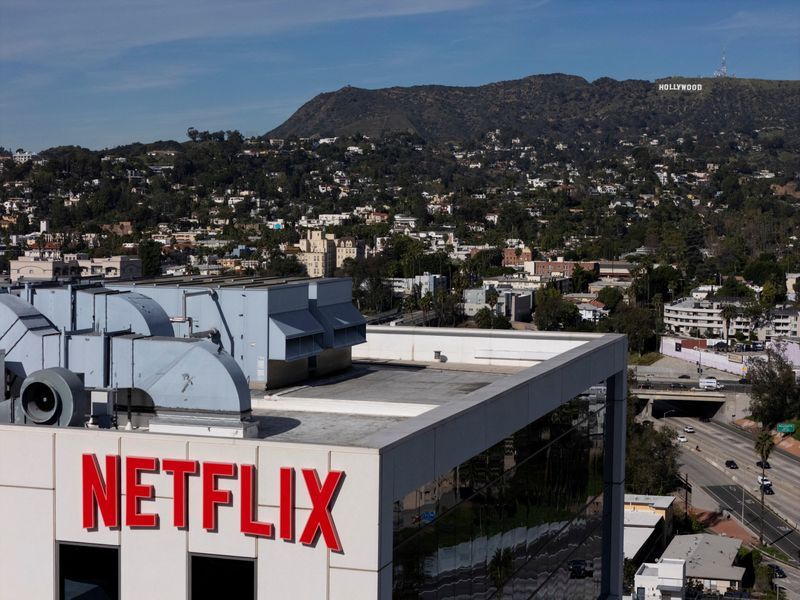
Netflix heads into its second-quarter earnings announcement on Thursday facing a pivotal moment, with investors demanding clarity on how the streaming platform plans to reignite growth after losing more than one-fifth of its market value this year. The company's struggles underscore a fundamental challenge facing mature tech giants: sustaining momentum when the easy wins have already been claimed and competition has intensified from established media conglomerates, YouTube, and the rise of mobile-first content consumption.
Analysts surveyed by LSEG project Netflix will report revenue growth of 13.6 percent, reaching $12.59 billion—a figure that represents the company's slowest quarterly expansion over the preceding sixteen months. Adjusted earnings per share are expected to land at 79 cents. While such numbers would constitute impressive performance for most entertainment businesses, they fall short of the growth trajectory Netflix maintained during its rapid ascent, and the deceleration has spooked investors accustomed to the company's historical momentum.
The core issue troubling Wall Street centres on Netflix's ability to generate new revenue streams beyond subscription fees. The advertising tier, which management heralded as a transformative growth engine when it launched in 2022, is projected to generate $705.8 million in quarterly revenue—far below initial enthusiasm. Ross Benes, an analyst at Emarketer, has been forced to slash his advertising forecast, reflecting a broader market realisation that Madison Avenue's appetite for Netflix ad inventory is not materialising at previously anticipated levels. The advertising business simply has not accelerated as most industry observers initially believed it would, raising questions about whether this channel can ever become the meaningful revenue diversifier the company requires.
This advertising shortfall becomes particularly significant because Netflix's previous growth levers are rapidly losing potency. The password-sharing crackdown and successive price increases that drove subscriber gains over the past two years have largely exhausted themselves as growth catalysts. With most paying customers already signed up and fewer people willing to accept higher prices, management must identify alternative mechanisms to expand the top line. The company's exploration of live sports, including a reported bid for American rights to the 2030 and 2034 FIFA World Cup tournaments, represents an attempt to diversify its appeal and create premium advertising inventory that might attract global brands.
The Letterboxd acquisition discussions similarly reveal Netflix's desire to deepen engagement beyond passive viewing. Letterboxd, a social platform where film enthusiasts curate and discuss movies, could theoretically transform Netflix from a distribution channel into a community hub, strengthening viewer retention and generating data that informs content recommendations and advertising targeting. Such a manoeuvre would position Netflix as a lifestyle brand rather than merely a content delivery service, though the company's mixed track record with acquisitions suggests scaling such properties presents operational challenges.
Yet beneath these strategic gambits lies a more troubling undercurrent: audience retention is deteriorating. Bloomberg News reported this month that viewers are increasingly abandoning Netflix shows after their first season, with acclaimed series such as "The Night Agent" and "Beef" hemorrhaging roughly half or more of their initial audience when subsequent seasons air. This pattern exposes a critical vulnerability—Netflix's originals are generating cultural moments and critical acclaim, but they are not converting into the sustained engagement necessary to justify spending on expensive production slates. If viewers sample a show, enjoy it, then migrate away, Netflix gains neither the long-term subscription value nor the advertising impressions that justify seven-figure episode budgets.
The competitive environment has intensified substantially since Netflix pioneered the streaming model. Traditional media companies including NBCUniversal, now spun off from Comcast, have launched competing streaming services with decades of archive content and established franchises. These rivals offer fundamentally different value propositions than Netflix—a movie studio's streaming service provides access to a known universe of content, whereas Netflix must constantly innovate to justify its existence. This structural advantage held by legacy media companies means Netflix cannot rest on its existing catalogue; it must perpetually outspend competitors on original programming to justify premium positioning.
Paolo Pescatore, an analyst at PP Foresight, has articulated the strategic paradox Netflix now confronts: the company has evolved from disruptive upstart into dominant incumbent, yet the playbook that worked during disruption does not necessarily apply to consolidating and expanding dominance from a vastly larger revenue base. Netflix cannot grow at 30 percent annually when it is already a $30 billion enterprise; the mathematics become impossible. Simultaneously, investors have been conditioned to expect growth and are punishing the company for normalisation.
Some analysts expect Netflix to pursue smaller, opportunistic acquisitions rather than another transformational merger. This measured approach could prove prudent, allowing management to integrate existing investments before attempting another large-scale integration. Yet this strategy risks perceived timidity in the eyes of investors seeking bold moves that definitively reshape Netflix's trajectory. The earnings call will provide management an opportunity to articulate whether recent setbacks represent temporary obstacles or early signals of a structural slowdown that requires fundamental rethinking of the business model.
For Southeast Asian audiences, Netflix's challenges carry real implications. The company has invested substantially in regional content, recognising that Asian markets represent significant growth opportunities. However, if Netflix's broader growth story falters, content investment in smaller regional markets may face reductions as the company prioritises profitable productions. The outcome of Thursday's earnings announcement will therefore influence not merely Netflix's corporate strategy but also the pipeline of locally-produced series and films that have begun to establish meaningful presence in the region's entertainment landscape.

