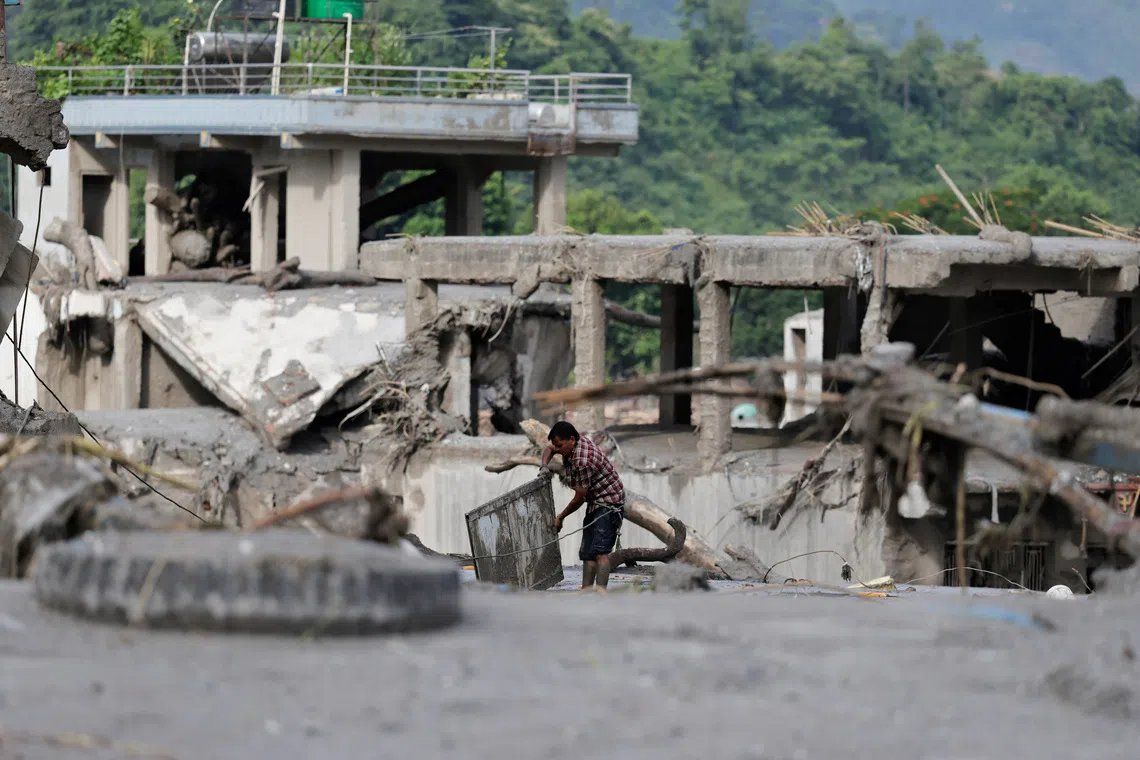
Authorities in Nepal and China issued urgent warnings on Thursday as two swollen lakes formed from Wednesday's catastrophic glacier collapse threaten to burst and unleash fresh flooding across the Himalayan border region. The disaster has already claimed at least 362 lives, with over 1,000 people still missing in debris-choked valleys as search and rescue teams continue their grim work across Nepal and China's Tibet. The twin threat now comes not from the original cataclysm but from the unstable water barriers left in its wake—a secondary hazard that could potentially overwhelm communities still reeling from the initial impact.
The original disaster unfolded when a massive glacier collapse in the high mountains dislodged enormous quantities of rock, ice, and mud that funnelled into river systems, creating a wall of debris that swept down populated valleys. Both governments have pinpointed this glacier failure as the culprit, highlighting the growing vulnerability of Himalayan ice masses to climate pressures. The destruction was felt across both sides of the Nepal-China border, with entire communities buried under mudslides and villages swept away by torrential debris flows. Rescue operations have been hampered by the challenging terrain and the sheer scale of devastation, forcing teams to navigate treacherous hillsides and navigate through destroyed infrastructure.
In Nepal, disaster authorities have identified a critical secondary risk: a natural dam of debris has accumulated at the flood site, creating a lake that continues to swell as water backs up behind the blockage. Officials warned that this accumulation could reach a critical threshold, potentially bursting with little warning and sending another destructive wave downstream. The notice issued to residents stressed the urgency of the situation, instructing those living in lower-lying areas along affected rivers to move immediately to higher ground. The directive was explicit and broad, encompassing not only civilians but also rescue workers still conducting search operations in the valleys below.
China's assessment of the threat appears particularly grave. The Chinese water resources ministry estimates that approximately 3 million cubic meters of water—equivalent to roughly 1,200 Olympic-sized swimming pools—will drain into an already strained dam system on the Chinese side of the border over the next seventy-two hours. This massive volume of inflow is expected to create dangerous conditions at the dam, with authorities predicting peak water flow around September 1st. The concentration of water over such a short timeframe represents an extreme stress test for existing infrastructure, with breach scenarios potentially catastrophic for downstream communities in Tibet.
Weather forecasts have compounded official anxiety about the situation. Meteorological predictions indicate that rainfall will persist across the region over the coming week, continuously feeding the swollen lakes and dams with additional water precisely when they are most vulnerable. State broadcaster CCTV cited warnings from the Chinese water resources ministry that deteriorating weather conditions could accelerate the accumulation process and narrow the window for emergency response measures. Zhu Jinfeng, a hydrology researcher at the ministry's department, conveyed the escalating severity during an interview, noting that both water volume and associated risks are climbing simultaneously—a compounding effect that leaves little margin for error.
The situation underscores the cascading nature of natural disasters in mountainous regions, where a single catastrophic event can trigger multiple secondary hazards that unfold over days or weeks. For Malaysian and Southeast Asian observers, the Nepal-China situation serves as a sobering reminder of climate-related vulnerabilities in the region. Himalayan glaciers are retreating at accelerating rates, destabilising slopes and creating conditions where major collapses become more frequent. The glacier failure that triggered this week's disaster represents the kind of tail-risk event that climate scientists have long warned could become more commonplace as global temperatures rise.
Rescue operations have had to adapt in real time to these emerging threats. Teams previously focused on searching for survivors have been forced to reassess their positioning and priorities. Pawan Koirala, leading a rescue team of thirteen personnel, made the difficult decision to relocate his unit away from the river beds and debris zones after the warning was issued. The choice reflected a pragmatic acknowledgement that continuing search operations in areas now threatened by secondary flooding would risk adding rescuers to the casualty toll. This calculus—balancing the moral imperative to search for missing persons against the duty to keep emergency responders alive—represents one of the most difficult decisions facing disaster management authorities.
The coordination between Nepal and Chinese authorities appears to be functioning at a technical level, with both governments sharing hydrological data and forecasts. This cross-border cooperation is essential given that problems originating on one side can directly impact populations on the other. The Himalayan rivers that form the basis of the flood threat do not respect political boundaries, and water flowing from the slopes above Nepal will eventually enter Tibetan territory. Effective early warning systems require real-time data sharing, and the issuance of coordinated warnings suggests that communication channels between the two nations' disaster management agencies are operating effectively despite broader geopolitical tensions.
For the broader region, this disaster illustrates why investment in mountain hydrology infrastructure and early warning systems remains critically important. Southeast Asian nations with Himalayan tributaries or downstream connections to major river systems depend on accurate information about conditions in the high mountains. Thailand, Laos, Cambodia, and Vietnam all rely on water flows from Himalayan sources, and disasters in Nepal and Tibet can eventually cascade into regional impacts. Building resilient warning systems and sharing meteorological and hydrological data across national borders has become an urgent regional priority rather than merely a humanitarian concern.
The immediate priority remains preventing the secondary flooding from causing additional casualties and damage. Authorities are mobilising resources to reinforce vulnerable dams and debris barriers, while evacuations continue in areas directly threatened by potential breaches. The next seventy-two hours will be critical in determining whether emergency response measures can contain the swollen lakes or whether fresh catastrophe will unfold. Throughout the region, rescue workers, engineers, and residents are bracing for a scenario where last week's disaster could pale in comparison to what might follow if the secondary threats materialise as feared.

