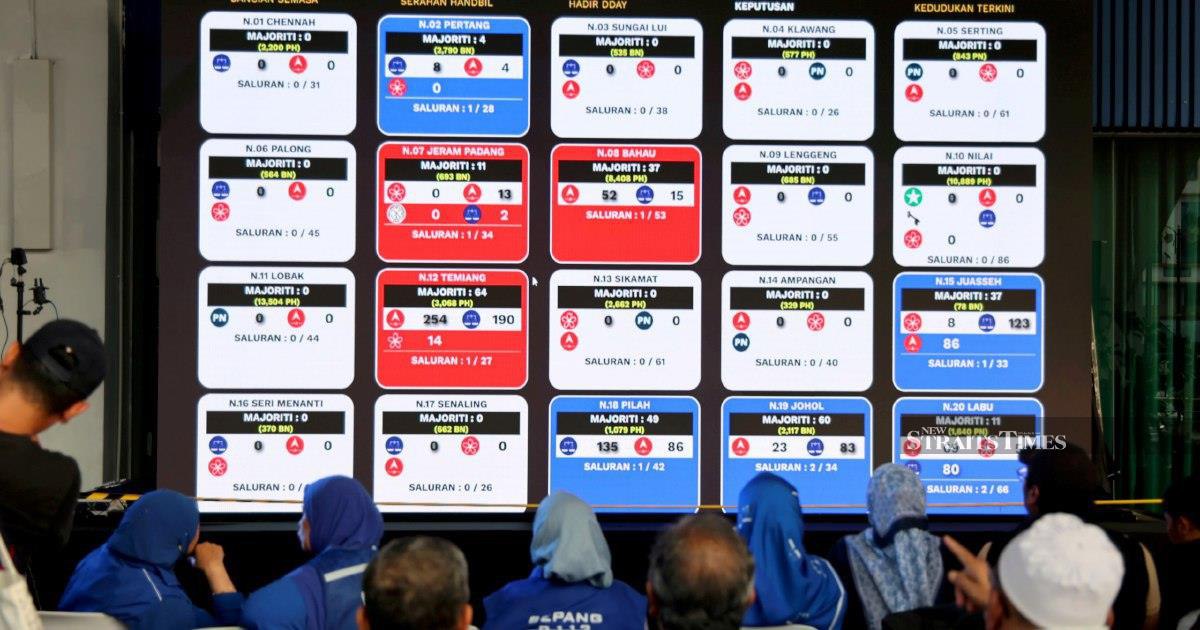
The Negri Sembilan state election served as a revealing mirror held up to Pakatan Harapan's coalition structure, exposing fundamental difficulties in maintaining momentum among Malay voters—a constituency that remains pivotal to Malaysia's electoral mathematics. The results underscore a problem that has quietly festered within the opposition alliance: despite efforts to cultivate broader appeal, significant portions of the Malay electorate remain unconvinced by the coalition's messaging or credentials, particularly in states with large Malay Muslim populations seeking religiously-anchored governance.
The timing of this electoral test proved significant for understanding national political currents. Negri Sembilan, nestled between the Klang Valley's urbanised dynamics and the rural strongholds of Pahang, typically reflects broader sentiment shifts across Malaysia's heartland. The state's mixed demographic composition—neither overwhelmingly urban nor entirely rural—makes it a bellwether for how competing coalitions connect with ordinary Malaysians navigating economic pressures and cultural priorities. The failure to consolidate gains here suggests vulnerabilities that extend well beyond a single state contest.
For Pakatan Harapan, the challenge runs deeper than mere electoral tactics. The coalition comprises parties with fundamentally different organisational bases and ideological commitments. While DAP anchors urban Chinese-majority support and PKR maintains an increasingly fractious multiethnic profile, Amanah positions itself as Islam-friendly but remains structurally weak compared to UMNO's entrenched network. This asymmetry means coalition messaging often struggles to penetrate Malay-Muslim communities effectively, where UMNO and PAS maintain decades of institutional relationships and social embeddedness.
The religious dimension cannot be overlooked in any serious analysis of Negri Sembilan's electoral outcome. Many Malay voters view religious credentials and commitment to Islamic governance as non-negotiable when evaluating political alternatives. Pakatan Harapan's reputation for secular-leaning governance and its fractious relationship with conservative Islamic values creates a persistent perception gap. Even where the coalition articulates religious commitments through Amanah, the broader coalition's composition generates hesitation among voters prioritising religious governance markers.
Economic anxiety also shaped voter behaviour in ways that disadvantaged the opposition coalition. Malay rural communities and small-town dwellers—significant demographic blocs in Negri Sembilan—grapple with volatile agricultural commodity prices, income stagnation, and precarious employment in light manufacturing sectors. Such constituencies often respond to messaging emphasising racial-based economic redistribution and communal preference mechanisms. Pakatan Harapan's economic platform, emphasising meritocratic competition and reduced corruption costs, resonates primarily with urban middle-class voters already convinced of the existing system's fundamental unfairness.
The coalition's internal dynamics compound these external challenges. Ongoing disagreements between DAP and Amanah over governance approaches, combined with PKR's leadership succession uncertainties, generate public perceptions of disunity precisely when unity messaging would strengthen coalition appeal. Malay voters observing coalition infighting rationally interpret such divisions as evidence of weakness and unreliability—characteristics particularly damaging when voters are genuinely uncertain about switching allegiances.
Geographic variation within Negri Sembilan's results likely demonstrates that Pakatan Harapan performs relatively better in urban centres like Seremban proper while losing significantly in outlying constituencies. This geographic polarisation mirrors national patterns, reflecting how different voter communities inhabit fundamentally different information ecosystems and priority frameworks. Urban-rural divergence has become so pronounced that single-coalition strategies struggle to simultaneously address urban electorates demanding good governance and transparency alongside rural communities prioritising subsidy security and cultural representation.
For Southeast Asian observers, the Negri Sembilan results illuminate broader regional patterns regarding opposition coalition durability in majority-Muslim democracies. Coalitions spanning secular-progressive and religious-conservative constituencies face inherent tensions difficult to permanently resolve. Thailand, Indonesia, and the Philippines all demonstrate similar patterns whereby opposing religious and secular movements struggle to maintain unified political presence. Malaysia's Pakatan Harapan experiences these pressures intensely given the electorate's demographic composition and Malaysia's specific history of race-based political organisation.
The state-level nature of this contest also matters for understanding its implications. Federal governance arrangements and national security portfolios matter less to voters evaluating state-level governance capacity. Negri Sembilan voters assessed which coalition could deliver reliable local administration, responsive service delivery, and competent governance of state resources. On these operational metrics, the incumbent coalition apparently communicated greater confidence, perhaps by virtue of controlling resources and existing administrative machinery.
Looking forward, Negri Sembilan's electoral signal creates both challenges and opportunities for Pakatan Harapan strategically. The immediate challenge involves preventing further erosion among fence-sitting Malay voters before national elections eventually arrive. This requires not simply better campaign communication but genuine coalition restructuring addressing perceived religious and cultural deficits. Alternatively, the coalition might pursue differentiated strategies accepting reduced rural Malay support while maximising urban and non-Malay constituencies—a mathematically feasible but politically risky approach.
The opposition coalition must confront whether attempting to outcompete ruling coalitions using identical messaging and appeals generates sufficient differentiation to overcome incumbency advantages. Negri Sembilan suggests this approach produces disappointing returns. More fundamental strategic recalibration regarding coalition composition, party positioning, and campaign framing likely proves necessary if Pakatan Harapan intends reversing current trajectories among Malay Muslim voters who remain electorally decisive across most Malaysian states.

