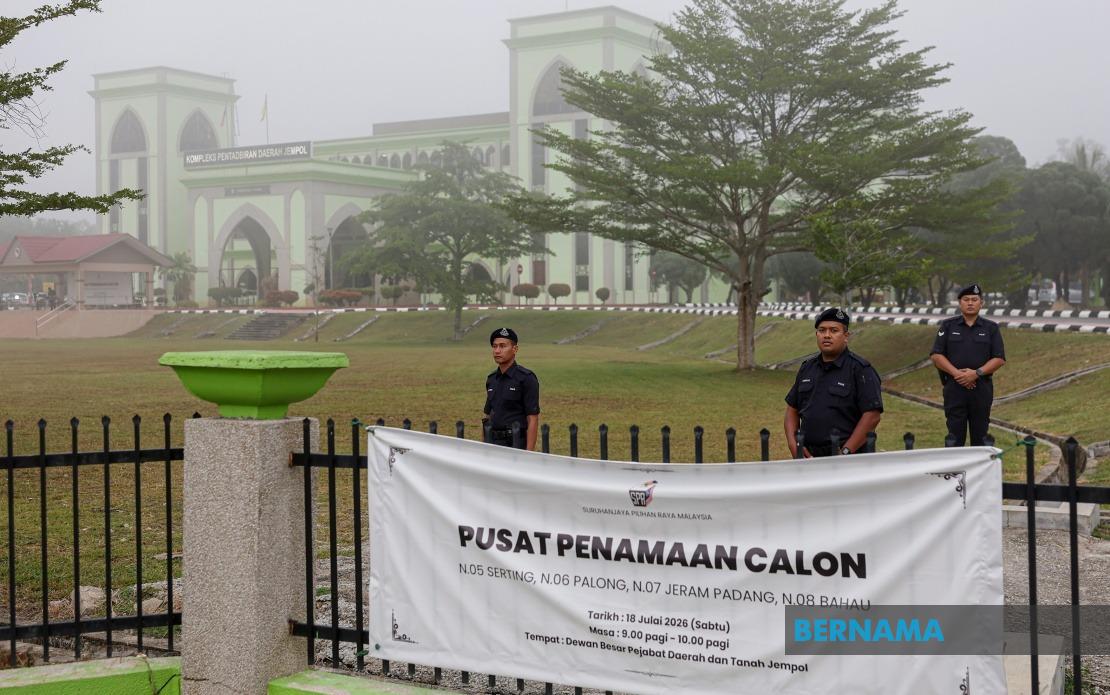
The 16th Negeri Sembilan state election moved into its formal candidate registration phase today as all eight nomination centres opened their doors simultaneously at 9 am, marking the official commencement of the electoral process. The nomination window, compressed into a single hour until 10 am, represents a critical moment when political parties formally declare their contenders and the state's returning officers begin verification of candidate eligibility across all districts.
Neighbouring states and federal observers are watching Negeri Sembilan closely, as this election will serve as a significant barometer of political sentiment in the central region ahead of potential federal-level contests. The timing of the election, following the dissolution of the State Legislative Assembly on June 5 after obtaining consent from Tuanku Muhriz Tuanku Munawir, ensures that the state will have renewed representation before the year's end, preventing any prolonged period of potential governance ambiguity.
The state police force has mobilized substantially to support the nomination process, with Datuk Alzafny Ahmad, the Negeri Sembilan police chief, confirming that 2,393 personnel have been stationed across the eight nomination centres to maintain public order and security throughout the registration period. This deployment reflects standard election protocols designed to prevent disruptions and ensure that candidates can register without incident, though the visible police presence underscores the seriousness with which authorities treat the electoral exercise.
Following today's nominations, the Election Commission has scheduled a 14-day campaign period that will begin immediately upon the official announcement of eligible candidates and extend until 11.59 pm on July 31. This relatively compressed timeline means that political parties will have less than two weeks to conduct ground-level activities, rally events, and public engagement—a constraint that particularly affects incumbent parties seeking to consolidate support and challengers attempting to build momentum.
Weather conditions proved favourable across all seven districts today, eliminating potential logistical complications that adverse weather might have caused. The absence of rain or extreme heat allowed both election officials and party representatives to conduct their business without operational hindrances, though the broader campaign period will inevitably contend with the region's monsoon season and typical July weather patterns.
The electoral roll updated as of June 4, 2026, indicates that approximately 889,490 registered voters are eligible to participate in this election, comprising 867,151 ordinary voters alongside 16,884 military personnel and their spouses and 5,455 police personnel designated as early voters. This voter base represents the expanded democratic franchise that Negeri Sembilan has developed over successive electoral cycles, with particular provisions recognizing the voting rights of uniformed personnel stationed within the state.
In the previous 2023 state election, Pakatan Harapan captured 17 of the 36 available seats, establishing itself as the dominant political force, while Barisan Nasional secured 14 seats and Perikatan Nasional won five seats. This distribution of seats provides the incumbent PH administration with a working majority, though not one so commanding that internal discipline becomes irrelevant—a dynamic that may influence how both government and opposition parties approach this election cycle.
The Election Commission has structured the electoral timeline around early voting on July 28, followed by the main polling day on August 1. This staggered approach allows eligible personnel from security forces to cast votes in advance, reducing potential conflicts between voting and their operational duties, while also providing a preliminary indication of voter sentiment before the official results tally on polling day.
For Malaysian political analysts, the Negeri Sembilan election carries significance beyond state-level implications. The state's diverse composition of urban centres, rural constituencies, and semi-developed areas means that voting patterns here often reflect broader national political trends. Results from this contest could provide insight into how recent federal government policies have resonated with Malaysian voters and whether any meaningful shifts in electoral alignments are occurring across the peninsula's central regions before larger electoral contests potentially emerge in subsequent years.

