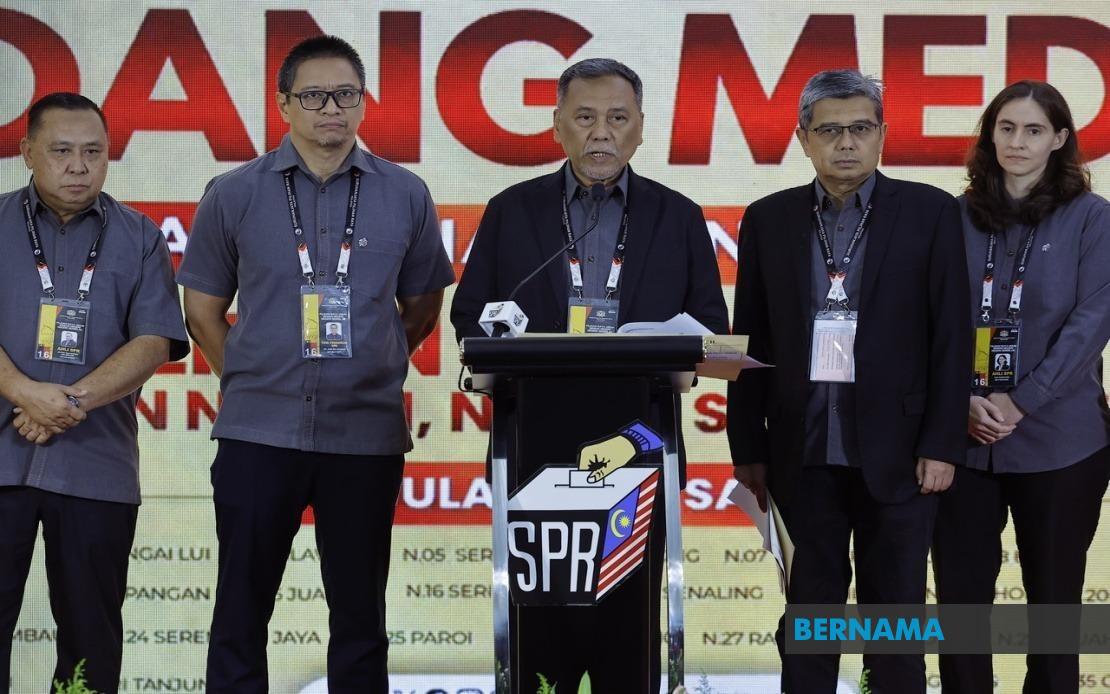
The Election Commission (EC) has formally validated 103 candidates for the upcoming Negeri Sembilan state election, setting the stage for a competitive political battle across the state's 36 assembly seats. EC chairman Datuk Seri Ramlan Harun announced the results on July 18 after the nomination process closed, revealing a field that promises significantly fragmented contests across many constituencies.
The candidate distribution reflects the changing landscape of Malaysian electoral politics, with Pakatan Harapan establishing a substantial lead by fielding 36 nominees across all available seats. Barisan Nasional follows with 25 candidates, while the newer entrant Bersatu has put forward 24 contenders. Perikatan Nasional, the coalition that includes Bersatu along with PAS and several other parties, has fielded 11 separate candidates, indicating some degree of independent participation by PN-aligned politicians. This layering of candidacies from ostensibly allied parties underscores the complex and sometimes overlapping nature of Malaysian coalition politics at the state level.
Smaller political movements have also seized the opportunity to contest, adding further diversity to the electoral process. Berjasa, the Malaysian Orang Asli Party (ASLI), and the Socialist Party of Malaysia (PSM) have each nominated a single candidate, while four independent aspirants are running without party affiliation. This broader representation, though unlikely to shift the overall outcome significantly, reflects the democratic openness of the electoral process and provides voters with a wider ideological spectrum from which to choose.
The nomination landscape immediately highlights the fragmentation that characterises contemporary Malaysian state elections. Out of the 36 seats, 21 will witness three-cornered contests, representing nearly 60 percent of constituencies. This concentration of three-way battles substantially differs from the binary competition that historically dominated Malaysian politics, creating complex dynamics where the winning candidate may capture a seat with less than 40 percent of the vote. Additionally, four seats—Nilai, Sri Tanjung, Jeram Padang, and Rahang—will feature even more crowded fields, with four or five candidates competing for each position.
Demographically, the candidate pool skews heavily male, with 94 male contenders against only nine female nominees. This imbalance persists despite growing calls for greater gender representation in Malaysian politics. The age range spans from a 23-year-old Bersatu representative standing in Sri Tanjung to a 70-year-old PH candidate contesting in Gemencheh, reflecting generational diversity within the political establishment. These variations in candidate profiles may influence how different constituencies engage with local issues and contemporary concerns.
Negeri Sembilan's electorate comprises approximately 889,490 registered voters who will determine the composition of the 16th state assembly. This figure includes 867,151 ordinary voters, 16,884 military personnel and their spouses, and 5,455 police officers. The inclusion of uniformed personnel in the voting rolls reflects Malaysia's constitutional framework and affects the character of contests in certain constituencies. The electoral calendar established by the EC permits early voting on July 28, with the main polling day scheduled for August 1.
The state's dissolution on June 5 has set in motion a five-week campaign period that allows all contenders time to present their platforms to voters. For the incumbent PH administration, maintaining its stronghold in Negeri Sembilan represents a crucial test of its popularity since the 2022 federal election. BN's challenge involves reclaiming ground lost in recent years, while Bersatu and its PN allies seek to establish themselves as credible alternatives capable of forming government.
The prevalence of three-cornered contests carries significant implications for all participants. Parties that finish second or third, despite securing substantial vote shares, will return empty-handed from individual seats due to Malaysia's first-past-the-post electoral system. This reality intensifies the stakes for each organisation and creates scenarios where tactical voting becomes relevant. Voters concerned about vote-splitting may strategically support candidates they perceive as most viable to prevent their least-preferred option from winning.
For Malaysian observers of electoral politics, Negeri Sembilan's configuration offers insight into broader national trends. The spread of candidates across multiple parties and coalitions demonstrates that the two-coalition framework—PH versus BN—that characterised earlier decades has fragmented considerably. Bersatu's fielding of 24 candidates while simultaneously maintaining loose associations with PN's 11 candidates exemplifies this complexity. Regional variations in political dynamics mean that Negeri Sembilan's outcome may not precisely predict outcomes in other states, yet the patterns observable here likely reflect similar dynamics elsewhere.
The campaign period ahead will test each party's organisational capacity and message resonance. With nearly 900,000 voters and substantial three-way contests in most constituencies, traditional ground game approaches must compete with digital outreach and media engagement. The outcome will reshape the state's political direction and potentially influence calculations regarding subsequent national developments, given Negeri Sembilan's position as a swing state with historical significance in Malaysian politics.

