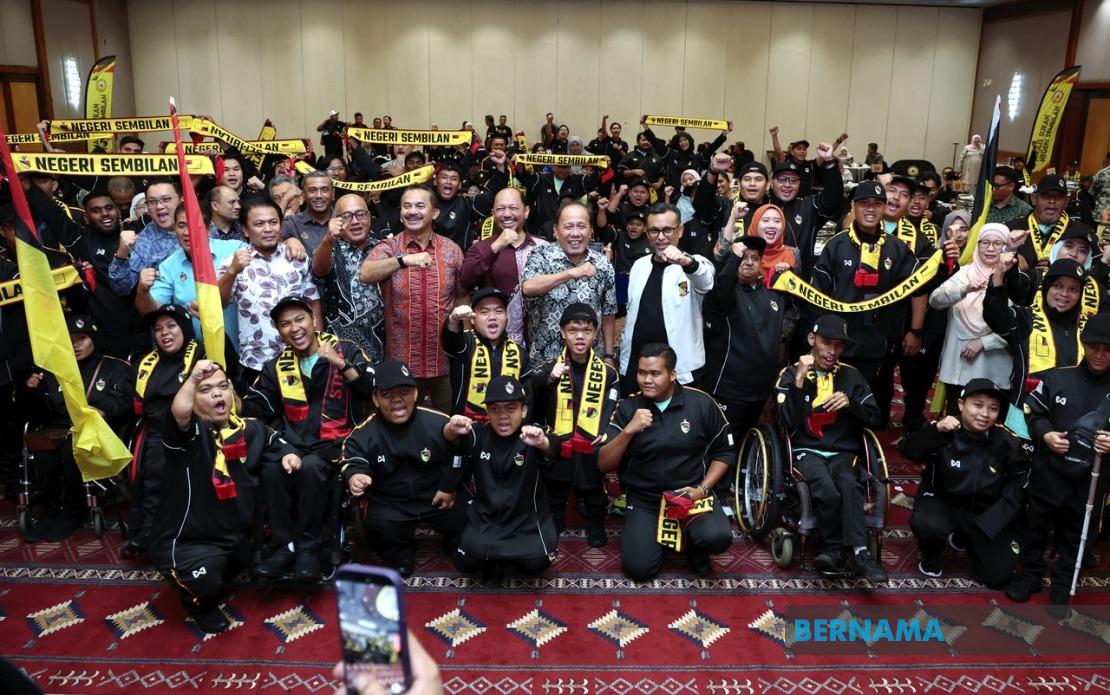
Negeri Sembilan's government has pledged strong backing for its contingent competing in the 2026 Para Malaysia Games, establishing a gold medal target of 12 as the state seeks to rebuild confidence following a weaker-than-expected showing at the regular SUKMA Games that concluded on Monday. The 80 para athletes selected for the Games, scheduled to commence on September 5 in Selangor, will carry the state's hopes for a resurgence in parasport excellence.
Menteri Besar Datuk Ismail Lasim framed the target not as an arbitrary benchmark but as a reflection of months of rigorous training, mental preparation, and strategic development undertaken by the Negeri Sembilan Sports Council and coaching staff. Speaking after overseeing the ceremonial flag handover to the Chef de Mission and Team Managers at an event in Seremban, Lasim emphasised that the medal goal represented achievable ambitions grounded in realistic assessment of the athletes' capabilities.
The timing of this announcement carries particular significance given Negeri Sembilan's recent underwhelming performance at SUKMA 2026, where the state's contingent secured merely seven gold medals from a total tally of 48 medals. This outcome marked a considerable decline compared to the state's performance two years prior, when it accumulated 19 gold medals alongside 56 total medals at the same biennial event. The contrast has prompted state leadership to recalibrate expectations and focus resources on parasport development.
Lasim expressed confidence that the gap between regular athletes and para athletes represents an opportunity for distinction. He characterised para athletes as individuals possessing exceptional mental fortitude and determination, qualities that transcend conventional athletic measurement and speak to a deeper reservoir of competitive spirit. This rhetorical framing serves to motivate the contingent whilst also suggesting that parasport deserves equivalent investment and recognition within Negeri Sembilan's broader sports agenda.
The state's support structure includes concrete incentive schemes designed to reward medal-winning performances at Para SUKMA 2026. Such financial backing demonstrates institutional commitment beyond symbolic gestures, signalling to athletes and coaching staff that parasport receives tangible government endorsement. For athletes from a state without Singapore's resources or Selangor's metropolitan advantages, such guarantees matter considerably in sustaining motivation.
Negeri Sembilan's historical performance at Para SUKMA provides a reasonable foundation for the current target. At the 2024 Games held in Sarawak, the state's para athletes captured 14 gold medals, 19 silver, and 20 bronze—results that suggest the 12-gold target represents a modest recalibration downward rather than radical overambition. Parasport classifications and athlete availability vary biennially, and the 2024 figure of 14 golds establishes that double-digit gold medal counts remain within reach for the state's sports infrastructure.
The Deputy Chief Minister's personal involvement in the flag handover ceremony underscores that Para SUKMA occupies genuine priority space in Negeri Sembilan's governance agenda. Accompanying officials including State Youth and Sports Development Action Committee chairman Datuk Mustapha Nagoor and Negeri Sembilan Sports Council director Marhizah Abdul Razak reinforces the multi-agency coordination necessary for effective parasport development. Such visible administrative cohesion, demonstrated through ceremonial presence and sequential responsibility, helps translate policy intentions into measurable on-field outcomes.
For Malaysian parasport broadly, Negeri Sembilan's commitment exemplifies how state governments contribute to the wider ecosystem of disabled athlete development. Whilst larger or wealthier states may dominate medal counts, mid-tier states like Negeri Sembilan demonstrate that meaningful parasport infrastructure can emerge through focused investment and leadership buy-in from elected officials. The state's willingness to benchmark performance, acknowledge shortfalls, and recommit resources suggests a maturing approach to parasport governance beyond tokenism.
The Para SUKMA Games themselves serve crucial functions within Malaysia's disability sports landscape. These biennial competitions provide competitive pathways for athletes with physical impairments, visual disabilities, and other conditions, offering platforms for identifying talent and building training cohorts for international competitions including Paralympic Games. Negeri Sembilan's 80-athlete contingent, though modest compared to larger state delegations, represents concentrated human capital that the state has invested in identifying and developing.
The September 5 commencement date provides approximately one week for final preparations, tapering, and logistical arrangements. Hosting the Games in Selangor, Malaysia's most developed state with superior sporting facilities, eliminates infrastructure disadvantages that might otherwise confront athletes from less-developed regions. For Negeri Sembilan's contingent, proximity to Selangor also reduces travel-related disruptions, permitting additional training sessions immediately before competition.
Lasim's emphasis on athlete discipline and preparation quality reflects contemporary understanding that medal performance emerges not from talent alone but from systematic training methodologies, nutritional support, sports science integration, and psychological conditioning. By publicly connecting the 12-gold target to these preparatory foundations rather than treating it as a standalone number, the Menteri Besar signals that state government understands modern sport's complexity and has resourced accordingly.
The contrast between Negeri Sembilan's weaker SUKMA performance and renewed Para SUKMA ambitions also suggests a strategic pivot. Para athletes often demonstrate exceptional resilience precisely because their training addresses not merely physical development but psychological barriers and social stigma. State leadership backing may therefore yield disproportionate returns in morale and team cohesion, potentially translating into better collective performances than conventional sport pathways generate.

