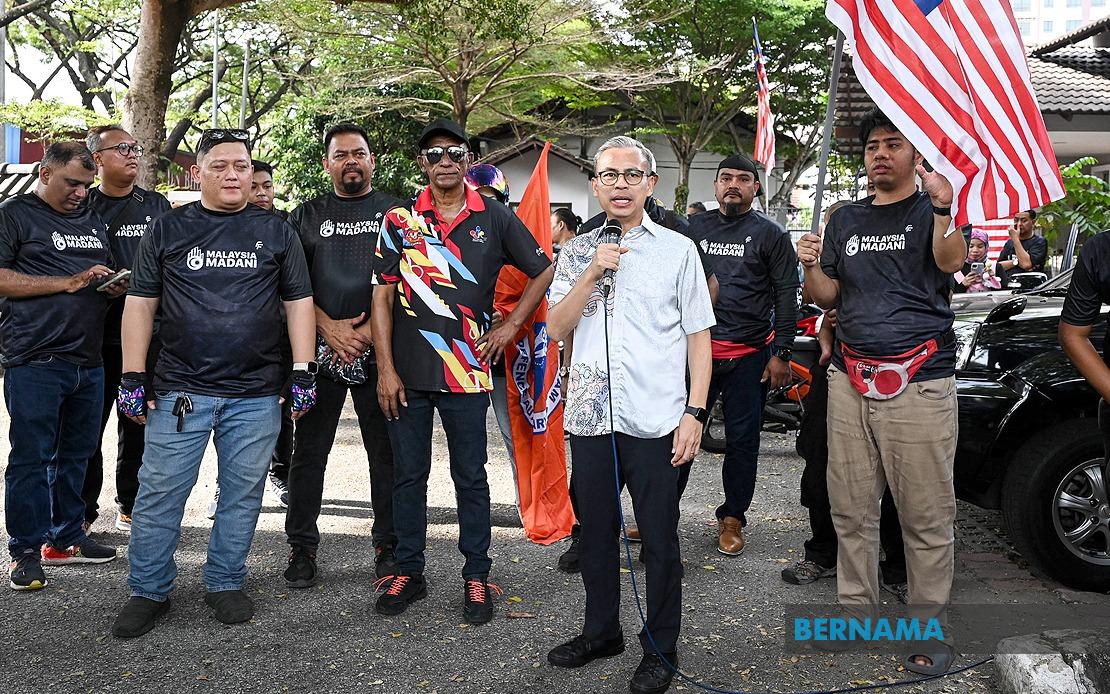
Nearly 300 motorcyclists converged in the Lembah Pantai constituency on Merdeka eve for a colourful convoy aimed at reinforcing communal harmony and national pride among the area's diverse population. The event underscored efforts by local leadership to channel grassroots participation in Independence Day festivities through a distinctly Malaysian activity: the motorcycle rally. Communications Minister Datuk Seri Fahmi Fadzil, who represents Lembah Pantai, oversaw the programme and used the occasion to articulate the government's vision of unity transcending religious and ethnic boundaries.
Fahmi's remarks during the ceremony stressed that the convoy served a deeper purpose than ceremonial display. He emphasised that residents of Lembah Pantai, drawn from multiple backgrounds and faiths, had assembled to demonstrate shared Malaysian identity. The minister portrayed the gathering as evidence of organic community cohesion, suggesting that such demonstrations of unity were not imposed from above but emerged from genuine neighbourhood bonds. His framing positioned the convoy as a microcosm of the nation's multicultural ideal, particularly relevant in an urban constituency like Lembah Pantai where diversity is demographically pronounced.
The route structure reflected careful planning to maximise community engagement across the constituency. Participants departed from Taman Seri Sentosa and proceeded through five designated stops, including Kampung Pasir, the IWK Eco Park, and Vista Angkasa in Kampung Kerinchi, eventually concluding at Bangsar LRT station. This itinerary ensured that the convoy traversed multiple residential and recreational zones, creating visibility and inviting participation from various segments of the local population. The choice of endpoints—beginning at a community park and concluding at public transportation infrastructure—suggested accessibility and inclusive design.
A symbolic dimension infused the convoy's activities at each halt. Participants distributed Jalur Gemilang flags to representatives of Resident Representative Councils and community organisations stationed at the pit stops. This handover ritual carried nationalist significance, positioning flag distribution not as mere merchandise but as a deliberate transfer of patriotic responsibility from the convoy participants to grassroots community structures. The gesture implicitly conveyed that national pride and Independence Day observance belonged to ordinary residents and local organisations, not exclusively to government apparatus or formal institutions.
Fahmi articulated an aspirational vision for sustained community engagement extending beyond the single-day event. He expressed optimism that the fellowship demonstrated during the convoy would catalyse ongoing collaborative initiatives. The minister specifically referenced future participation in community assistance programmes, additional Merdeka celebrations, and unspecified supplementary activities. This rhetoric suggested that organisers viewed the convoy as catalytic—a launching point for institutionalising cross-ethnic cooperation through structured channels rather than treating the event as a standalone commemorative exercise.
The timing of the convoy—Merdeka eve—positioned it within the national calendar's most consequential civic moment. By holding the event immediately before Independence Day itself, organisers amplified its resonance and allowed participants to transition directly from the convoy to formal national day observances. This sequencing transformed the motorcycle rally from isolated entertainment into an integrated component of broader Merdeka festivities, lending it weight and ceremonial significance within the year's civic calendar.
Lembah Pantai's selection as the venue carried political and demographic implications. The constituency, encompassing affluent and middle-class residential areas alongside more established working-class neighbourhoods, presents a cross-section of Kuala Lumpur's urban complexity. By showcasing interethnic cooperation in this particular locality, organisers highlighted a model applicable to similar metropolitan constituencies throughout Malaysia. The implicit message was that if unity could be visibly demonstrated and sustained in an urban setting of significant social heterogeneity, then the national vision of harmonious multiculturalism remained achievable across the country.
Motorcyclist participation specifically deserves consideration. Rather than conventional political gatherings or formal ceremonies, the convoy mobilised members of a transport community with its own cultural identity and social networks. Motorcycling communities in Malaysian urban areas often transcend ethnic and class boundaries, attracting participants across demographic divides. By channeling this established social constituency toward patriotic observance, organisers tapped into existing horizontal associations rather than constructing participation solely through top-down mobilisation.
The involvement of Resident Representative Councils as recipients and custodians of the distributed flags highlighted the role of hyperlocal governance structures in national identity construction. These councils, rooted in individual neighbourhoods and residential complexes, represent the most immediate layer of community organisation. By empowering them as symbolic stakeholders in Merdeka observance through the flag-handover ceremony, the programme acknowledged that national patriotism gains authenticity and durability when embedded in neighbourhood-level institutions and relationships.
The Communications Ministry's direct involvement in organising and promoting the convoy reflects contemporary government strategy regarding national celebration and social cohesion. Rather than treating Independence Day as a scheduled holiday requiring minimal active participation, the ministry evidently approaches Merdeka as an occasion demanding creative, participatory programming that engages citizens beyond passive flag-waving or mandatory work holidays. The motorcycle convoy represents this philosophy in action—transforming a national day into an occasion for demonstrable, choreographed community interaction.
For Southeast Asian observers, the Lembah Pantai convoy illustrates how Malaysia continues experimenting with mechanisms to actualise its constitutional vision of plural harmony. While questions persist regarding whether orchestrated demonstrations of unity produce durable social cohesion, events like this provide regular, visible reminders of interethnic cooperation and shared national purpose. The consistency with which such programmes recur during Merdeka season suggests institutional commitment to reinforcing multicultural messaging during Malaysia's most patriotic moment.

