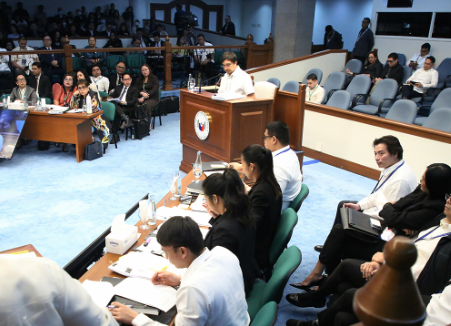
On the fifth day of her Senate impeachment trial, Vice President Sara Duterte faced a critical procedural moment when National Bureau of Investigation regional director Jeremy Lotoc provided testimony suggesting she had both the means and the demonstrated intent to execute the assassination threats she made against President Ferdinand Marcos, First Lady Liza Araneta-Marcos, and former Speaker Martin Romualdez. The NBI official's remarks, delivered before the Senate impeachment court on Tuesday, represented a significant inflection point in the prosecution's effort to establish that Duterte's public statements constituted the grave crime of threats and a fundamental betrayal of public trust warranting her removal from office.
Lotoc, who previously served as chief of the NBI's Cybercrime Division and oversaw the initial investigation into Duterte's controversial statements, testified unequivocally that the bureau had determined her remarks satisfied the legal elements required to establish grave threats as a criminal offence. When directly asked by Senate President Sherwin Gatchalian whether the Vice President possessed the actual capability to translate her words into violent action, Lotoc replied with a single word: "Definitely." His reasoning proved expansive—he pointed not merely to her current constitutional office but also to her family's extensive political pedigree, particularly her father's tenure as president. This lineage, in Lotoc's assessment, conferred upon her the networks, resources, and spheres of influence necessary to commission violence against state officials.
The heart of the prosecution's case, however, rested on demonstrating that Duterte had allegedly contracted someone to serve as an instrument of her violent intentions. During her public statements on November 23 and November 26, 2024, the Vice President had indeed acknowledged speaking with an unidentified individual about exacting revenge should she be killed, though she has consistently maintained she never actually hired an assassin. When questioned by senators about the basis for the NBI's conclusion that such a contract existed, Lotoc anchored his bureau's position entirely in the Vice President's own utterances. He stated plainly that investigators possessed no independent corroborating evidence—no intercepted communications, no witness testimony from the alleged hit man, no financial records—identifying or confirming the existence of any such person. The NBI's entire case depended upon accepting Duterte's own admissions at face value.
This evidentiary foundation proved contentious during cross-examination, particularly when the defence highlighted the absence of physical or circumstantial proof supporting the alleged conspiracy. Lotoc acknowledged that investigators had wanted to question Duterte in person to press her on these details, but she declined to appear before the bureau, instead submitting only a written denial. The NBI official argued that her simple negation carried little weight. "Mere denial would not discount the fact that she made those utterances and that she talked with somebody," he testified. The logic appeared circular to some observers: Duterte must have contacted someone to kill the President because she said she did, and her denial that she actually did so could not erase the initial statement itself.
During the prosecution's redirect examination, private prosecutor Amado Virgil Ligutan pressed a critical distinction that coloured Lotoc's subsequent remarks. Duterte, the prosecution noted, had never disavowed making the threatening statements in the first place. Rather, she had confined her denials to the narrower claim that she had not actually paid anyone to commit murder. Lotoc reviewed the November 26 interview transcript and observed that Duterte had essentially reiterated her earlier remarks rather than walking them back, suggesting to him that she viewed her statements as sincere commitments rather than rhetorical flourishes or political theatre. This interpretation undergirded the prosecution's broader argument: that Duterte's conduct revealed her unfitness for the vice presidency and her potential inability to discharge the constitutional duties that would devolve upon her should the President die or become incapacitated.
The defence strategy during cross-examination focused heavily on technical irregularities and evidentiary gaps, challenging various typographical errors that had appeared in NBI investigative documents. These forays, however, appeared to frustrate rather than assist the Vice President's legal team. Prosecution adviser Robert Ace Barbers objected strenuously to what he characterised as the defence's obsession with clerical minutiae, arguing that such quibbling over "typographical and clerical errors" avoided engaging with the substance of Lotoc's testimony and the underlying facts the NBI had assembled. The technical critique, from the prosecution's vantage point, amounted to attacking the messenger rather than the message—a tactic that drew implicit criticism from the prosecutors when they had the opportunity to speak.
A parallel line of inquiry emerged when several senator-judges pressed Lotoc about "Operation Romanov," a purported threat to the Vice President's own life that Duterte had cited as justification or context for her violent remarks. Duterte has suggested that shadowy forces within the government harboured assassination plans against her, creating a climate of fear that prompted her to seek insurance through a similar arrangement of her own. According to Lotoc's testimony, however, the term "Romanov" originated not from any coherent threat apparatus but rather from remarks made by Davao City Mayor Sebastian Baste Duterte during a January 2024 rally, and those remarks were directed at the President and his family, not at the Vice President. When a vlogger named Princess Maui subsequently raised "Operation Romanov" during the November 23 briefing to suggest that Vice President Duterte's life was in danger, the NBI attempted to corroborate her claims but found her story lacking credibility. Princess Maui failed to appear before investigators to substantiate her allegations, leaving the bureau unable to validate any legitimate threat against the Vice President.
The broader context of this impeachment proceeding involves fundamental questions about the constitutional separation between the presidency and vice presidency in the Philippine system. Under the 1987 Constitution, the Vice President becomes president automatically upon the death or incapacity of the chief executive, yet the Vice President need not come from the same political party or coalition as the President. Duterte and Marcos belong to different political camps, and their relationship has deteriorated significantly over various policy disputes and personalised tensions. The prosecution's argument rests on the proposition that a Vice President who has publicly articulated assassination fantasies against the President and his family can no longer be entrusted to assume the highest office should circumstances require it. The fitness-for-office question thus transcends the immediate incident of her statements; it engages the fundamental stability of the constitutional succession.
For Malaysian and broader Southeast Asian observers, this trial underscores the persistent institutional vulnerabilities that can emerge when constitutional design fails to ensure alignment between presidential and vice-presidential succession. Unlike in Malaysia's system, where the Deputy Prime Minister operates within a unified cabinet structure and party discipline, the Philippine arrangement creates the possibility of genuine political adversaries occupying the two highest offices simultaneously. The conviction or acquittal of Vice President Duterte on impeachment charges may accordingly signal something larger about whether Southeast Asian democracies possess institutional mechanisms sufficient to police threats to constitutional order emanating from senior officeholders themselves. The testimony by Lotoc and others in this trial will likely reverberate through discussions about presidential systems, constitutional accountability, and the fragility of democratic governance in the region.

