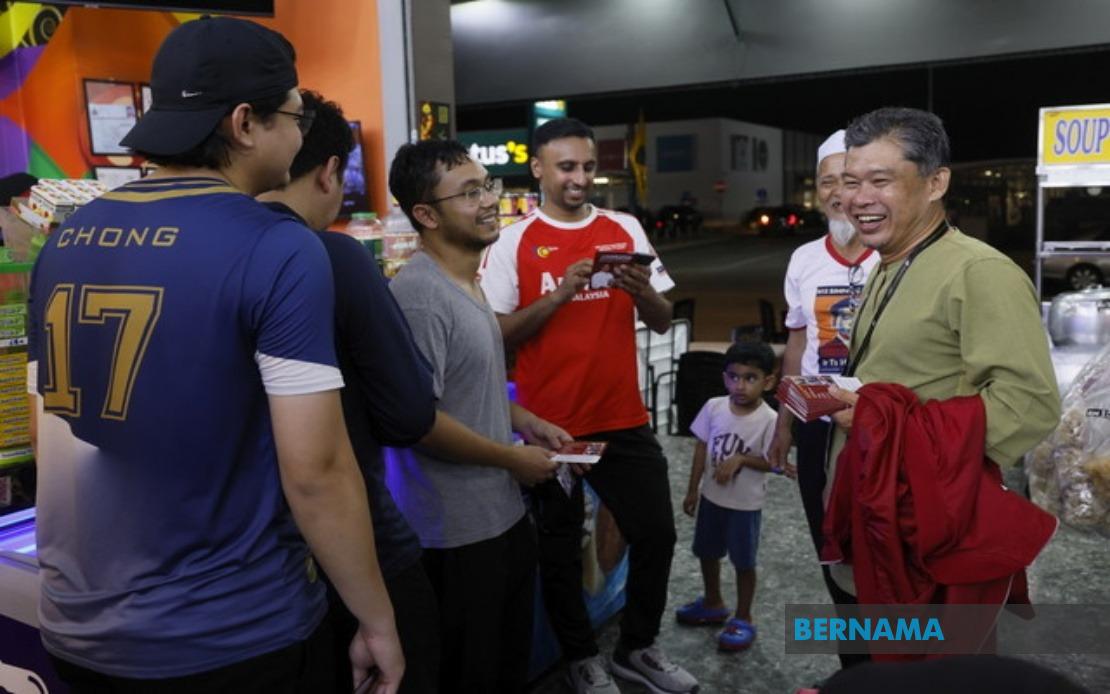
Pakatan Harapan's candidate for the Simpang Jeram state seat, Nazri Abd Rahman, is advancing a bold strategy to address one of rural Malaysia's most persistent challenges: the drift of young people toward urban centres. Speaking during campaigning in Muar ahead of the 16th Johor State Election, Nazri outlined his commitment to strengthening technical and vocational education pathways as a means of creating meaningful local employment opportunities that would allow youth to build careers without abandoning their home communities.
The centrepiece of Nazri's approach rests on mobilising Muar's existing industrial ecosystem. As one of Malaysia's largest furniture manufacturing hubs, the district already possesses substantial capacity for skilled workers. The availability of nearby training facilities through the Pagoh Education Hub adds institutional depth to this proposition. By channeling young people toward structured TVET programmes aligned with these existing industries, Nazri argues that the district can create a virtuous cycle: local talent development feeding directly into local job creation, which then reduces incentives for migration.
Central to Nazri's pitch is the economic feasibility of remaining in the district. He highlighted that entry-level positions in manufacturing and related sectors command salaries starting from RM1,700 monthly, sufficient for young workers to maintain comfortable living standards with their families whilst avoiding the transportation costs and time burdens associated with commuting from rural areas to distant city-centre workplaces. This calculation directly addresses a structural problem in Malaysia's regional development: rural youth often migrate not out of preference but because local wage opportunities fail to offset the hidden costs of long-distance commuting.
Nazri's own background lends credibility to his platform. Currently completing doctoral studies in engineering, he brings technical expertise to his candidacy. More significantly, he served as a civil engineer with the Muar Municipal Council, providing him with hands-on experience in infrastructure development and maintenance. These credentials position him to translate TVET ambitions into concrete infrastructure improvements and industry-training coordination efforts.
Crucially, Nazri's education agenda builds upon the legacy of his predecessor, the late Datuk Seri Salahuddin Ayub, who held the Simpang Jeram seat under the PH-Amanah banner. Salahuddin's tenure was marked by focus on "Rahmah" welfare initiatives and responsive infrastructure maintenance. Nazri's framing of TVET as an extension of this welfare philosophy—rather than a departure from it—demonstrates strategic continuity. He is positioning skills development not merely as economic policy but as part of a broader social compact in which government equips citizens with pathways to dignified self-sufficiency.
The political terrain in Simpang Jeram remains contested. The seat will witness a four-cornered contest involving candidates from Barisan Nasional, MUDA, and Perikatan Nasional, contending for 41,975 registered voters. Notably, Nazri's relationship with rival candidates reflects a localist tone increasingly rare in Malaysian politics. He characterised the competition as healthy rather than adversarial, emphasising that personal and family ties supersede electoral rivalry. This demeanour may resonate in constituencies where traditional social bonds remain influential.
Nazri's political trajectory itself merits attention. He began his political career with Parti Islam Se-Malaysia (PAS) in 1993 before migrating to Amanah in 2015. This transition mirrors broader realignments within Malaysia's Islamist political landscape, reflecting schisms over governance philosophy and coalition strategy. His presence in the PH-Amanah alliance during a period of renewed competitive elections suggests that Amanah continues positioning itself as a bridge between Islamist constituencies and centrist reform agendas.
The performance of Simpang Jeram in previous electoral contests provides useful benchmarks. In the 2022 state election, Salahuddin delivered victory with a majority of 2,399 votes, a relatively narrow margin in absolute terms. When Salahuddin passed away, triggering a 2023 by-election, Nazri secured the seat with an expanded majority of 3,514 votes, suggesting either genuine swing toward PH-Amanah or successful consolidation of the incumbent advantage. This trajectory indicates that the seat, whilst not entirely secure, represents reasonable ground for Pakatan Harapan in Johor.
The broader context of the Johor election adds significance to Nazri's campaign. With 172 candidates competing across 56 seats on July 11, the state contest has implications far beyond Johor's borders. The peninsula's southernmost state remains economically significant, and the election outcome will test whether Pakatan Harapan can sustain its 2022 momentum or whether recent political volatility has shifted advantage to rival coalitions. A TVET-centred campaign in a single-seat context might appear parochial, yet it touches on a genuine anxiety across Southeast Asian societies: how to ensure that economic development benefits are distributed equitably across geographic space rather than concentrating in primate cities.
Nazri's emphasis on TVET also aligns with Malaysia's strategic priorities articulated in recent economic policy documents. The nation's push toward becoming a high-income country hinges partly on developing a sophisticated, mobile workforce capable of navigating industrial transitions. By championing vocational training pathways, Nazri is implicitly endorsing a skills-based rather than credentials-based approach to workforce development—a distinction increasingly important in labour-scarce sectors.
Yet implementation challenges loom. Translating TVET rhetoric into sustained institutional change requires coordination across multiple agencies—education ministries, industry bodies, local councils—and sustained funding commitments. The fact that Nazri explicitly deferred detailed policy discussions pending the official release of the PH election manifesto suggests these mechanisms remain under negotiation. Voters will ultimately assess whether his vision, however compelling, translates into actionable governance.

