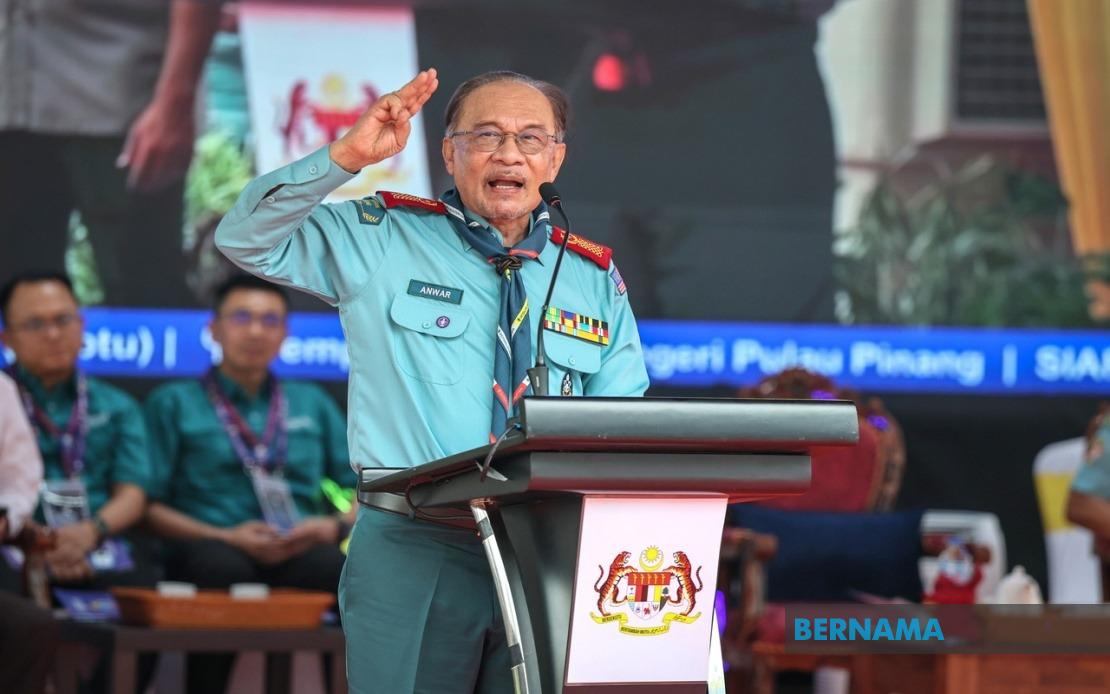
Prime Minister Datuk Seri Anwar Ibrahim has challenged the prevailing notion that a nation's achievements can be measured purely through economic gains and technological prowess. Addressing participants at the 15th Malaysian Scouts Jamboree (MYJAM15) at the Penang State Stadium on August 29, Anwar articulated a broader vision of national success that places equal weight on the moral and intellectual development of Malaysia's youth. His remarks underscored a fundamental debate within Southeast Asian societies grappling with rapid modernization: whether progress can be sustained without maintaining foundational cultural and ethical anchors.
Anwar stressed that educational institutions bear responsibility beyond transferring academic knowledge. Schools, colleges and universities, he argued, should cultivate individuals who embody discipline, integrity and a genuine commitment to serving their communities. This perspective reflects growing concerns across the region that educational systems focused narrowly on technical and vocational skills may produce generations adept at technology but lacking the ethical grounding necessary for cohesive societies. The Prime Minister framed education not as a mechanism for personal advancement alone, but as a pathway to developing citizens who understand their obligations to family, society and nation.
The timing of these remarks proves significant given Malaysia's demographic trajectory. With more than half the population under 40 years old, the values and orientations that take root in the current generation will substantially determine the nation's direction through the mid-21st century. Anwar's emphasis on instilling "spirit, education, discipline and love" through formative years acknowledges an implicit anxiety: that rapid modernization and digital connectivity might erode traditional social bonds and communal responsibility if left unchecked. This concern resonates throughout Southeast Asia, where policymakers increasingly recognise that GDP growth alone cannot guarantee social stability or citizen well-being.
Adressing the specific challenge posed by accelerating technological change, Anwar outlined a delicate balancing act required of Malaysia's youth. The emergence of artificial intelligence and advanced information systems presents unprecedented opportunities for economic advancement and problem-solving capability. However, he cautioned that this technological embrace must not come at the expense of cultural identity and inherited values. This framing recognizes that developing nations often face particular vulnerability to cultural homogenization through digital channels, where the default templates and narratives embedded in global platforms may subtly displace local traditions and ways of knowing. Young Malaysians, in his view, must become sophisticated navigators of this landscape—fluent in technology yet rooted in heritage.
The Prime Minister also highlighted the imperative of unity within Malaysia's ethnically and religiously diverse society. By positioning the younger generation as future custodians of this pluralistic compact, Anwar elevated youth development beyond individual self-improvement into a matter of national cohesion. The diversity of Malaysia's population—with Malay-Muslims, Chinese, Indians, indigenous communities and various religious traditions coexisting in close proximity—creates unique demands on leadership and mutual understanding. Young people equipped with both knowledge and moral discipline, Anwar suggested, would be better positioned to navigate potential tensions and sustain the delicate equilibrium that Malaysia's stability depends upon.
Anwar's call for youth to maintain their patriotic spirit ahead of the 2026 National Day celebrations connected these abstract principles to concrete civic engagement. Rather than viewing patriotism as an antiquated sentiment, he reframed it as a necessary resource for confronting future trials. This approach acknowledges that Malaysia, like other developing economies, faces mounting challenges ranging from climate change and economic disruption to potential geopolitical tensions in Southeast Asia. A generation infused with patriotic commitment—understood not as blind nationalism but as genuine investment in collective welfare—may prove essential for mobilizing the sustained effort and sacrifice such challenges will demand.
The MYJAM15 gathering itself served as both backdrop and proof of concept for Anwar's vision. Bringing together more than 5,450 scouts from Malaysia and 11 other nations—including South Korea, Indonesia, Singapore and Sri Lanka—the jamboree embodied his emphasis on youth development through mentorship, discipline and community engagement. The scouting movement's historical focus on character formation, outdoor competence and civic responsibility aligns closely with the Prime Minister's articulation of what modern education should encompass. By selecting this venue for his remarks, Anwar implicitly endorsed the scouting model as a worthy complement to formal schooling.
The geographic significance of holding MYJAM15 in Penang also carried symbolic weight. The state's return as host after a 60-year interval—the last jamboree in Penang took place in Teluk Bahang in 1966—marked a generational cycling. The scouts gathering in 2024 represent a cohort separated from their 1966 predecessors by nearly three full generational cycles. Yet the continuity of the institution itself suggests that the values and practices it embodies retain relevance across rapidly changing times. This notion of rootedness within modernity—maintaining institution and tradition while engaging contemporary challenges—mirrors Anwar's broader argument about Malaysian youth.
The international composition of the jamboree additionally illustrates the regional dimensions of youth development challenges. All Southeast Asian nations confronted by rapid digitalization, globalization and economic transformation share analogous concerns about preserving cultural distinctiveness and social cohesion amid change. The presence of scouts from South Korea—a nation that has experienced perhaps the most intensive technological integration globally—alongside those from Sri Lanka and Indonesia suggests that this is a fundamentally regional conversation. Anwar's comments thus spoke not only to Malaysia's internal audience but implicitly to neighboring societies facing similar questions about balancing tradition and progress.
The substance of Anwar's remarks also reveals tensions within Malaysian governance that extend beyond this single speech. The emphasis on moral and disciplinary education contrasts somewhat with trends toward increasingly competitive, examination-focused schooling systems across the region. If Malaysian youth are to develop the holistic combination of knowledge, discipline, values and service orientation Anwar advocates, educational policy and practice may require significant recalibration. Similarly, the appeal to young people to maintain cultural roots while embracing technology calls for deliberate institutional design—whether through curriculum choices, extracurricular programming or media literacy education—to make this integration feasible rather than leaving it to chance.
Anwar's framing of youth development as a national imperative rather than a peripheral concern suggests an implicit recognition that demographic dividends are not automatic. Many countries have squandered the economic potential of youthful populations by failing to provide quality education, meaningful opportunity or clear pathways to dignified participation in society. Malaysia's relatively strong economic position provides opportunity to avoid this trap, yet requires deliberate choices about educational investment and youth engagement. The Prime Minister's remarks at MYJAM15 can be read as an argument for treating youth development as central to economic strategy rather than as a soft policy concern separate from serious fiscal and industrial planning.

