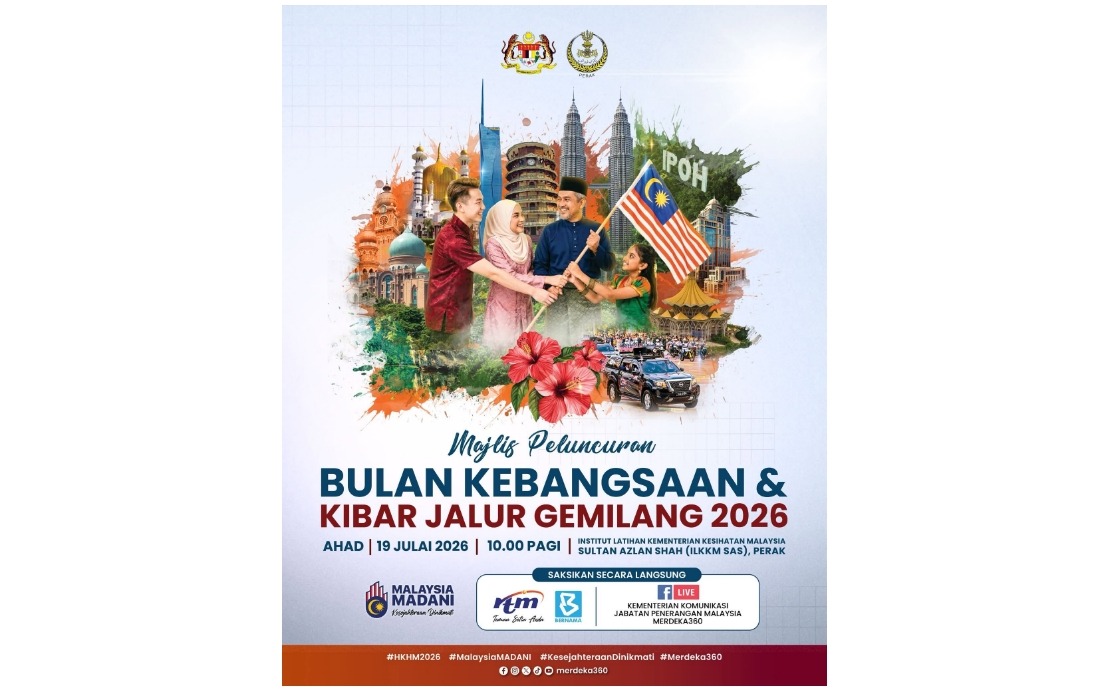
The opening ceremony for National Month 2026 and the Fly the Jalur Gemilang campaign will take place on July 19 at Institut Latihan Kementerian Kesihatan Malaysia Sultan Azlan Shah in Perak, formally inaugurating Malaysia's patriotic season. The event represents an important symbolic moment, transitioning the nation from everyday governance into a month-long period of civic celebration and national reflection that culminates in formal Independence Day observances.
Scheduled to commence at 10 am, the launch ceremony will enjoy broad media coverage through partnerships with national broadcasters. Radio Televisyen Malaysia, BERNAMA TV, and simultaneous streaming via Facebook Live across the Merdeka360 platform, the Ministry of Communications, and the Department of Information Malaysia will ensure citizens across the country can participate in real time, regardless of geographic location. This multi-channel approach underscores the government's commitment to making the opening accessible to the broadest possible audience during prime morning hours.
The central rallying call behind this year's campaign emphasises the Malaysian flag as a unifying symbol, inviting citizens to "ignite the spirit of patriotism and embrace National Month 2026". The Merdeka360 website has been established as a digital resource hub where Malaysians can obtain the official campaign logo, patriotic songs, and promotional materials. By centralising these assets online, the government enables schools, workplaces, community organisations, and households to participate in consistent, coordinated celebrations while allowing local autonomy in how institutions incorporate the national message.
The overarching theme selected for both National Day 2026 and Malaysia Day 2026 celebrations—"Malaysia MADANI: Kesejahteraan Dinikmati"—encapsulates the government's development vision. This framework, grounded explicitly in principles of justice, humanity, and public welfare, positions national prosperity not as an abstract ideal but as a tangible benefit that should reach all Malaysians comprehensively and equitably. The retention of the Malaysia MADANI logo as the official emblem reinforces continuity in branding and messaging, allowing citizens to connect 2026 celebrations with the broader governance philosophy introduced in preceding years.
Communications Minister Datuk Seri Fahmi Fadzil has previously outlined the physical venues for major celebrations, signalling how festivities will be distributed geographically across the nation. The primary National Day commemoration on August 31 will unfold at Dataran Putrajaya on a carefully calibrated scale described as "modest yet vibrant"—language suggesting the government seeks to balance fiscal responsibility with meaningful public engagement. This centralized format contrasts with Malaysia Day 2026 on September 16, which will be hosted in Sarawak, acknowledging the constitutional significance of Sabah and Sarawak's distinct entry into the federation and distributing national ceremonial focus across multiple regions.
The seven supporting programmes and activities designed to sustain momentum throughout National Month represent a comprehensive approach to embedding patriotism across diverse cultural and spiritual contexts. Kembara Bahasa HKHM taps into linguistic heritage and identity, while Quran Hour acknowledges the Islamic dimensions of Malaysian identity. Ambang Merdeka, Merdeka Countdown, and RIUH Merdeka leverage popular cultural frameworks and digital engagement to appeal to younger demographics. The National Statesmen Commemoration Ceremony grounds celebrations in historical memory and institutional continuity, ensuring citizens connect current prosperity to founding figures and principles.
This diversified programming structure reveals sophisticated thinking about how to sustain patriotic sentiment across a pluralistic society. Rather than imposing uniform celebrations, the framework permits different communities to express national identity through culturally resonant activities while remaining bound by shared dates and symbols. For Malaysian readers accustomed to celebrating Merdeka within varied ethnic and religious contexts, this architecture offers pathways for genuine participation without requiring assimilation to a single national expression.
The July 19 launch in Perak carries particular regional significance, as the state possesses substantial historical prominence in Malaysian federalism and governance. Selecting Perak as the ceremonial starting point acknowledges the state's contributions while signalling the government's intent to distribute national events beyond the federal capital. This decision likely resonates especially with Perak residents and reflects consideration for geographic equity in how the nation marks its most important civic occasions.
From a Southeast Asian perspective, Malaysia's National Month celebrations demonstrate how established democracies periodically recommit to national narrative and cohesion. The sophisticated media strategy—incorporating traditional broadcast television alongside digital platforms—reflects understanding that modern patriotic campaigns must reach citizens across generational and technological divides. The emphasis on downloading materials and decentralised participation contrasts with more top-down approaches historically associated with national celebrations in some regional neighbours, highlighting Malaysia's relatively open framework for civic engagement.
The Malaysia MADANI framework itself warrants attention, as it attempts to articulate a development model emphasizing inclusive prosperity rather than purely economic metrics. By anchoring National Month 2026 celebrations around this philosophy, the government signals that patriotism encompasses social responsibility and equitable distribution of national gains. This positioning becomes increasingly significant as Malaysia navigates post-pandemic economic recovery and regional competition for talent and investment, framing national identity around shared prosperity rather than competition or hierarchy.
For businesses and civil society organisations, the July 19 launch serves as an official green light to intensify patriotic messaging and activate corporate social responsibility initiatives aligned with National Month themes. Schools will coordinate independence day programmes, community groups will organize flag-raising ceremonies, and media outlets will amplify patriotic content. The extended lead time between the July 19 launch and August 31 National Day provides six weeks for coordinated activation across public and private sectors.
Looking forward, the decision to hold Malaysia Day celebrations in Sarawak acknowledges the importance of this date to East Malaysian identity and governance. September 16 marks the formation of Malaysia as a federation when Sabah and Sarawak joined the union, making it constitutionally distinct from August 31 Merdeka Day. By rotating the celebration venue and according Sarawak hosting responsibilities, the federal government demonstrates commitment to recognizing all regions' contributions to Malaysia's nationhood, not merely the peninsula's historical independence narrative.

