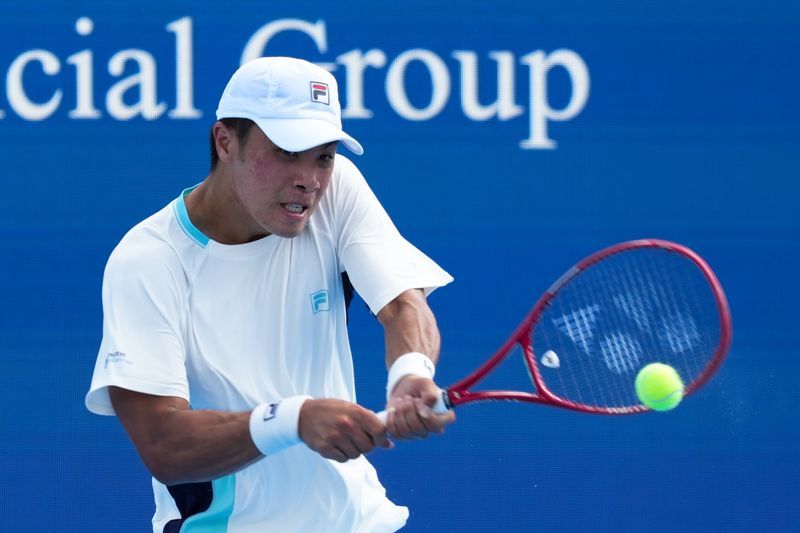
Brandon Nakashima's exceptional run through North American hard courts accelerated further on Friday when the 25-year-old American overcame sixth-seeded compatriot Taylor Fritz 7-6(9) 4-6 6-3 at the Cincinnati Open, propelling himself into the semi-finals of back-to-back Masters 1000 tournaments. The result represents a significant career milestone for Nakashima, who has emerged as one of the continent's most dangerous players heading into the season's final Grand Slam, the U.S. Open, which commences later this month.
Nakashima's victory assumes particular importance given his historical struggles against Fritz, arriving at this quarter-final clash with a modest 1-4 record in their head-to-head encounters. Yet the San Diego native demonstrated the mental fortitude and technical precision that has characterised his recent surge, engineering a comeback from a break down in the deciding set to eventually dominate the closing stages of the match. This ability to recover from adversity under pressure points to genuine progress in his psychological development as a competitor, an evolution that augurs well for his Grand Slam prospects.
The opening set epitomised the intense baseline exchanges that have defined modern professional tennis on hard courts. Both Nakashima and Fritz showcased exemplary serving throughout, with neither player affording the other meaningful opportunities to convert break points during the regulation play. The consequence was an inevitable tiebreak, where the match's narrative shifted dramatically with each mini-break. After both competitors exchanged advantages in what proved a tense contest of precision serving and return positioning, Nakashima ultimately prevailed by converting his fifth set point when Fritz's response sailed marginally beyond the baseline.
Fritz responded emphatically to that setback, recalibrating his tactical approach by implementing aggressive returning patterns that immediately pressured Nakashima's service rhythm. The sixth seed capitalised on his renewed momentum by securing an early break in the second set, subsequently consolidating his advantage through the set with characteristic power serving that concluded with an ace. The relative ease with which Fritz claimed the second set suggested momentum had decisively shifted, potentially positioning him favourably as the match progressed toward its conclusion.
The decisive third set became the crucible where both competitors' mental resilience would be tested. Fritz struck first, converting on Nakashima's unforced errors to establish a 3-2 advantage that seemingly placed the American sixth seed in command. However, what transpired demonstrated Nakashima's growing capacity to absorb pressure and respond with conviction. From a precarious 30-0 deficit on serve, Nakashima mounted an extraordinary recovery, ultimately converting his second break point of the contest to restore parity at 3-3. This turning point proved momentous, as the momentum permanently shifted toward the 27th seed.
From that juncture, Nakashima's confidence visibly escalated while Fritz's composure correspondingly deteriorated. The younger American captured the final three games in succession, powered by aggressive baseline play and diminishing errors, whilst Fritz's unforced mistake count accumulated alarmingly. Nakashima's service games became virtually unbreakable, allowing him to dictate from the baseline and extract errors through sustained pressure rather than outright winners. This methodical approach reflected improving tactical maturity alongside enhanced physical conditioning.
The magnitude of Nakashima's achievement extends beyond merely advancing to another semi-final. His consecutive Masters 1000 semi-final appearances—following last week's achievement in Montreal—represent unprecedented success at this elevated level of competition. Across the 2024 season, Nakashima has now recorded four top-10 victories, a statistic that underscores his emergence as a legitimate threat to established stars on hard courts. For Southeast Asian tennis enthusiasts monitoring American tennis, Nakashima's trajectory mirrors the broader competitive acceleration occurring in men's tennis, where younger generation players increasingly displace seasoned competitors through improved physical preparation and psychological resilience.
Nakashima's path to the Cincinnati final will navigate through either Italian tenth seed Lorenzo Musetti or fellow American Frances Tiafoe in the semi-final. Both potential opponents present distinct challenges: Musetti's clay-court pedigree and defensive capabilities contrast sharply with Tiafoe's aggressive baseline assault. Regardless of opponent, Nakashima approaches these matches with exceptional momentum and confidence cultivated through successive high-level victories. His current form positions him advantageously for deep runs at Cincinnati and subsequently at the U.S. Open, potentially establishing him as a domestic contender for the year's final Grand Slam.
For Malaysian tennis observers, Nakashima's breakthrough carries broader significance within the context of evolving competitive standards across men's professional tennis. His success demonstrates how contemporary training methodologies, mental coaching, and sports science integration enable rapid ascension through competitive hierarchies. The hard-court specialisation demonstrated by Nakashima and other emerging American players reflects strategic tournament selection and surface-specific preparation that Malaysian players might contemplate when structuring their own development pathways. As Nakashima continues his surge toward the U.S. Open, his performances will undoubtedly influence discussions regarding talent development paradigms throughout regional tennis communities.

