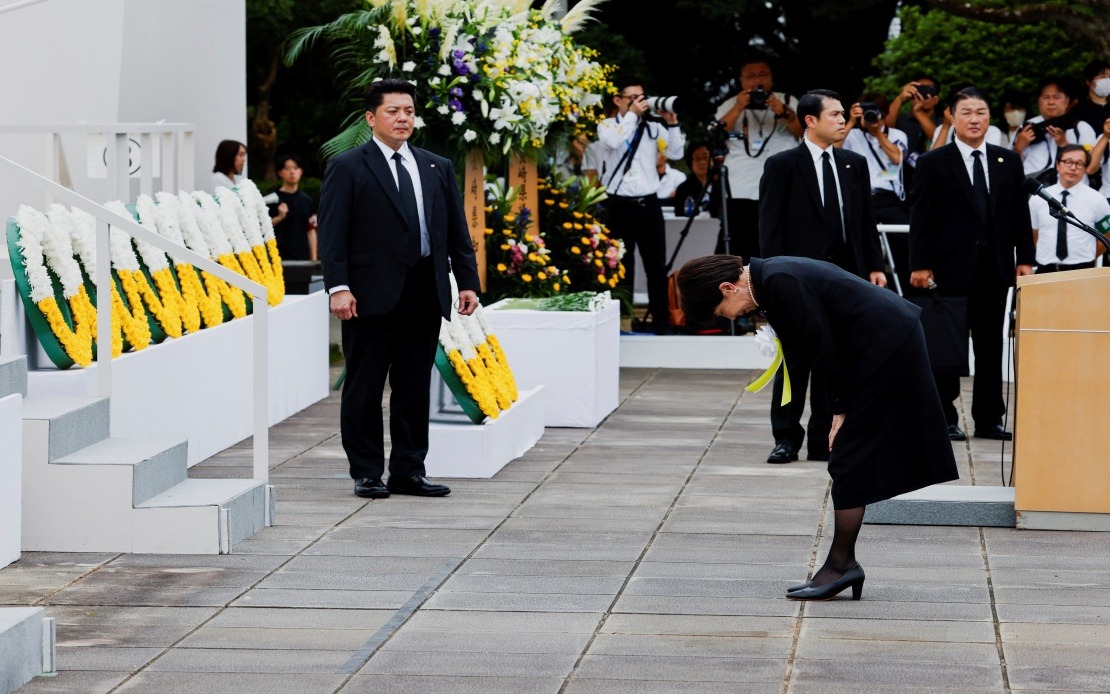
On Sunday, Nagasaki commemorated eight decades since the "Fat Man" plutonium bomb devastated the southwestern Japanese city on August 9, 1945, an event that remains the last documented nuclear attack on a populated center. The solemn observance unfolded against a backdrop of renewed international tension over nuclear weapons policy, with city officials and national leaders using the platform to advocate for renewed commitment to eliminating atomic arsenals worldwide.
The central ceremony included a moment of silence at 11:02 a.m., the precise time when the American bomber released its destructive payload over Nagasaki, just three days following the Hiroshima bombing that had leveled that city earlier in the week. Mayor Shiro Suzuki addressed attendees with a call for global leaders to pursue genuine nuclear disarmament, emphasizing a fundamental principle that underpins post-war Japanese policy: humanity and nuclear weapons cannot sustainably coexist. Prime Minister Sanae Takaichi attended the proceedings and delivered remarks reinforcing the government's position, while United Nations Secretary-General Antonio Guterres sent a statement to be read to the assembled crowd.
The destruction wrought upon Nagasaki in that single moment was staggering in human terms. Official records indicate approximately 74,000 residents perished by year's end 1945, with countless others enduring lifelong physical and psychological trauma from exposure to radiation and blast effects. Japan's surrender followed six days later on August 15, concluding World War II in the Pacific theater. The twin atomic bombings remain unparalleled in their demonstrated destructive capacity and continue to serve as a sobering reminder of nuclear weapons' civilization-threatening potential.
For Southeast Asian observers, Nagasaki's anniversary carries particular resonance given the region's geographic proximity to nuclear-armed powers and its own history of regional conflicts. The ceremony's emphasis on nuclear non-proliferation connects directly to stability concerns affecting Malaysia and neighboring nations, particularly as geopolitical competition intensifies in the Indo-Pacific theater. Understanding Japan's steadfast commitment to its three non-nuclear principles—rejecting the production, possession, or allowance of nuclear weapons on its soil—provides insight into how a militarily significant nation has navigated security challenges without pursuing atomic capabilities.
Yet Japan's adherence to these principles faces mounting pressure from shifting strategic circumstances. Following Thursday's commemoration in Hiroshima, Prime Minister Takaichi explicitly reaffirmed that her government "is upholding" the established non-nuclear policy, a statement seemingly intended to counter speculation about potential policy reconsideration. Growing discussion within Japan about whether to revisit these longstanding principles reflects anxieties about regional military capabilities, particularly concerning China's nuclear modernization and North Korea's weapons development programs. This internal debate represents a significant development in Japanese security thinking, though official pronouncements continue to maintain the established consensus.
International efforts to address nuclear proliferation face their own challenges. The quinquennial Review Conference of the Nuclear Non-Proliferation Treaty concluded in May following intensive negotiations in New York, yet delegates failed to reach consensus—marking the third consecutive review conference unable to produce agreement. This pattern of gridlock underscores deepening divisions among nuclear and non-nuclear states regarding disarmament timelines, verification mechanisms, and security guarantees. The failure carries implications for global non-proliferation architecture precisely when technological advances and regional tensions make effective international cooperation increasingly vital.
The hibakusha—survivors of the atomic bombings—increasingly recognize their role as custodians of historical memory facing the biological reality of advancing age. The officially recognized survivor population averages over 86 years old, creating an urgent imperative for these individuals and supporting organizations to transmit firsthand testimonies and lessons learned to younger generations. Their efforts extend beyond Japan's borders, resonating with international civil society movements advocating for disarmament and the humanitarian consequences movement that emphasizes nuclear weapons' indiscriminate destructive power.
For policymakers in Southeast Asia monitoring great power competition in their region, Japan's experience offers instructive lessons in maintaining security without nuclear weapons while managing relationships with nuclear-armed allies. The nation's emphasis on collective security arrangements, technological innovation, and diplomatic engagement provides an alternative model to proliferation, even as security challenges persist. Malaysia and other ASEAN members navigating similar strategic crossroads may draw valuable insights from Japan's institutional memory regarding how non-nuclear states maintain credible deterrence through alliance structures and conventional capabilities.
The ceremonial calendar marking Nagasaki's tragedy continues alongside broader international conversations about nuclear ethics, security policy, and species survival. As technological advancement accelerates and new nuclear powers emerge, the historical lessons encoded in Nagasaki's streets and survivor testimonies become more rather than less relevant. The city's quiet insistence that nuclear weapons represent an unacceptable threat to human civilization persists, even as strategic calculations in distant capitals suggest otherwise. Sunday's anniversary thus functions simultaneously as historical remembrance, ethical testimony, and contemporary political statement—a reminder that the consequences of atomic weapons use transcend abstract strategic calculations to touch the lives of ordinary people across generations.

