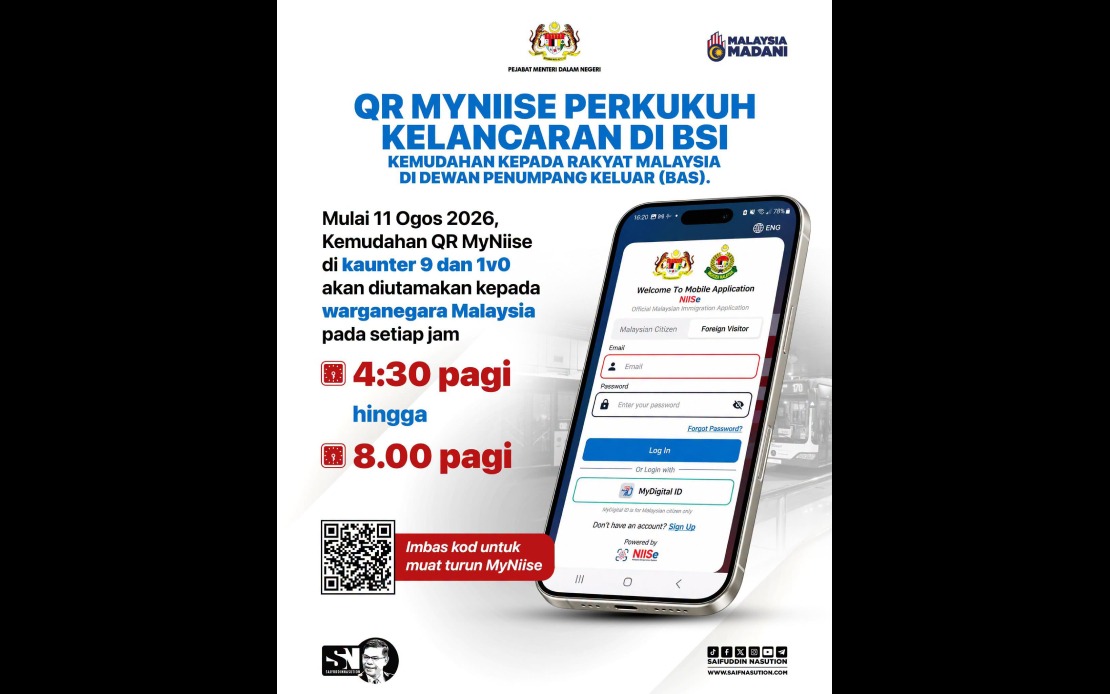
Travellers carrying the National Integrated Immigration System (MyNIISe) QR code now enjoy accelerated immigration clearance at Bangunan Sultan Iskandar (BSI), the main bus terminal linking Malaysia and Singapore. Home Minister Datuk Seri Saifuddin Nasution Ismail unveiled the priority lane initiative, which became operational at counters 9 and 10 in the Bus Departure Hall from 4.30 am to 8 am, targeting the heaviest commuter congestion period.
The move addresses a persistent challenge facing thousands of Malaysian workers and travellers who cross into Singapore daily. The pre-dawn and early morning hours represent the busiest transit window, with workers racing to arrive at offices by normal business hours. Queue delays during these critical periods have long frustrated frequent travellers, many of whom depend on early buses to reach their employment destinations on time. By offering a dedicated fast-track service, authorities aim to streamline the departure process and reduce waiting times that can stretch to 30 minutes or more during peak demand.
MyNIISe forms part of the government's broader modernisation agenda, positioning digital innovation at the centre of border management. The system operates as a mobile application accessible through major platforms including Apple App Store, Google Play Store, and Huawei App Gallery, reflecting efforts to reach users across different smartphone ecosystems. The QR code function enables travellers to present their immigration details electronically rather than relying solely on traditional document scanning and manual verification processes.
For Malaysia's cross-border commuter population, this represents tangible progress in reducing friction at a crucial transport hub. Bangunan Sultan Iskandar processes thousands of departures daily, with bus services operating continuously to accommodate the flow of workers, students, and leisure travellers. The morning rush coincides with Singapore's standard working hours, creating predictable congestion that impacts both individuals and the efficiency of border operations. By introducing selective expediting during these periods, authorities acknowledge that different traveller types and urgencies warrant differentiated service levels.
The implementation reflects broader regional trends in Southeast Asia toward digitising immigration procedures. Singapore itself operates sophisticated digital border systems, and Malaysia's MyNIISe represents an effort to match these technological standards while improving the bilateral crossing experience. The initiative may also serve as a model for other major land crossings in the region, including the Second Penang Bridge and other international departure points where congestion regularly compromises service quality.
Adoption of the MyNIISe system among frequent travellers remains the critical variable determining success. While the application is freely available, uptake depends on awareness campaigns and demonstrated benefits. Morning commuters who have experienced repeated delays represent the most motivated demographic for adoption, though some may hesitate if unfamiliar with mobile-based systems or lacking reliable smartphone access. The government has not yet announced complementary initiatives such as targeted promotion campaigns to inform regular travellers about the service or simplified registration processes for frequent users.
The 3.5-hour morning window aligns with school runs, office commencement times, and factory shift changes in Singapore's economy. Concentrating priority service during this window acknowledges that afternoon and evening departures, while occurring in volume, generally attract less time-critical passengers. This targeted approach maximises the impact of the initiative without straining resources across the full operating day, though the government may evaluate expansion based on demand patterns and congestion data collected over coming weeks.
Integration with existing immigration infrastructure requires smooth coordination between MyNIISe systems and manual verification protocols. Staff at counters 9 and 10 must efficiently process QR codes while maintaining security standards that protect border integrity. The success of this arrangement depends on reliable technology, adequate staffing, and protocols that prevent backlogs if the system experiences technical issues. Any disruption could undermine confidence in the digital approach and encourage reversion to traditional methods.
For Malaysian employers with Singapore-based operations, particularly in sectors such as manufacturing, logistics, and services, smoother border crossing times directly translate to reduced labour costs and improved worker punctuality. Companies with high proportions of Malaysian staff commuting daily stand to benefit from reduced travel time variability. This efficiency gain extends beyond individual convenience, potentially influencing recruitment and retention patterns among Malaysian workers considering cross-border employment.
The initiative also reflects government acknowledgment of the Malaysia-Singapore economic relationship, which depends heavily on fluid cross-border movement. Both nations maintain one of Southeast Asia's busiest land boundaries, with hundreds of thousands crossing in both directions monthly. Functional border processes support the broader economic integration that benefits both countries, from supply chain continuity to labour market flexibility. Investments in digital infrastructure and priority service mechanisms signal commitment to maintaining this relationship despite periodic political tensions.
Longer-term success will depend on whether the MyNIISe system gains traction among the broader commuting population. Early adoption among tech-savvy users may establish proof of concept, but penetration among traditional travellers remains uncertain. The government should monitor usage patterns, measure congestion reduction during the priority lane hours, and assess whether the system generates spillover benefits such as faster processing at adjacent counters. This data will inform decisions about expanding the initiative to other border crossings and time periods where congestion remains problematic.
As Malaysia advances its digital government agenda, MyNIISe's border application demonstrates tangible value to citizens navigating daily cross-border routines. The priority clearance initiative moves beyond aspiration toward measurable service improvement, though sustained benefits will depend on continued investment in technology, staff training, and promotion to ensure the travelling public understands and utilises the system effectively.

