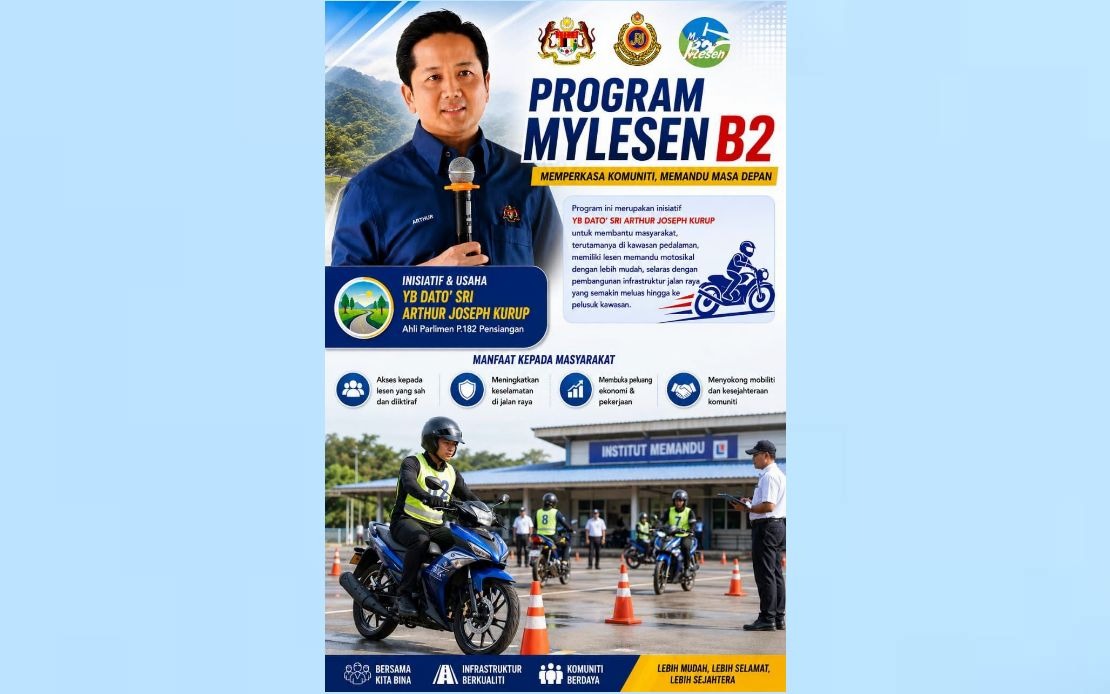
The MyLesen B2 initiative has made its return to Pensiangan, bringing motorcycle licensing services directly to Sabah's rural communities. Spearheaded by Pensiangan Member of Parliament Datuk Seri Arthur Joseph Kurup, who also serves as Natural Resources and Environmental Sustainability Minister, the programme addresses a critical gap in accessibility for residents seeking valid riding credentials. Rather than undertaking lengthy journeys to urban driving schools, participants can now complete the licensing process within their own district, removing significant barriers that have historically prevented rural youths from obtaining proper documentation.
The core objective of this initiative extends beyond mere administrative convenience. By decentralising the licensing process, the programme seeks to formalise motorcycle use among communities where two-wheelers represent the primary mode of personal transport. Rural residents, particularly younger members of these communities, often operate motorcycles without formal qualifications, creating genuine public safety concerns. Arthur's emphasis on combining accessibility with mandatory training underscores recognition that convenience alone cannot substitute for proper instruction in road safety fundamentals.
Participants must meet specific requirements despite the programme's accessibility focus. Individuals aged between 16 and 63 are eligible, with particular emphasis on those who have never previously held driving credentials. Importantly, convenience does not translate to reduced standards. All applicants must complete required courses and successfully navigate prescribed examinations before receiving their licence, ensuring that the qualification carries the same legitimacy and credibility as licences obtained through conventional channels in urban centres. This dual commitment to accessibility and standards reflects a sophisticated understanding that expanding licensing capacity without maintaining rigour would undermine the safety objectives driving the initiative.
The documentation obtained through MyLesen B2 carries substantial practical significance for beneficiaries. A valid motorcycle licence represents more than a regulatory compliance tool; it functions as a gateway to legitimate employment opportunities. Rural youths often face geographic constraints limiting economic mobility, and formal licensing credentials can unlock access to delivery services, transportation businesses, and other livelihoods dependent on legal motorcycle operation. The long-term validity of the licence, which remains active throughout the holder's life subject to compliance with prevailing regulations, means that successful participants gain a durable asset with enduring economic value.
Road safety considerations form the programmatic foundation. Rural areas in Malaysia, particularly in East Malaysia, experience disproportionate motorcycle accident rates, often linked to inadequate training and limited enforcement of traffic regulations. By providing structured instruction and formal qualification processes, MyLesen B2 addresses both causal factors simultaneously. Participants develop deeper awareness of traffic laws, hazard recognition, and defensive riding techniques, while the documentation itself facilitates enforcement activities. Police can readily identify licensed operators, encouraging compliance with prevailing regulations and deterring reckless behaviour through clearer accountability.
The logistical structure supporting the programme demonstrates institutional coordination across multiple levels of government. Registration services operate through two primary channels: the Pensiangan Parliamentary Service Centre and the Sook State Assemblyman's Service Centre. This dual-agency approach reflects recognition that optimising accessibility requires positioning registration points near population centres while distributing administrative workload across existing government infrastructure. For residents, this means accessing services through established local institutions rather than creating entirely new facilities.
Pensiangan's socioeconomic context makes this initiative particularly relevant. As a relatively remote parliamentary constituency in Sabah, Pensiangan comprises primarily rural communities where subsistence agriculture, small-scale commerce, and resource-based livelihoods predominate. Geographic distances between settlements and limited public transport mean motorcycles function as essential infrastructure, not luxury transportation. Formalising access to riding credentials acknowledges this reality while simultaneously enhancing public safety. The programme implicitly recognises that attempting to restrict motorcycle use through limited licensing availability would prove counterproductive, instead channelling inevitable two-wheeler usage into structured, safer frameworks.
The timing and expansion of MyLesen B2 reflects broader government priorities concerning economic inclusion and rural development. Beyond immediate road safety benefits, improving youth access to formal employment through credential acquisition supports longer-term rural prosperity objectives. Young people equipped with valid licences and formal training can establish transport businesses, service delivery operations, or other ventures generating income within their communities. This economic dimension adds substantial weight to the programme's significance beyond narrow traffic safety considerations.
Minister Arthur's public commitment to supporting participants through the entire licensing journey signals political attention to implementation fidelity. Government officials frequently announce programmes that subsequently suffer from inconsistent execution or inadequate resource allocation. The explicit ministerial assurance regarding sustained support throughout the process suggests awareness that genuine accessibility requires more than simply opening application windows—it demands consistent institutional commitment and responsiveness to participant needs throughout the qualification process.
For Malaysian policymakers examining rural service delivery challenges, MyLesen B2 offers instructive lessons about decentralisation and accessibility. The model demonstrates that expanding access to government services need not require establishing entirely new institutions or dramatically increasing budgetary commitments. Instead, strategically positioning services through existing government infrastructure—parliamentary and state assemblyman offices already maintained for constituent services—can extend reach while managing costs effectively. This approach carries broader applicability across diverse policy domains where rural communities experience service access deficits.
The programme's success will ultimately depend on execution consistency and participant uptake. Rural communities often demonstrate hesitancy toward new government initiatives if communication remains limited or process requirements appear burdensome. Effective outreach through community leaders, established networks, and clear explanation of benefits will prove essential for converting programme availability into meaningful participation. Additionally, ensuring that testing schedules accommodate agricultural calendars and other rural employment patterns can substantially enhance accessibility for time-constrained participants.
Looking forward, MyLesen B2's expansion to Pensiangan suggests potential for broader replication across other rural parliamentary constituencies. If implementation succeeds in generating meaningful licensing uptake while demonstrably improving road safety outcomes, the model could inform efforts to extend comparable decentralised licensing services to other regions experiencing similar accessibility challenges. Such expansion would represent significant progress toward ensuring that rural residence no longer constitutes an implicit barrier to obtaining credentials essential for legal economic participation.

