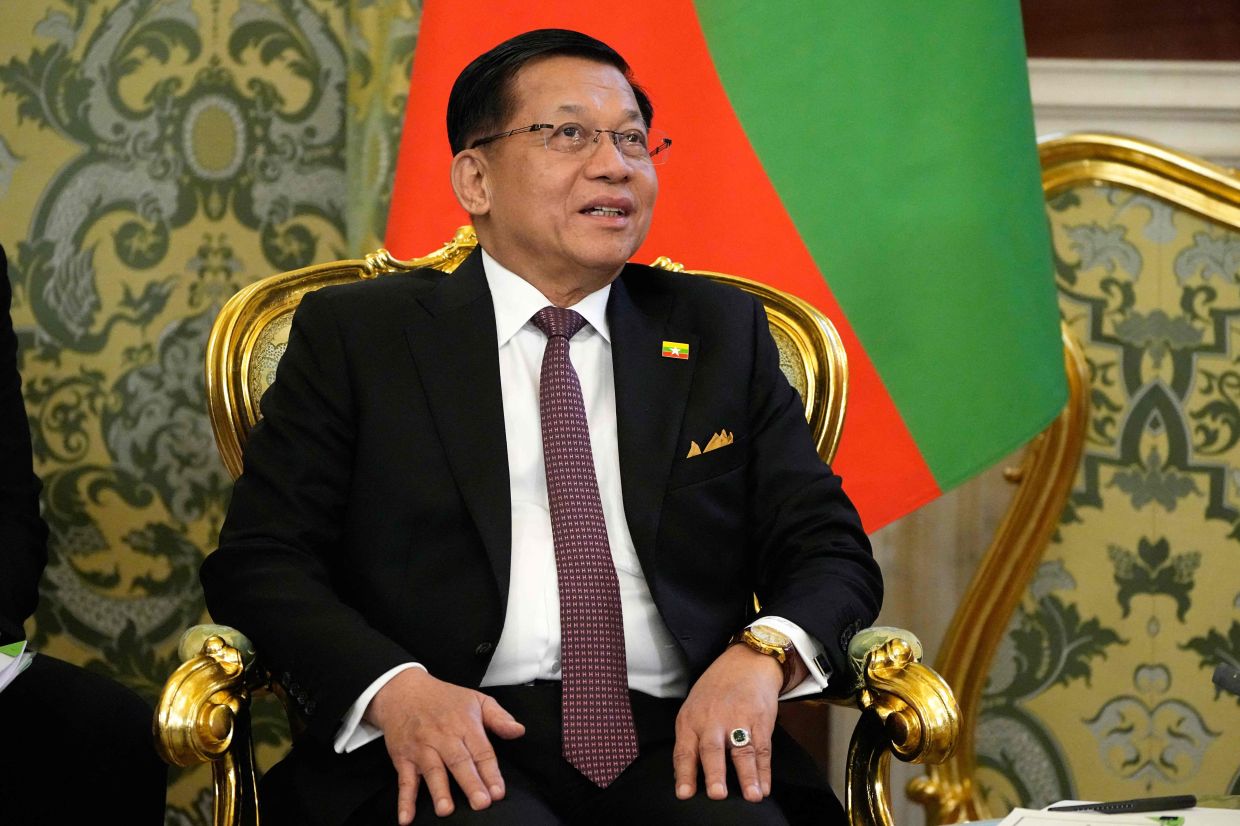
Myanmar's military leader Min Aung Hlaing is set to arrive in Cambodia for an official visit in early September, marking another stop in what observers view as a carefully orchestrated campaign to gain international recognition and legitimacy following his contested hold on power. The visit, confirmed by Cambodia's Senate, will focus on deepening bilateral relations between the two Southeast Asian nations, with Senate spokesperson Chea Thyrith emphasizing that the engagement represents a mutual effort to strengthen friendship and cooperation that serves both countries' interests.
The timing of the Myanmar leader's Cambodia journey follows an established pattern of regional diplomacy. Since his controversial April election—dismissed by international observers and rights groups as fundamentally flawed—Min Aung Hlaing has already visited India, China, Laos, Thailand and Russia in rapid succession. Each expedition has drawn scrutiny from human rights advocates who interpret these foreign tours as deliberate attempts to normalize his rule and circumvent the international isolation that has followed Myanmar's military takeover in February 2021, which deposed civilian leader Aung San Suu Kyi and plunged the nation into political turmoil.
The substance of Min Aung Hlaing's diplomatic offensive cannot be separated from the serious allegations of systemic human rights abuses that have shadowed his tenure. Since the coup, thousands of pro-democracy activists, dissidents and ordinary citizens have been detained by military authorities. The detention of Aung San Suu Kyi herself has become emblematic of the regime's dismissal of democratic norms and international pressure. These actions prompted the Association of Southeast Asian Nations to adopt an unprecedented stance: Myanmar has been excluded from Asean summit meetings, a rare disciplinary measure reflecting deep regional concern about the junta's conduct and its rejection of democratic principles that underpin the regional bloc's Charter.
Kin Phea, president of Cambodia's International Relations Institute, offered nuanced analysis of what the Cambodian visit might signify. He acknowledged that the Myanmar leader's tour of regional capitals serves to buttress his position domestically and internationally, yet he also suggested that Cambodia's willingness to engage reflects a more complex diplomatic calculation. When Cambodia held the Asean chairmanship in 2022, it had attempted to mediate Myanmar's political crisis and facilitate dialogue, demonstrating that engagement rather than isolation was Phnom Penh's preferred approach to the regional crisis. The forthcoming visit can thus be understood as part of a continuation of that strategy, potentially offering Myanmar's military administration a channel to maintain international relations during its isolation from higher-level Asean forums.
However, Phea's analysis also contained important caveats about the limitations of bilateral engagement. He suggested that while countries like Cambodia might receive Myanmar's leader and pursue cooperative initiatives—potentially drawing on Cambodia's own experiences navigating post-conflict reconciliation and nation-building—such bilateral gestures could not substitute for genuine progress within Myanmar itself. External diplomatic recognition, he implied, cannot manufacture legitimacy that lacks foundation in domestic political reform and accountability.
This distinction becomes crucial when considering Asean's formal position on Myanmar's reinstatement. The bloc has established a five-point consensus that sets conditions for Myanmar's return to summit participation, effectively creating a governance benchmark that no individual member state can unilaterally waive. Phea made explicit that whether Cambodia or any other nation receives Min Aung Hlaing officially as a state leader remains a separate matter from Myanmar's status within Asean. The implementation of the five-point consensus, not the diplomatic courtesies extended by individual member states, will determine whether and when Myanmar can resume full participation in regional decision-making forums.
The Myanmar junta's election in April further complicated international perceptions. Held without meaningful opposition participation and widely dismissed as a carefully choreographed exercise in manufactured legitimacy rather than genuine democratic choice, the election demonstrated the regime's determination to establish institutional continuity for military rule rather than facilitate any transition toward civilian governance. That Min Aung Hlaing emerged as the elected president was hardly surprising given the military's control of the electoral apparatus, yet it added another layer to the diplomatic campaign: the junta could now claim not merely military stewardship but formal civilian presidency, however hollow that claim appeared to observers.
Cambodia's Senate confirmed the visit through its institutional apparatus, with Minister of the Royal Palace Kuy Sophal and senior festival organizer Chin Ketna reportedly inspecting venues to receive the Myanmar delegation. The administrative preparations signal that Phnom Penh intends to accord the visit sufficient ceremonial weight and formal recognition, even as questions persist about what tangible outcomes such engagement might produce. The venue selections and protocol arrangements reflect Cambodia's decision to treat the visit as a significant diplomatic occasion rather than a merely routine encounter between neighbors.
For Malaysia and other Southeast Asian nations, the Myanmar situation presents enduring complexity. The region faces genuine dilemmas in balancing its commitment to non-interference in member states' internal affairs against its Charter-based principles regarding democracy and human rights. Myanmar's military-led government represents neither a temporary crisis likely to resolve quickly nor a situation amenable to simple solutions. Min Aung Hlaing's diplomatic tour, while seeking to portray international normalcy, cannot alter the fundamental reality that his regime maintains power through repression rather than consent, that thousands remain imprisoned for political reasons, and that fundamental questions about Myanmar's democratic future remain unresolved.
The Cambodia visit will likely be among the most consequential stops on Min Aung Hlaing's regional tour because of Cambodia's traditional diplomatic positioning within Asean and its stated commitment to Myanmar engagement. Yet regardless of how successfully the visit proceeds at ceremonial or bilateral levels, it operates within constraints established by regional consensus. The junta leader's efforts to accumulate international legitimacy through bilateral relations cannot overcome the structural isolation Asean has imposed through the five-point consensus mechanism, which remains the decisive framework for determining Myanmar's regional standing and future.
As Myanmar's political crisis extends into its fourth year, with no clear pathway toward reconciliation or democratic transition visible, the question of how regional nations should engage with the military regime remains unresolved. Cambodia's approach—maintaining diplomatic channels while acknowledging that genuine progress requires Myanmar's internal transformation—reflects the difficult balancing act confronting all Asean members. The September visit will demonstrate whether such engagement can contribute to constructive dialogue or merely provides the junta with the international legitimacy it actively seeks without requiring corresponding commitments to substantive political change.

