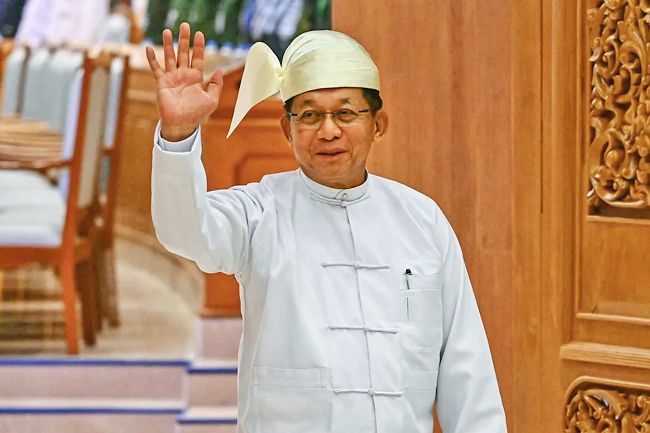
Myanmar's military leader Min Aung Hlaing is set to visit Thailand next month for high-level talks with Prime Minister Anutin Charnvirakul on August 6 and 7 in Bangkok. Thailand's Foreign Minister Sihasak Phuangketkeow disclosed the planned meeting to international media on Tuesday, confirming the visit comes as Southeast Asia's regional bloc deliberates on how to re-engage with Naypyidaw following the junta's 2021 seizure of power.
The announcement reflects mounting diplomatic activity around Myanmar's isolation from the Association of Southeast Asian Nations' mainstream forums. Although Myanmar technically retains its seat within ASEAN, it has been barred from participating in the organization's most significant gatherings since the military toppled Aung San Suu Kyi's democratically elected government three years ago. This suspension has created considerable tension within the ten-member bloc, with member states split over whether engagement or pressure offers the better path toward Myanmar's political transition.
Thailand's proactive stance on Myanmar engagement stems from acute geopolitical pressures unique to Bangkok's position. Sharing an extensive border with Myanmar and hosting substantial refugee populations fleeing the country's deteriorating security situation, Thailand faces immediate humanitarian and stability concerns that other ASEAN capitals do not experience with the same intensity. Bangkok's advocacy for reintegrating Myanmar has exposed fundamental disagreements among member states about how the bloc should respond to military coups and democratic backsliding within its ranks.
During regional consultations in Manila this week, Sihasak characterized discussions among ASEAN foreign ministers as "frank and candid," a diplomatic formulation suggesting substantive disagreement rather than consensus. The conversation centered on determining realistic benchmarks for Myanmar's rehabilitation within ASEAN's framework. Rather than insisting on immediate compliance with established conditions, Sihasak outlined a gradualist philosophy that acknowledges the complexity of Myanmar's internal political environment and the limited leverage available to external actors.
Thailand's approach combines bilateral engagement with Myanmar on practical matters alongside broader diplomatic objectives. Sihasak identified transnational crime, cybercrime scams, and narcotics trafficking as pressing issues requiring direct Thailand-Myanmar cooperation. These concerns have intensified as criminal networks exploit Myanmar's state fragility to operate across borders, creating public security challenges that affect Thailand's own domestic stability. The bilateral dimension of the Bangkok visit therefore addresses immediate shared threats rather than serving purely as a vehicle for regional reintegration.
However, Sihasak explicitly rejected characterizations that Thailand's bilateral engagement abandons ASEAN's established diplomatic framework. The bloc has maintained a five-point peace plan since 2021, which includes halting violence, initiating constructive dialogue with Myanmar's armed forces and opposition groups, allowing humanitarian assistance, and ensuring ASEAN special envoy access to all relevant parties. Thailand's "dual-track approach" attempts to maintain adherence to these principles while simultaneously pursuing practical progress through bilateral channels that might unlock incremental movement where multilateral pressure has stalled.
A central challenge in measuring progress toward Myanmar's reintegration involves determining what concrete improvements would justify the junta's return to ASEAN's main forums. Sihasak posed questions to ASEAN colleagues about whether allowing the special envoy access to detained civilian leader Suu Kyi would constitute meaningful progress, or whether reducing violence along the Thai-Myanmar border would signal political movement. These markers reflect Myanmar's vast gaps between international expectations and current junta behavior, highlighting the difficulty of establishing mutually acceptable performance metrics.
Sihasak's emphasis on realistic timelines acknowledges Myanmar's entrenched political deadlock. The military's recent elections, heavily restricted and widely dismissed as fraudulent, installed Min Aung Hlaing as president while maintaining junta control over governance. Sihasak nevertheless expressed hope that even these limited electoral processes might facilitate future dialogue with armed ethnic groups and Myanmar's democratic opposition forces. Thailand's strategy implicitly accepts that Myanmar's transition will unfold incrementally through multiple overlapping conversations rather than through dramatic institutional transformations.
Thailand's role as facilitator extends to potential mediation with ethnic armed organizations positioned along the Thai-Myanmar border. By hosting refugee populations and maintaining relationships with cross-border communities, Thailand possesses diplomatic assets and cultural understanding that other ASEAN members lack. Sihasak suggested Thailand could help catalyze discussions between the junta and ethnic groups, framing such dialogue as foundational building blocks for broader Myanmar political settlement. This approach distributes the diplomatic burden across multiple channels rather than relying solely on ASEAN's formal structures.
The regional debate over Myanmar engagement has prompted consideration of structural reforms to ASEAN's own mechanisms. Philippine Foreign Minister Theresa Lazaro indicated the bloc is evaluating the appointment of a permanent, long-term special envoy to Myanmar, replacing the existing annual rotation system that has failed to generate sustained diplomatic momentum. This potential institutional change suggests ASEAN members increasingly recognize that Myanmar's complexity demands continuous specialized attention rather than periodic oversight.
Thailand's diplomatic initiative ultimately reflects the tension between ASEAN's traditional non-interference principle and members' recognition that Myanmar's internal crisis carries cross-border consequences. Bangkok's engagement strategy does not represent abandonment of pressure for democratic restoration but rather an argument that isolation has proven ineffective. Whether this measured approach can build consensus within ASEAN or deepen divisions among members remains uncertain, but the Bangkok visit signals that diplomatic channels with Myanmar's junta will remain open regardless of broader bloc positions.

