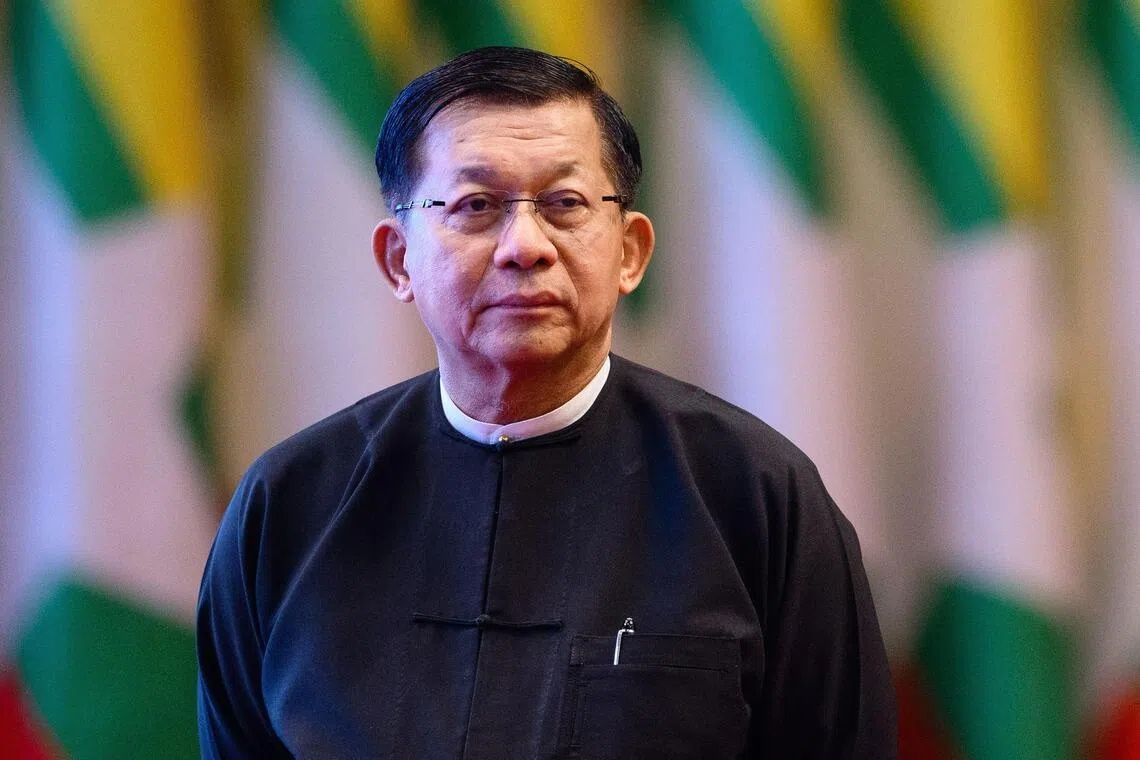
Myanmar's ex-junta chief Min Aung Hlaing is expected to land in Thailand on Thursday for what marks his first official visit to a neighbouring country since shedding his military title and transitioning to civilian leadership. The visit signals an intensifying diplomatic campaign by Myanmar's military-dominated government to claw back international legitimacy and secure readmission to the inner circles of the Association of Southeast Asian Nations, a bloc that has kept Yangon's leadership at arm's length since the controversial 2021 putsch.
Min Aung Hlaing orchestrated the military takeover that unseated democratically elected leader Aung San Suu Kyi, unleashing a cascade of violence that has devastated Myanmar over the past three years. The conflict has fractured along multiple fault lines, pitting the armed forces against a sprawling coalition of armed resistance groups, ethnic militias, and civilian defence forces spread across the country's regions. Casualty figures from independent monitors suggest that more than 100,000 people have perished in the fighting, though precise accounting remains difficult given the fragmented nature of the conflict and ongoing security challenges. The turmoil has also displaced vast populations and triggered a humanitarian catastrophe affecting basic services, food security, and livelihood opportunities across Myanmar's population.
To consolidate power and create a veneer of democratic legitimacy, the junta orchestrated stage-managed elections in 2024 that resulted in Min Aung Hlaing's appointment as president. Democracy monitoring organisations and governments in the West dismissed these elections as a theatrical exercise designed to rebrand military rule as civilian governance while maintaining actual control. The transition from fatigues to formal business attire has been the most visible marker of this repackaging effort, though substantive power structures remain unchanged.
Thailand has emerged as Myanmar's most active champion within Southeast Asia, spearheading bilateral engagement and championing normalisation efforts through Asean channels. Bangkok's motivations are rooted in practical regional concerns that transcend ideological positioning or judgments about democratic governance. The long, porous border between the two countries has become a flashpoint where Myanmar's internal armed conflicts increasingly spill into Thai territory, destabilising border communities and straining Thai security resources. Thailand currently harbours approximately two million refugees and migrant workers from Myanmar, a burden that creates social, economic, and administrative pressures on border provinces and urban centres.
Beyond refugee flows, Thailand faces mounting criminal challenges originating from Myanmar's ungoverned spaces. Transnational scam networks operating from lawless territories in Myanmar have become a serious regional security concern, with thousands of victims across Southeast Asia and beyond losing substantial sums to sophisticated online fraud operations. Parallel to this, Myanmar's borderlands have evolved into major transit zones for illicit narcotics destined for regional markets, with drug trafficking organisations exploiting the security vacuum to move product through Thai territory. From Bangkok's perspective, restoring functional diplomatic relations and channeling Min Aung Hlaing through state mechanisms offers potential leverage to pressure Myanmar authorities into cooperation on these security issues.
Thailand's Foreign Minister Sihasak Phuangketkeow signalled in recent comments that cybercrime would feature prominently in Thursday's discussions, framing the conversation not as a confrontation but as a mutual problem requiring coordinated solutions. The diplomat's public welcome for Aung San Suu Kyi's recent meeting with International Committee of the Red Cross representatives—her first confirmed contact with a foreign official since her detention—suggests Thailand is attempting to balance its pragmatic engagement with Min Aung Hlaing against international concerns about human rights and political detention in Myanmar.
Min Aung Hlaing has embarked on an ambitious regional tour since transitioning to civilian leadership, with stops in India, China, and Laos already completed before the Thailand visit. These journeys reflect a calculated strategy to accumulate diplomatic legitimacy through bilateral engagements, preparing the ground for Myanmar's reinclusion in high-level Asean forums from which the country has been sidelined. Asean maintains formal protocols excluding Myanmar's leadership from summits and ministerial meetings, though lower-level engagement has resumed incrementally. Myanmar's foreign minister attended an informal gathering with regional counterparts in Thailand last month, signalling a gradual thawing of the bloc's unified stance.
However, the junta's approach to Asean's collective peace framework reveals fundamental contradictions that analysts interpret as a zero-sum negotiating posture. Min Aung Hlaing's government has consistently rejected the five-point consensus, a framework that Asean members agreed upon to address Myanmar's crisis through inclusive dialogue involving all parties to the conflict. This refusal to engage with the bloc's structured peace mechanism—even while pursuing diplomatic rehabilitation—exposes the hollowness of Myanmar's claims to regional responsibility. According to independent analyst David Mathieson, this paradox reflects Min Aung Hlaing's primary objective: securing international recognition and status restoration while maintaining unfettered military control domestically and resisting external pressure for political compromise.
During Thursday's Bangkok engagement, Min Aung Hlaing will receive formal honours typically accorded to visiting heads of state, including an honour guard ceremony at Government House and a one-on-one meeting with Thai Prime Minister Anutin Charnvirakul. The visit's official programme includes a business forum and state dinner, underlining Thailand's intention to frame the engagement as normal interstate relations. The two governments are expected to sign a memorandum of understanding on labour cooperation, reflecting Thailand's substantial economic interests in cross-border workforce mobility and remittance flows that benefit both economies.
Yet the visit remains contentious. Critics and human rights advocates argue that Thailand is inappropriately rehabilitating a leader who faces serious accountability challenges on the international stage. Min Aung Hlaing has been sanctioned by multiple Western governments and carries an International Criminal Court arrest warrant for crimes against humanity and war crimes allegedly committed during military operations against civilian populations. Advocacy groups such as Justice For Myanmar contend that diplomatic normalisation without accountability mechanisms amounts to rewarding criminality and abandoning victims seeking justice.
The tension between regional pragmatism and international justice norms reflects broader geopolitical dynamics in Southeast Asia, where countries balance neighbouring relations against global human rights standards. Thailand's approach—engaging Min Aung Hlaing to address immediate security challenges while tacitly acknowledging concerns through gestures toward detained leaders—represents a middle path that prioritises regional stability over principled stands on governance. For Malaysia and other Asean members watching these developments, the Thailand-Myanmar rapprochement signals that economic and security considerations will likely outweigh broader democratic concerns in shaping the bloc's Myanmar policy, a trajectory that carries implications for how Asean approaches future political crises among its members.

