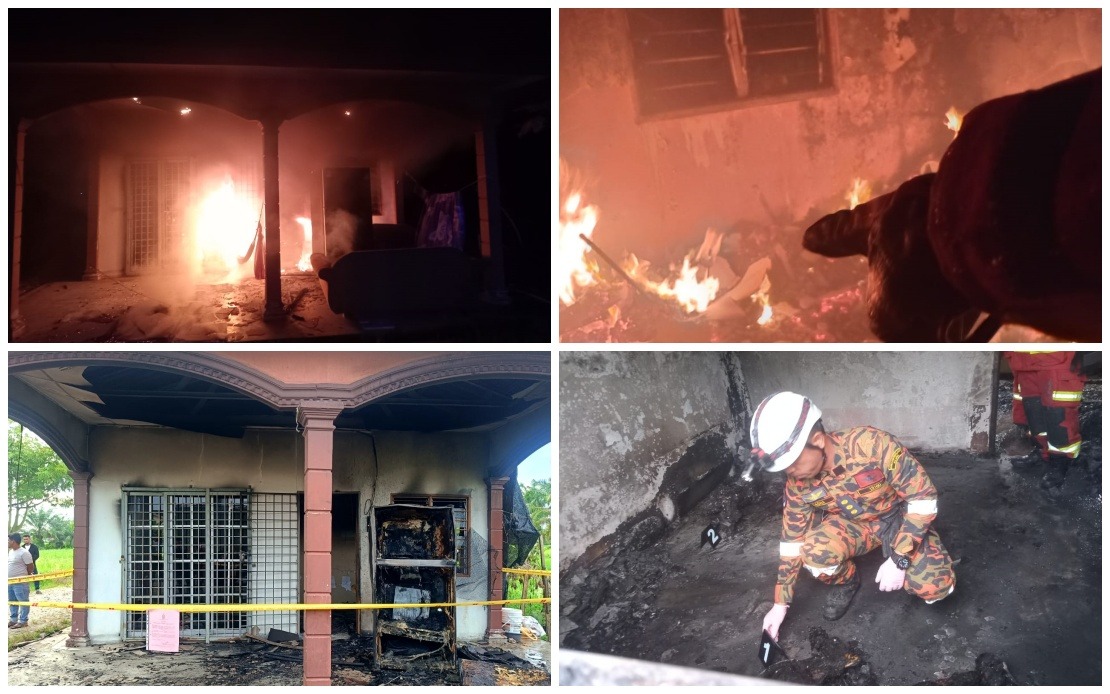
A tragedy unfolded in Perak on Friday morning when a house fire claimed the lives of three members of a Myanmar refugee family in Taman Serai Maju, Bagan Serai. The victims—identified as Mohd Yunus Nor Ali, 27, and his two young sons Muhammad Woheed Mohd Yunus, 6, and Mohamad Aheed Mohd Yunus, 3—were found in the burning structure after emergency responders arrived at the scene. His wife, Saniya Jahan Juma Abul Kasim, 24, also a Myanmar refugee, managed to escape the blaze but sustained burns to her hands and feet.
The Perak Fire and Rescue Department received the emergency call at 5:17 am on the 999 line, with the first vehicle reaching the residential location at 5:30 am. Upon arrival, firefighters discovered a Class A house measuring 20 feet by 40 feet that was engulfed in flames, with approximately 70 per cent of the structure damaged. The property was home to seven foreign nationals at the time of the incident, adding complexity to the emergency response.
According to Perak Fire and Rescue Department director Datuk Sayani Saidon, Saniya was found outside the house and immediately informed responders that her husband and two children remained trapped inside. This critical information guided the subsequent search and rescue efforts. The fire and rescue team deployed the RECEO concept—a standard operational procedure encompassing rescue, extinguish, confine, overhaul, and operations—to systematically search the burning structure and locate victims.
The search proved tragically unsuccessful in saving the three male family members. All three victims were discovered in the first room where the fire had originated, and medical officers from the Ministry of Health who responded to the scene pronounced them deceased at the location. The loss represents a devastating blow to the refugee family, highlighting the vulnerabilities that displaced populations often face when living in makeshift or substandard housing arrangements.
Meanwhile, Saniya received immediate medical treatment at the scene before being transported to hospital via the Emergency Medical Rescue Services vehicle. Her condition, while serious with burns injuries, was stabilised enough for hospital transfer. The injured woman remains a crucial witness to the incident, and her account may prove essential in understanding how the fire started and what circumstances prevented the family from escaping together.
Firefighters successfully brought the blaze under control by 6:20 am, with the entire operation concluding by 7:35 am. The deceased victims were subsequently handed over to the Royal Malaysia Police for formal procedures and further investigation. Authorities are treating the incident as a matter requiring thorough examination, given both the loss of life and the need to establish preventative measures for future fire safety in similar residential situations.
The preliminary investigation conducted by the Perak Fire and Rescue Department's forensic team indicates that the fire originated in the first room where the victims were ultimately discovered. However, the precise cause of ignition remains under active investigation, with researchers examining potential sources ranging from electrical faults to cooking accidents or other ignition points. Determining the exact cause is critical not only for closure for the bereaved but also for understanding whether the incident was preventable through better safety practices or structural improvements.
This tragedy underscores ongoing concerns about the living conditions and fire safety standards in accommodations housing refugee and migrant populations across Malaysia. While Malaysia hosts significant refugee communities, particularly those fleeing Myanmar and other conflict zones, housing arrangements are often cramped and may lack proper fire safety infrastructure such as smoke detectors, fire extinguishers, or clearly marked emergency exits. The concentration of seven foreign nationals in a single residential property suggests the economic pressures that force displaced families to share limited resources and space.
The incident also raises questions about building inspections and enforcement of safety regulations for properties housing refugees and migrant workers. Many such individuals, already vulnerable due to their legal status and limited resources, may be unable to advocate for safer living conditions or report hazardous situations to authorities. Language barriers, unfamiliarity with Malaysian regulations, and fear of legal complications can all contribute to acceptance of substandard housing arrangements that increase fire risk and other safety hazards.
For the broader refugee community in Perak and across Malaysia, this incident serves as a sobering reminder of the precarious nature of displacement. Beyond the immediate tragedy, the loss of a primary breadwinner and two young children will likely have severe consequences for Saniya's survival and access to support networks. Refugee families typically rely on tight community ties and collective resources, making the death of working-age members particularly catastrophic for remaining family members.
Authorities are expected to complete their comprehensive investigation in coming weeks, which may include interviews with Saniya once her medical condition permits, examination of the property's structural integrity and electrical systems, and consultation with neighbours who may have observed events leading up to the fire. The findings could inform recommendations for improved fire safety protocols in accommodations housing vulnerable populations, though implementation of such measures requires coordination between fire departments, local councils, housing authorities, and community organisations serving refugee populations.
The incident highlights the need for enhanced awareness campaigns about fire safety targeting non-Malay-speaking communities, as well as the importance of ensuring that residential properties meet minimum safety standards regardless of occupants' immigration status. Moving forward, there may be calls for specialist support programmes to help refugee families access safer housing and understand fire prevention measures in their native languages.

