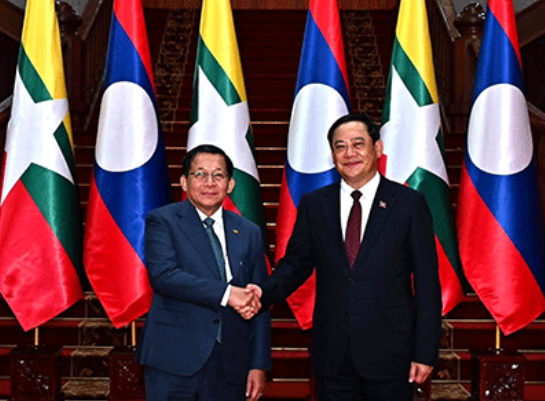
Myanmar President Min Aung Hlaing's three-day state visit to Laos this week underscored the enduring diplomatic partnership between two Southeast Asian neighbours, as both nations committed to elevating their strategic engagement across defence, economic and cultural domains. The visit, which commenced on July 3 at the invitation of Lao President Thongloun Sisoulith, coincided with commemorations of 70 years of formal relations, a milestone that symbolises the longevity and resilience of ties forged during the post-independence era.
The Myanmar leader arrived with his wife and a substantial high-level delegation, signalling the importance placed on reinvigorating bilateral bonds that have historically centred on shared Buddhist heritage, similar development challenges, and complementary positions within regional architecture. At a full-honours state ceremony held at the Presidential Palace in Vientiane, the Lao leadership extended a warm reception, with President Thongloun characterising the engagement as a pivotal moment for deepening friendship and cooperation accumulated over more than seventy years of interaction.
During formal bilateral talks, both presidents reviewed the breadth of existing cooperation frameworks and identified strategic priorities for the coming years. The discussions reflected mutual satisfaction with progress achieved across multiple sectors, particularly in political coordination, which the two sides credited to consistent high-level exchanges and a foundation of trust. President Thongloun took the occasion to congratulate Myanmar on its electoral processes and institutional transitions, expressing optimism that the country would advance under President Min Aung Hlaing's stewardship, a gesture reflecting Laos's diplomatic recognition of Myanmar's domestic political developments.
The security dimension emerged as a focal point in the expanded agenda, with both nations agreeing to fortify border management protocols, intensify intelligence sharing, and coordinate responses to transnational challenges. This emphasis on defence and security cooperation reflects broader anxieties across mainland Southeast Asia regarding cross-border crime, illicit drug trafficking, and resource scarcity. By institutionalising cooperation mechanisms in these areas, Laos and Myanmar are positioning themselves to address vulnerabilities that threaten stability in one of the region's most geographically complex zones.
Trade and investment featured prominently in the discussions, with leaders acknowledging that economic interdependence remains underdeveloped relative to political ties. Both nations committed to encouraging their respective private sectors and government agencies to identify fresh opportunities for commerce and capital flows. Energy cooperation, particularly in hydropower and emerging renewable technologies, represents an especially promising avenue, given Laos's abundance of water resources and Myanmar's growing energy demand. Transport infrastructure enhancement, including improved road and rail connectivity, could facilitate deeper regional integration and reduce Myanmar's dependence on maritime routes through congested Southeast Asian straits.
The two prime ministers, Sonexay Siphandone of Laos and his Myanmar counterpart, convened separately to discuss operational mechanisms for translating political commitments into tangible benefits for citizens. Prime Minister Sonexay underscored that the presidential visit would consolidate the friendship and neighbourly relations that define the bilateral equation. The parallel engagement of parliamentary leadership further institutionalised the relationship, with Lao National Assembly President Xaysomphone Phomvihane emphasising that Laos was the first Asean member state to receive President Min Aung Hlaing since his assumption of office, a distinction that reinforces the strategic weight both countries attach to their partnership.
Parliamentary cooperation agreements represent a significant development, as they create oversight mechanisms for bilateral accords and ensure legislative bodies monitor implementation of memorandums of understanding. This institutional embedding of bilateral commitments reduces the risk of agreements remaining symbolic rather than operationalised. Xaysomphone pledged that the Lao National Assembly would provide legislative support and scrutiny to guarantee that signed documents generate practical outcomes, particularly in trade, investment and economic cooperation where parliamentary coordination can address regulatory harmonisation and private sector facilitation.
Tangible outcomes from the visit included the signing of two memorandums of understanding: one establishing tourism cooperation between Laos's Ministry of Culture and Tourism and Myanmar's Ministry of Hotels, Tourism and Culture, and another designating Vientiane and Naypyidaw as friendship cities. The tourism accord carries significance for Southeast Asia's broader travel recovery, as both nations seek to diversify visitor sources and develop niche tourism products rooted in Buddhist heritage and cultural authenticity. The friendship city arrangement, meanwhile, provides a people-to-people dimension to state-level relations, fostering cultural exchanges, municipal partnerships, and educational linkages that can sustain goodwill across generations.
A symbolic gesture highlighting shared public health priorities occurred when Myanmar handed over snake antivenom serum supplies to Laos's Ministry of Health, addressing a practical medical need in rural regions where snake envenomation remains a persistent occupational hazard. This transfer exemplifies how bilateral cooperation can address unglamorous but vital humanitarian dimensions of neighbourly relations. Concurrently, President Min Aung Hlaing participated in traditional ceremonies, including laying wreaths at Vientiane's Unknown Soldier Monument and attending a Baci blessing ceremony, acts demonstrating respect for Lao national symbols and Buddhist spiritual practices.
The scheduled extension of the visit to Luang Prabang, a UNESCO World Heritage site famed for its temples and cultural landmarks, underscores tourism promotion objectives and provides the Myanmar delegation with exposure to Laos's cultural riches. Such cultural immersion often softens diplomatic proceedings and creates informal channels of communication that prove valuable during future negotiations. The visit's timing also carries significance within the context of regional geopolitics, particularly given Myanmar's complex relationship with Western governments following its 2021 military intervention and Laos's long-standing alignment with China and Russia, positions that have drawn both nations into an alternative geopolitical orbit within Southeast Asia.
For Malaysian observers, the Laos-Myanmar rapprochement illustrates broader patterns of intra-Asean diplomatic deepening that may influence collective regional decision-making. When smaller member states like Laos strengthen partnerships with peers like Myanmar, they potentially reinforce blocs within Asean that shape consensus-building on contentious issues ranging from the South China Sea to Myanmar's internal affairs. The emphasis on Mekong-Lancang Cooperation frameworks and United Nations engagement also signals that both nations are calibrating their multilateral engagement to balance Chinese-led initiatives with traditional international organisation participation.
The cooperation agreements and institutional mechanisms established during this visit establish foundations for sustained engagement that transcends individual leaders or political cycles. By formalising arrangements through parliamentary oversight, joint committees, and sector-specific cooperation protocols, Laos and Myanmar are institutionalising their partnership in ways that create momentum independent of diplomatic vicissitudes. For Malaysian policymakers and regional observers, this visit demonstrates how neighbouring states construct resilient partnerships through consistent engagement, mutual respect for sovereignty, and pragmatic identification of shared interests—lessons potentially applicable to resolving maritime disputes and strengthening Asean cohesion.

