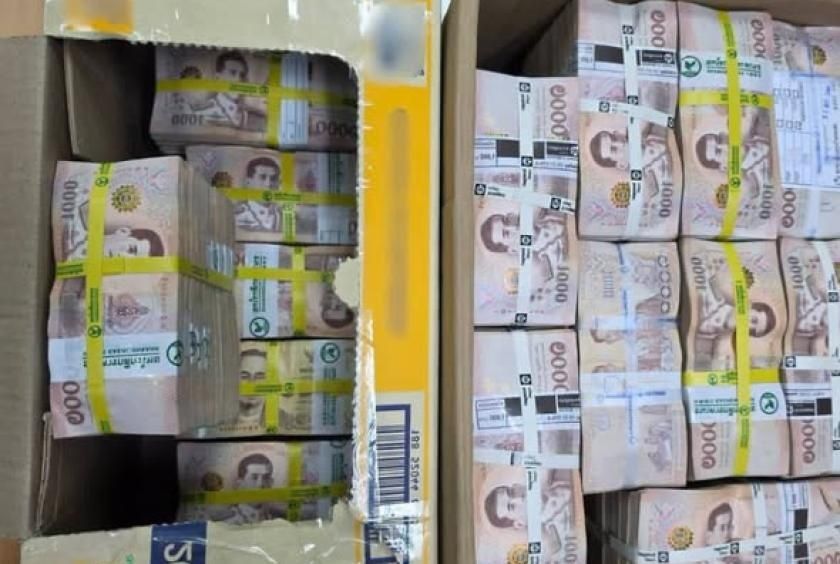
Thai border officials apprehended a Myanmar national this week at the Mae Sai Friendship Bridge after discovering he was transporting more than 23 million baht in undeclared currency. The arrest highlights ongoing concerns about money movement across the region's porous borders and underscores the challenges customs agencies face in detecting sophisticated smuggling attempts even at official checkpoints.
The incident occurred when customs officers stationed at the Thai side of the Mae Sai crossing inspected a vehicle displaying Myanmar registration plates. During a routine screening procedure, inspectors noticed unusual packaging within the vehicle and decided to conduct a thorough examination of the contents. This decision proved crucial in uncovering one of the larger recent seizures of contraband currency at the border.
What made this operation notable was the concealment method employed. Rather than attempting to hide the money in conventional ways, the smuggler had carefully packed bundles of 1,000-baht banknotes inside cartons ostensibly containing dried fish and potatoes. The currency itself was wrapped in plastic bags before being placed within these food boxes, a technique designed to avoid arousing suspicion during preliminary inspections and to potentially mask the presence of the cash from detection equipment.
The volume of currency discovered was substantial. Officials recovered approximately 17 million baht from the first carton and an additional 6.023 million baht from a second box, totalling 23.023 million baht. At current exchange rates, this amounts to roughly US$689,077, representing a significant sum that would have represented either substantial personal wealth or funds intended for larger financial transactions.
The 31-year-old Myanmar driver now faces serious legal consequences. Thai authorities have initiated charges under provisions of Thailand's Customs Act, legislation that carries penalties for attempting to move restricted goods and currency across national boundaries. Additionally, the suspect faces violations of Thailand's foreign exchange control regulations, which strictly govern the movement of Thai baht into and out of the country. Such regulations exist partly to prevent capital flight and to maintain stability in Thailand's currency markets.
The Mae Sai checkpoint, located in Chiang Rai province in northern Thailand, is one of the busiest cross-border points in the region. The Friendship Bridge itself symbolizes the trade and people-to-people connections between Thailand and Myanmar, yet it remains a critical enforcement point where authorities must balance facilitating legitimate commerce and travel with intercepting illegal movements of goods and money. The volume of daily traffic through this corridor makes detection of contraband a persistent challenge.
This seizure reflects broader regional concerns about illicit financial flows. Myanmar's political instability since the 2021 military coup has created conditions where individuals and organizations seek to move assets across borders, either to secure wealth or to finance various activities. The substantial amount involved suggests this may have been part of a larger scheme rather than an isolated incident. Thai investigators are now pursuing leads to identify whether the driver was merely a courier for more substantial operations or whether he held greater involvement in the smuggling network.
The investigation's next phase involves determining the source and intended destination of the funds. Authorities must establish whether the money originated from legitimate Myanmar sources or whether it was connected to illicit activities. Similarly, tracing where the funds were ultimately headed will help investigators understand the scope and purpose of the smuggling operation. Such connected networks often involve multiple players across different jurisdictions.
For Malaysia and other Southeast Asian nations, this case underscores the persistent vulnerability of border checkpoints despite modern technology and trained personnel. Smugglers continuously develop new concealment methods and exploit gaps in inspection procedures. The use of food packaging to hide currency demonstrates the creativity criminals employ. This incident serves as a reminder that comprehensive border security requires consistent vigilance, well-resourced customs agencies, and effective intelligence sharing among regional partners.
The arrest also raises questions about the broader context of financial crime in the region. The illegal movement of large sums across borders can facilitate money laundering, terrorism financing, and other serious crimes. Effective detection and prosecution of such cases form an essential component of national security frameworks across Southeast Asia. Thailand's efforts in this instance demonstrate the importance of trained customs personnel and proper inspection protocols.
Suspect detention at Mae Sai Police Station will continue during the investigation. Thai authorities have indicated they are actively pursuing leads to identify accomplices or organizers of the smuggling attempt. The case highlights how international cooperation and information sharing become crucial when investigating cross-border criminal activities, particularly in regions where organized smuggling networks operate with sophistication and resources.

