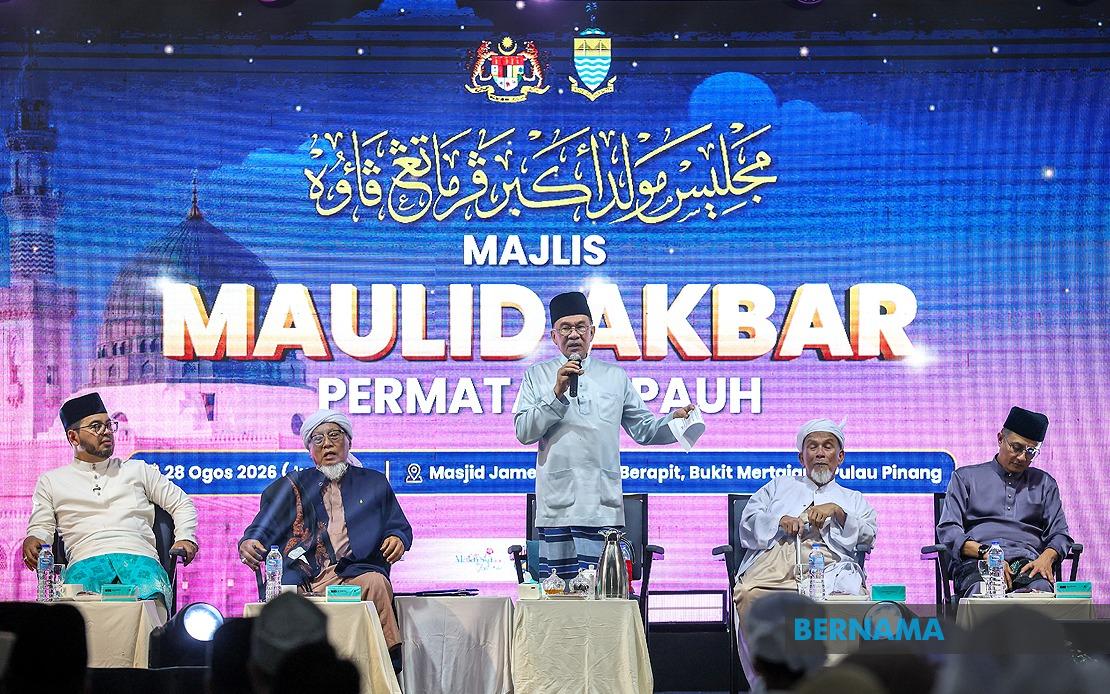
Prime Minister Datuk Seri Anwar Ibrahim has called on Muslim communities to become torchbearers of ethical conduct and moral excellence, arguing that societal respect flows naturally from individuals who embody virtue in their everyday actions. Speaking at a Maulid Akbar ceremony coinciding with National Day festivities at Masjid Tengah in Bukit Mertajam on August 28, Anwar stressed that Muslims cannot expect admiration or confidence from society based merely on religious identity, but rather must demonstrate it through tangible demonstrations of character, hard work and trustworthiness.
The Prime Minister articulated a vision where Muslim conduct serves as a living testament to Islamic values, suggesting that the community's standing in Malaysian society depends fundamentally on how individuals present themselves in professional and personal spheres. He emphasized that observing someone working industriously, fulfilling commitments reliably, avoiding deceptive practices and refraining from financial misdeeds creates an organic foundation for respect that transcends religious boundaries. This framing represents a departure from performative religiosity toward what Anwar characterizes as authentic Islamic practice rooted in behavioral integrity.
Anwar's remarks underscore a broader philosophy guiding his administration's approach to governance and national development. He positioned Islam not as a set of ritualistic requirements but as a comprehensive ethical framework promoting compassion and benevolence toward all people, irrespective of their religious background or ethnicity. This inclusive interpretation carries particular significance for Malaysia's multicultural context, where such messaging from the country's chief executive carries weight in shaping intercommunal relations and establishing benchmarks for public sector conduct.
Central to Anwar's thesis is the notion that material advancement and religious fulfillment are not mutually exclusive but rather interdependent elements of a balanced existence. He articulated the necessity for Muslims to cultivate intellectual growth alongside spiritual development, to pursue economic prosperity without abandoning ethical moorings, and to harness technological capabilities while remaining anchored to foundational values. This holistic conception reflects contemporary challenges facing developing nations attempting to modernize without sacrificing cultural or moral coherence.
The Prime Minister specifically referenced Malaysia MADANI, the government's overarching development framework, as a vehicle that cannot succeed through policy mechanisms and economic metrics alone. Instead, he contended that sustainable national progress requires a robust moral superstructure comprising faith-based principles, character development and ethical consistency. The metaphor he employed—of reaching toward the sky while remaining rooted to earth—encapsulates the tension between aspiration and authenticity that many societies grapple with during rapid transformation.
Anwar also highlighted the instrumental role of Islamic scholars in fostering this ethical environment, appealing to religious leaders to provide counsel grounded in constructive principle rather than divisive rhetoric. This acknowledgment of scholarly influence reflects recognition that intellectual and spiritual authorities wield considerable sway over public sentiment and behavioral norms within Muslim-majority communities. By inviting dialogue between political and religious leadership, the Prime Minister sought to create pathways for alignment between governance objectives and faith-based guidance systems.
The presence of Dr Zulkifli Hasan, Minister in the Prime Minister's Department overseeing Religious Affairs, at the gathering underscored governmental commitment to integrating religious considerations into policymaking processes. This institutional presence signals that moral and spiritual dimensions are not peripheral to developmental planning but constitute essential infrastructure for the Malaysia MADANI agenda. The configuration of these political figures at a religiously significant event reflects deliberate positioning of the administration as responsive to faith-based constituencies while maintaining secular constitutional frameworks.
Anwar's emphasis on rejecting corruption and wrongdoing carries particular resonance given Malaysia's ongoing struggles with institutional integrity and public sector accountability. By framing anti-corruption efforts through moral and religious vocabulary rather than purely legalistic language, the Prime Minister appealed to intrinsic motivations and faith-based imperatives. This approach acknowledges that regulatory frameworks alone prove insufficient to reshape behavioral patterns, requiring instead internalization of ethical principles at individual and community levels.
The timing of these remarks during National Day celebrations signals their patriotic dimension, positioning ethical Muslim conduct as integral to national identity and cohesion. Anwar implicitly argued that Malaysia's success in achieving developed-nation status while maintaining social harmony depends on communities voluntarily embracing high standards of personal conduct and interpersonal responsibility. This framing transforms ethics from a technical governance challenge into a shared national project requiring participation from all segments of society.
For Malaysian readers and regional observers, Anwar's message represents an attempt to navigate complex terrain between religious identity politics, development economics and multicultural governance. By emphasizing that moral leadership emerges from individual action rather than institutional coercion, he outlined a vision where Muslims contribute to national wellbeing through voluntary excellence rather than prescribed compliance. Whether this aspirational framework translates into substantive institutional change remains to be determined, but the rhetorical commitment to integrating ethics into Malaysia MADANI signals recognition that development divorced from values risks creating hollow material progress.

