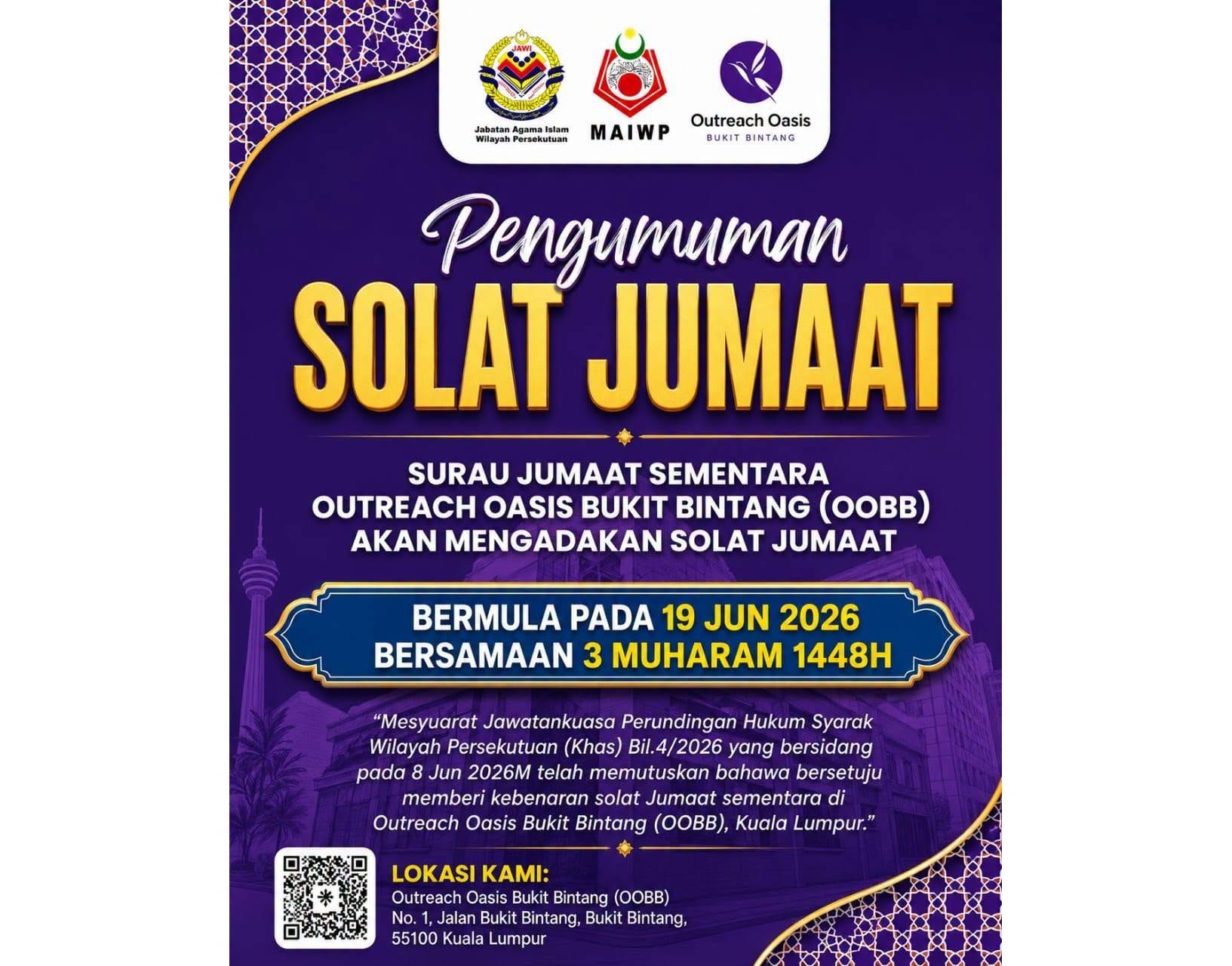
Muslims throughout Kuala Lumpur's Bukit Bintang district have been granted access to Friday prayer facilities at the Bukit Bintang Outreach Oasis, beginning June 19, following special government authorisation. The facility addresses a longstanding gap in religious accommodation within one of the capital's most densely populated commercial and tourism zones, where working professionals and shoppers have previously faced significant inconvenience when seeking to fulfil their weekly congregational prayer obligations.
Dr. Zulkifli Hassan, the Minister in the Prime Minister's Department (Religious Affairs), announced the development through a public statement, emphasising that the temporary arrangement will remain in place until a purpose-built permanent Friday surau is completed at the location. This phased approach acknowledges both the immediate pastoral needs of the Muslim community and the government's longer-term vision for a dedicated, well-appointed prayer facility that can accommodate larger congregations comfortably.
The opening of this interim prayer space represents a practical solution to a challenge that has affected Muslims working or visiting Bukit Bintang, a district that encompasses major shopping malls, restaurants, hotels, and other commercial establishments. Previously, those seeking to perform Friday prayers had limited options, often requiring journeys to more distant prayer facilities or creating significant logistical difficulties within their daily routines. The provision of on-site prayer accommodation demonstrates official recognition of religious diversity within Malaysia's urban commercial landscapes.
Dr. Zulkifli framed the announcement in historical terms, signalling the symbolic importance of expanding Islamic infrastructure in secular retail and hospitality spaces. His reference to the elimination of the need to "rush, race against time, or squeeze through crowds" acknowledges the practical frustrations experienced by Muslim workers and visitors who previously struggled to balance professional commitments with religious observance. This reflects broader conversations within Malaysian society about integrating religious practices seamlessly into modern urban life.
The minister's invitation for the broader Bukit Bintang community—including workers, residents, and regular visitors—to participate in Friday prayers extends beyond mere facility provision. By encouraging attendance as a demonstration of "solidarity" and "Islamic eminence," the government seeks to create a visible and normalised Muslim presence within a predominantly commercial district. This approach suggests confidence that religious observance and commercial activity can coexist harmoniously within the same spaces.
The background to this initiative reveals government engagement with planning for Muslim-majority populations in secular urban environments. Previous reporting indicated that the government had already committed to developing a permanent Friday surau facility in Bukit Bintang, suggesting this interim arrangement accelerates the timeline for providing congregational prayer access while construction of the permanent structure proceeds. The dual-phase approach balances immediate community needs with longer-term infrastructure ambitions.
For Malaysian workers in Kuala Lumpur's commercial heart, the opening carries practical implications. The existence of dedicated prayer space within or near major employment clusters reduces the productivity loss associated with travelling to distant prayer facilities. Professionals who previously might have skipped Friday prayers due to time constraints or logistical challenges now have a feasible option, potentially affecting patterns of religious participation and workplace scheduling across the district.
The initiative also reflects evolving standards for religious accommodation in Malaysian commercial real estate and public spaces. As the country develops more sophisticated urban environments hosting diverse populations with varying religious needs, incorporating prayer facilities into planning becomes an increasingly standard expectation. The Bukit Bintang Outreach Oasis model may establish a precedent for other commercial districts facing similar demands.
The permanent surau, once completed, will represent a more substantial commitment to Muslim infrastructure in the district. The specifications and capacity of this facility, while not yet publicly detailed, will likely reflect lessons learned from the interim arrangement and demonstrate long-term confidence in sustained demand for such facilities. The progression from temporary to permanent status underscores that this is not a provisional experiment but rather a foundational step toward established Islamic institutional presence in central Kuala Lumpur.
Beyond the immediate Bukit Bintang context, this development carries broader significance for Southeast Asia's major commercial cities. As regional economies integrate larger Muslim populations into urban commercial zones, similar initiatives in other countries may follow Malaysia's example of deliberately accommodating congregational worship within secular commercial precincts. The Bukit Bintang project demonstrates that such accommodation can be implemented without disrupting commercial operations or creating infrastructure conflicts.
The special approval required for this arrangement suggests that the process involved coordination across multiple government agencies and possibly private facility owners. Such approvals typically address space allocation, scheduling, maintenance responsibilities, and integration with existing commercial operations. The successful navigation of these bureaucratic requirements positions the Bukit Bintang initiative as a potential model for future applications elsewhere in Malaysia's expanding urban areas.
%22%2F%3E%3C%2Fpattern%3E%3C%2Fdefs%3E%3Crect%20width%3D%22100%25%22%20height%3D%22100%25%22%20fill%3D%22url(%23ph1ap43g)%22%2F%3E%3Crect%20width%3D%22100%25%22%20height%3D%22100%25%22%20fill%3D%22url(%23ph1ap43p)%22%2F%3E%3Ctext%20x%3D%2250%25%22%20y%3D%2250%25%22%20text-anchor%3D%22middle%22%20dominant-baseline%3D%22central%22%20fill%3D%22rgba(255%2C255%2C255%2C0.95)%22%20font-family%3D%22Georgia%2C%20'Times%20New%20Roman'%2C%20serif%22%20font-weight%3D%22700%22%20font-size%3D%22320%22%20letter-spacing%3D%22-0.02em%22%3EMiri%3C%2Ftext%3E%3C%2Fsvg%3E)
%22%2F%3E%3C%2Fpattern%3E%3C%2Fdefs%3E%3Crect%20width%3D%22100%25%22%20height%3D%22100%25%22%20fill%3D%22url(%23ph3qw4bg)%22%2F%3E%3Crect%20width%3D%22100%25%22%20height%3D%22100%25%22%20fill%3D%22url(%23ph3qw4bp)%22%2F%3E%3Ctext%20x%3D%2250%25%22%20y%3D%2250%25%22%20text-anchor%3D%22middle%22%20dominant-baseline%3D%22central%22%20fill%3D%22rgba(255%2C255%2C255%2C0.95)%22%20font-family%3D%22Georgia%2C%20'Times%20New%20Roman'%2C%20serif%22%20font-weight%3D%22700%22%20font-size%3D%22170%22%20letter-spacing%3D%22-0.02em%22%3EMalaysia%3C%2Ftext%3E%3C%2Fsvg%3E)