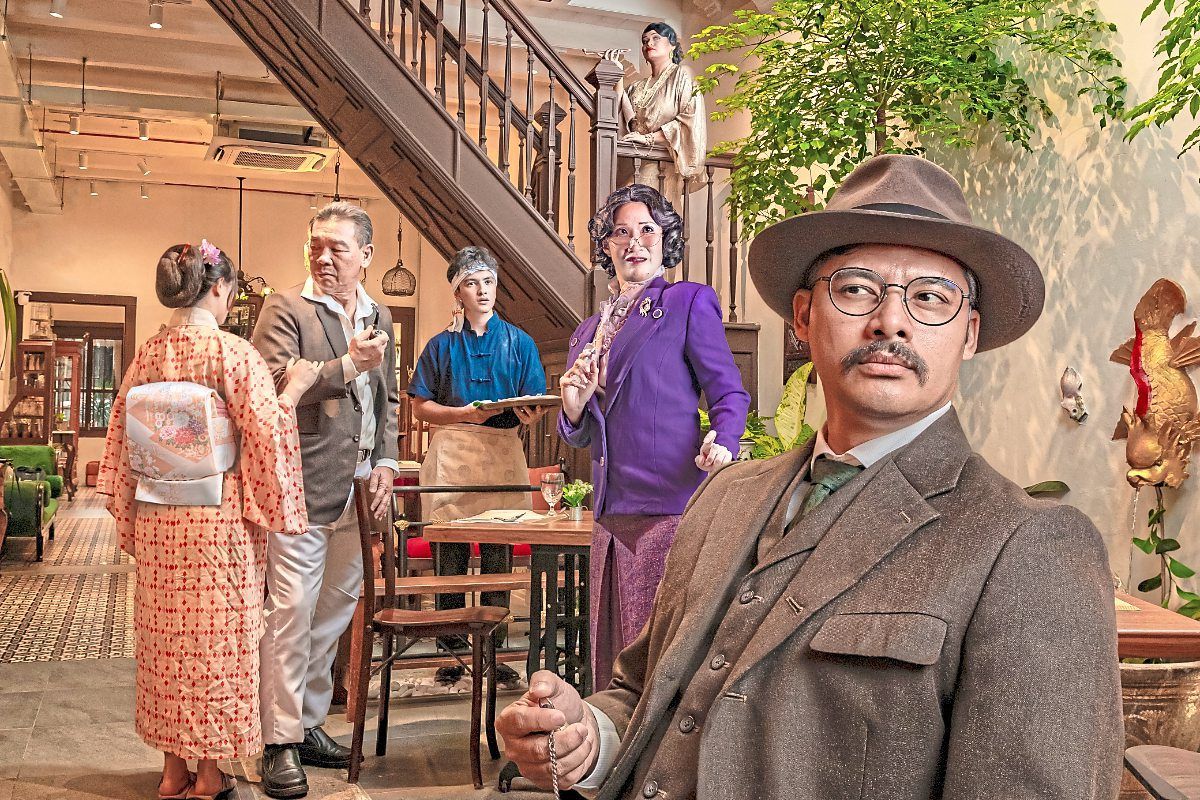
Detective work meets Peranakan cuisine in an ambitious new theatrical venture coming to Melaka this summer. Over four consecutive weekends in July and August, Krate Creative Space is partnering with The Garden@Heeren, a heritage Peranakan establishment located on Jalan Tun Tan Cheng Lock, to present an evening that collapses the boundary between dining, mystery and active audience participation. Rather than sitting passively while a story unfolds on stage, guests will move through the beautifully appointed rooms of the venue, interrogate suspects, hunt for clues and ultimately determine who they believe committed the crime at the heart of the narrative.
The experience is structured around a multi-course Peranakan dinner, with the culinary component integral to the storytelling rather than incidental to it. As courses emerge from the kitchen—pie tee, pongteh chicken, cincalok omelette and other traditional specialities—the mystery deepens, unfolding through character encounters, roleplay moments and the gradual revelation of clues woven into the fabric of the evening. Attendees aged fifteen and above are encouraged to arrive dressed in vintage or Peranakan-inspired clothing, setting the aesthetic tone for an immersion into 1930s colonial intrigue.
The narrative centres on the grand reopening of a meticulously restored restaurant showcasing the culinary talents of the celebrated Chef Fa. What begins as a triumphant celebration rapidly deteriorates when tragedy strikes and a guest is murdered. Fortunately, a detective—portrayed by Francis Augustine—happens to be present and assumes control of the investigation. From that moment, the audience becomes embedded in the story itself, working alongside the detective to examine crime scenes, uncover hidden evidence, interrogate increasingly suspicious characters and eventually present their own verdict about the perpetrator's identity.
The supporting cast, drawn from Krate's pool of experienced performers, includes Sonia Lee as Miss Irene, Lee You Meng as Baba Pang, Elijah Skye as Peter Pang and Neena Shu as Mama Maria. Each character has been crafted to respond dynamically to audience questions and investigations, meaning that no two performances will proceed identically. This variability is a deliberate design choice aimed at making each group's deduction process feel organic and personal rather than scripted.
The production runs for two and a half hours and employs a clever structural innovation: the first two weekends will conclude with one resolution, while the final two weekends present an alternate ending. This dual-narrative approach incentivises return visits, allowing audiences who attend multiple sessions to experience what Krate describes as a fundamentally different mystery, despite sharing the same setting and initial premise. The flexibility extends to audience agency as well; participants can choose whether to remain peripheral observers or thrust themselves into investigative roles that meaningfully shape how events unfold.
Wee, the Melaka-based writer and creative director who has developed all of Krate's interactive productions, articulated the genesis of this project. She had long harboured ambitions to create a murder mystery experience but struggled to identify the right collaborators and venue. The discovery of The Garden@Heeren's heritage architecture and Peranakan aesthetic proved transformative. "A classic heritage house naturally lends itself to mystery, suspense and storytelling," Wee explained, recognizing that the physical space itself becomes a character in the narrative.
Crucially, Wee sought to synthesise theatre with cuisine in a manner that transcended simple dinner accompaniment. By rooting the experience in Melaka's celebrated food culture and transporting audiences backwards nearly a century through multisensory immersion—costume, setting, music, interactions and flavour—she has created something that engages all five senses simultaneously. This approach reflects a broader philosophy about how stories can be told beyond conventional theatrical frameworks, transforming heritage venues into active storytelling instruments.
Krate Creative Space, established in 2016, has positioned itself as Melaka's first independent creative community focused on bespoke, interactive and multidisciplinary live performance. The organisation has mounted over ten original productions and cultivated both a dedicated local following and an expanding regional audience. While approximately half of Krate's patrons originate from Melaka itself, significant numbers journey from the Klang Valley, Penang, Johor and Singapore specifically to attend shows. International tourists seeking experiences that move beyond conventional sightseeing have also begun discovering Krate's offerings, recognising them as gateways to deeper cultural engagement.
The financial and operational realities of operating as an independent theatre company in Malaysia remain challenging, however. To sustain operations, Krate has diversified its revenue streams considerably, moving beyond performance presentation alone. The organisation's creative hub, situated in Bukit Beruang and encompassing rehearsal facilities, studio space and discussion areas, also functions as a café, generating supplementary income while strengthening community ties. This hybrid model reflects pragmatic adaptation rather than artistic compromise, allowing Krate to maintain independence while remaining financially viable in a landscape where institutional arts funding remains limited.
Wee's vision extends considerably beyond individual productions. She envisions immersive theatre becoming embedded within Malaysia's cultural tourism infrastructure, particularly in heritage-designated cities such as Melaka. The long-term strategy involves establishing a permanent venue within the city that would enable Krate to present heritage-inspired immersive experiences on a recurring basis throughout the year. Such a development would position original Malaysian narratives as accessible attractions for both domestic visitors and international tourists, generating sustainable employment and showcasing the country's rich cultural assets through innovative theatrical methodologies.
The expansion of Krate's reach into other heritage cities signals growing momentum. In May of last year, the organisation transported its original production The Best Nyonya to Penang's Georgetown Mansion, marking the first instance of Krate bringing a piece to audiences beyond Melaka's borders. This territorial expansion suggests that the market for heritage-focused, immersive theatrical experiences exists throughout Southeast Asia, and that Malaysian creators are increasingly positioned to capture it. The murder mystery initiative represents both a refinement of Krate's artistic practice and a calculated gamble that audiences in the region hunger for experiences that authentically engage their cultural inheritance whilst offering entertainment value and meaningful social interaction.
For Malaysian audiences and cultural commentators, Krate's trajectory carries broader significance. The organisation demonstrates that independent, regionally-rooted creative enterprises can achieve sustainability and artistic credibility without compromising either vision or financial necessity. The murder mystery production, in particular, signals how heritage sites and cultural narratives—often treated as static museum pieces—can be reanimated as dynamic, participatory spaces where contemporary audiences become collaborators in storytelling. As Melaka and other heritage cities increasingly position themselves as cultural destinations, productions of this calibre may prove instrumental in differentiating authentic, locally-controlled experiences from standardised commercial tourism offerings.

