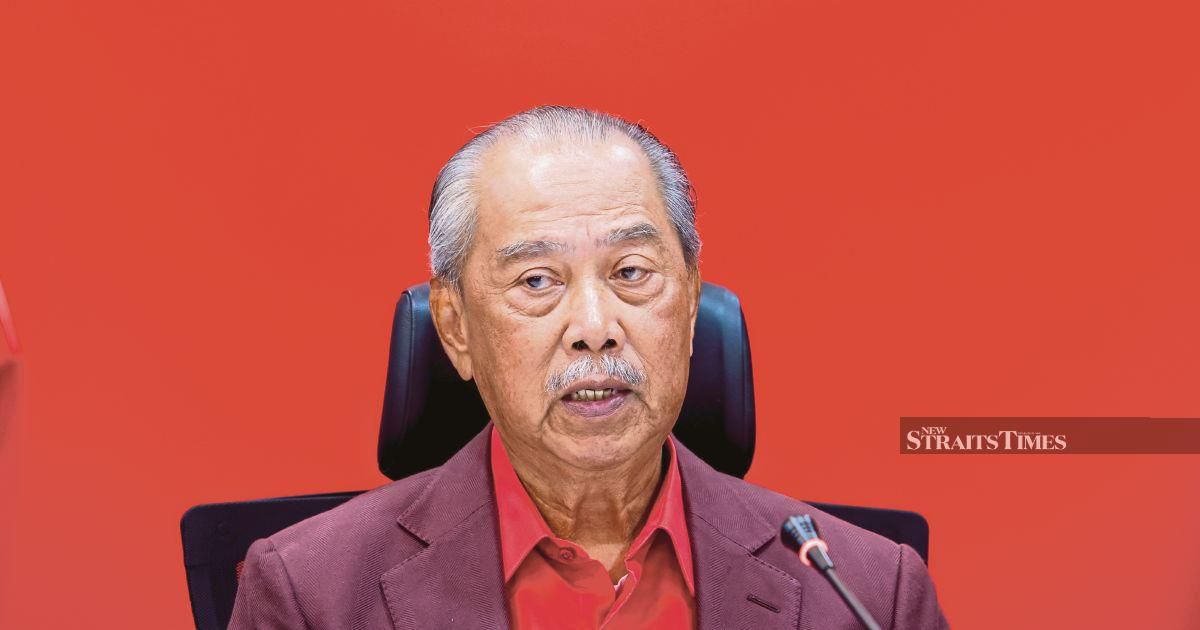
Bersatu president Tan Sri Muhyiddin Yassin has levelled fresh accusations against Umno, claiming the party is executing a deliberate strategy to undermine the unity government that currently governs Malaysia through collaboration between his party, Pakatan Harapan, and several other political components.
The allegation represents an escalation of tensions within the governing coalition at a critical juncture for the administration, which has faced mounting pressure from economic challenges and internal contradictions since its formation. Muhyiddin's warning carries particular weight given his previous experience as prime minister under the Perikatan Nasional framework, which collapsed amid internal defections and political manoeuvring that saw crucial party members withdraw their support during parliamentary sittings.
Muhyiddin's assertion hinges on his contention that Umno is employing parallel tactics to those deployed against the Perikatan Nasional government, suggesting a pattern of deliberate destabilisation rather than isolated political incidents. This interpretation reflects deep-seated anxieties within Bersatu's leadership about the fragility of coalitional arrangements in contemporary Malaysian politics, where narrow parliamentary majorities have become increasingly vulnerable to strategic defections and shifting alliances.
The timing of these claims is significant, arriving during a period when the unity government has struggled to maintain coherent policy direction and parliamentary discipline. Umno's position within the broader coalition has been a persistent point of friction, with the party's leadership maintaining considerable influence over government decisions while simultaneously harbouring reservations about certain policy directions favoured by Pakatan Harapan components.
For Malaysian observers, the dispute underscores a fundamental weakness in the unity government model, which was conceived as a stability mechanism following the 2022 general election. Rather than producing the promised political equilibrium, the arrangement has created multiple power centres often working at cross purposes, with each coalition component attempting to advance its specific interests while maintaining the broader alliance.
Umno's strategic position gives the party considerable leverage in these negotiations. As the dominant Peninsular Malay-Muslim party with significant grassroots organisation and state-level power bases, Umno can alternatively cooperate with or obstruct government initiatives depending on perceived benefit to its political fortunes. This structural imbalance has allowed Umno to extract concessions on matters ranging from cabinet appointments to policy implementation while occasionally threatening withdrawal if demands are unmet.
The implications for regional politics are noteworthy. Malaysia's political volatility has consequences extending beyond domestic borders, affecting investor confidence throughout Southeast Asia and complicating the nation's ability to pursue coherent regional leadership initiatives. When governing coalitions are perpetually at risk of collapse, policy continuity suffers and medium-term development planning becomes increasingly difficult to implement effectively.
Muhyiddin's previous tenure as prime minister, albeit brief and contentious, provides context for his current warnings. The Perikatan Nasional government's dissolution demonstrated how Malaysian parliamentary mathematics can shift rapidly, with individual defections or party-level realignments capable of overturning apparent majorities within days. These lessons have clearly shaped how Bersatu approaches coalition management, with the party leadership treating coalition partners with considerable wariness.
The unity government framework itself reflects lessons supposedly learned from the Perikatan Nasional experience. By bringing together ideologically diverse parties under a shared commitment to stability, architects of the current coalition believed they had constructed a more robust governing arrangement. However, fundamental incompatibilities between coalition partners on matters including economic policy, constitutional interpretation, and Islamic governance have repeatedly tested this arrangement.
For Malaysian voters and ordinary citizens, these elite political machinations carry practical consequences. Periods of coalition instability typically coincide with delayed policy implementation, ministerial uncertainty, and reduced government effectiveness in service delivery. The current episode signals that such uncertainties remain present despite the stated commitments of coalition partners to maintain governmental continuity.
The broader trajectory suggests that Malaysian politics has entered a period where stable majority governments may prove structurally difficult to achieve, forcing leaders to navigate increasingly complex coalitional arrangements. Whether such frameworks can deliver effective governance while satisfying diverse political constituencies remains an open question, with the unity government experiment offering a crucial test case for the viability of consensus-based governance models in the Malaysian context.

