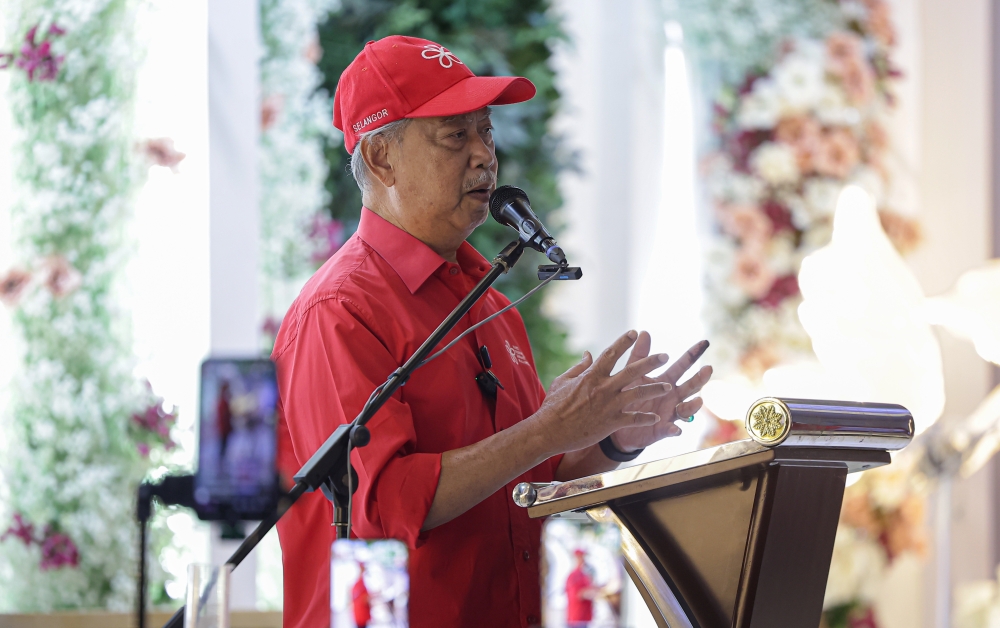
Tan Sri Muhyiddin Yassin has staked a bold claim to opposition legitimacy, asserting that Parti Pribumi Bersatu Malaysia alone represents Parliament's authentic opposition voice amid Malaysia's increasingly fractured political terrain. The former Prime Minister's pronouncement comes as the nation's major coalitions continue to shift and recalibrate their alliances, leaving traditional notions of opposition politics fundamentally reconfigured. Muhyiddin's declaration seeks to carve out a distinctive political identity for Bersatu at a moment when the boundaries between government and opposition have become considerably more ambiguous than in earlier democratic iterations.
The assertion reflects a strategic repositioning by Bersatu, which has navigated an unusually complex political journey over the past several years. The party's trajectory through various coalition arrangements—from its role in government through the Perikatan Nasional administration to its present parliamentary standing—has created both challenges and opportunities for the party to redefine its political purpose. Muhyiddin's emphasis on Bersatu's opposition credentials appears calculated to distinguish his party from other parliamentary blocs that have at various points been perceived as having compromised opposition independence through power-sharing arrangements or tacit understandings with the government.
Malaysia's opposition landscape has undergone profound transformation, particularly following the 2022 general election results that fractured the once-dominant Pakatan Harapan coalition. Where opposition politics traditionally meant a unified counterweight to government, contemporary Malaysian democracy has produced a more fragmented scenario. Multiple groupings now occupy opposition benches without necessarily acting as a coordinated force, creating space for individual parties to position themselves as uniquely principled or distinct in their approach to accountability and scrutiny. This fragmentation has simultaneously weakened opposition collective power whilst creating opportunities for smaller blocs to claim singular legitimacy.
Bersatu's specific positioning as the "only true opposition" carries particular significance given the party's complicated history with governance. Having been central to the government formation that initially supported Ismail Sabri Yaakob's administration and subsequently influenced other ministerial appointments, the party's opposition credentials require careful articulation. Muhyiddin's framing attempts to differentiate Bersatu from parties perceived to maintain informal arrangements with the government or those seen as having previously compromised their independence. The claim essentially stakes territory in Malaysia's competitive opposition marketplace, where various factions compete for legitimacy and voter attention.
The broader political context shaping this declaration involves the Pakatan Harapan coalition's own internal dynamics and its relationship with other parliamentary groupings. As the largest opposition alliance, Pakatan Harapan comprises multiple parties with sometimes divergent strategic interests, potentially creating openings for parties like Bersatu to argue that genuine opposition requires singular focus and undivided commitment. Muhyiddin's statement implicitly suggests that multi-party coalitions may dilute opposition effectiveness, though this argument itself remains contestable given Bersatu's own experience within coalition frameworks.
For Malaysian voters and observers, Muhyiddin's claim warrants careful scrutiny regarding what constitutes authentic opposition in contemporary democracy. Opposition politics encompasses multiple functions—legislative scrutiny, policy alternatives, electoral competition, and public accountability—and different parties may emphasise different dimensions. A party might maintain ideological consistency while still engaging pragmatically with governance arrangements, or conversely, maintain formal opposition status whilst lacking substantive policy differentiation. The question of opposition authenticity thus involves more than simple coalition alignment.
The statement also reflects broader regional patterns in Southeast Asian politics where traditional opposition-government binaries have become increasingly complicated. Countries across the region have witnessed opposition parties joining governments, serving in consultative capacities, or maintaining ambiguous relationships with ruling coalitions. Malaysia's experience fits this regional trajectory, with opposition politics requiring continuous renegotiation of meaning and purpose as formal institutional roles shift. Muhyiddin's assertion contributes to ongoing definitional debates about what opposition means within Malaysia's specific constitutional and electoral frameworks.
Bersatu's economic platform and policy positions will ultimately determine whether its opposition claims resonate beyond elite political circles. Parliamentary opposition requires not merely rhetorical distinctiveness but substantive policy alternatives addressing issues of concern to Malaysian voters—cost of living, economic opportunities, governance transparency, and interethnic relations. How effectively Bersatu articulates differentiated approaches to these challenges will test the credibility of its opposition positioning more than strategic coalition calculations alone.
Looking forward, Muhyiddin's characterisation of Bersatu as Parliament's sole true opposition will likely face challenge from multiple directions. Pakatan Harapan components will contest claims to authentic opposition identity, pointing to their established track record and legislative scrutiny contributions. Simultaneously, other parliamentary blocs may advance competing narratives about their own independence and opposition credentials. This competitive terrain suggests Malaysian opposition politics will remain fractured and contested, with various parties and coalitions advancing divergent claims about legitimacy and authenticity as the nation approaches subsequent electoral cycles.

