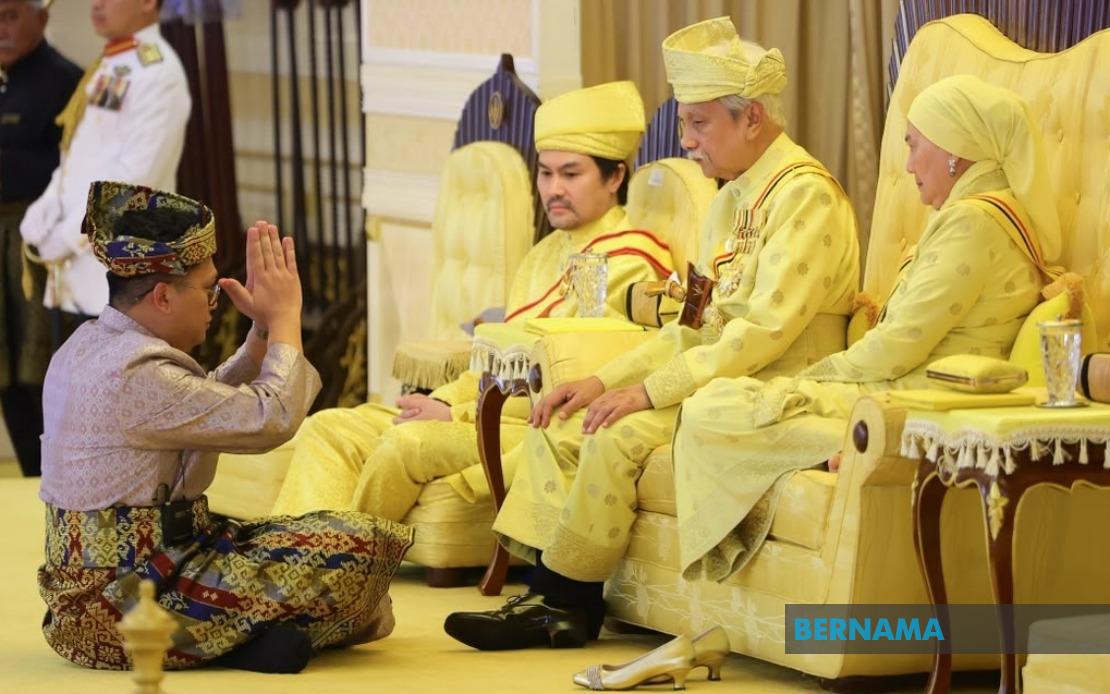
The Yang Dipertuan Besar of Negeri Sembilan, Tuanku Muhriz Tuanku Munawir, presided over the formal installation of Muhammad Faris Johari as the 11th Undang of Luak Sungei Ujong on June 27 at Istana Besar Seri Menanti in Kuala Pilah. The appointment marks a significant transition in the state's traditional governance hierarchy, with the ruler conferring upon the newly installed Undang the honourary title Datuk Klana Petra during the ceremonial proceedings.
The installation ceremony followed the time-honoured protocol that has guided such appointments within Negeri Sembilan's customary framework for generations. The proceedings commenced with the Orang Empat Istana—the group of four senior chieftains—formally seeking the ruler's permission to proceed with the installation rites. This preliminary step reflects the hierarchical relationship between the traditional leadership structure and the institution of the Yang Dipertuan Besar, ensuring that all customary appointments remain subordinate to the ruler's constitutional authority.
Following the Orang Empat Istana's petition, Muhammad Faris took the ceremonial pledge of loyalty to Tuanku Muhriz, a cornerstone moment in the installation process. This oath-taking ceremony carries profound symbolic weight within Negeri Sembilan's political culture, binding the newly appointed Undang to serve with unwavering dedication to both the ruler and the state. The pledge traditionally encompasses commitments to uphold the constitution, respect royal prerogatives, and discharge administrative duties with integrity.
Tuanku Muhriz used the occasion to reaffirm the foundational principles underpinning Negeri Sembilan's governance model. In his royal address, the ruler emphasised that the pledges undertaken during the ceremony must be honoured with complete sincerity, personal integrity, and an acute consciousness of individual and collective responsibility. He directed his remarks particularly toward the state's Orang Kaya—the traditional chieftains and nobility—reminding them of their paramount obligation to maintain unwavering loyalty to the institution of the Yang Dipertuan Besar and to cultivate respectful, cooperative relations with both the ruler and the palace.
The ruler articulated a broader vision for Negeri Sembilan's constitutional and customary arrangements, arguing that relationships grounded in reciprocal respect, mutual trust, and consensus-building remain absolutely essential for preserving the institution of constitutional monarchy. Tuanku Muhriz further stressed that such principled relationships form the bedrock upon which customary traditions are safeguarded and the state's continued prosperity and stability are assured. This framing demonstrates how Malaysian rulers use significant ceremonial moments to reinforce the legitimacy and importance of both formal constitutional structures and informal customary practices.
The high-profile attendance of senior palace figures underscored the ceremonial importance of the occasion. Present alongside Tuanku Muhriz were Tunku Ampuan Besar Tuanku Aishah Rohani Tengku Besar Mahmud, Tunku Besar Seri Menanti Tunku Ali Redhauddin Tuanku Muhriz, and Tunku Panglima Besar Tunku Zain Al-'Abidin, each representing different facets of Negeri Sembilan's royal and customary hierarchy. Additionally, Menteri Besar Datuk Seri Aminuddin Harun and senior officials from the state administration participated in witnessing the proceedings, signalling the convergence of traditional and contemporary governmental frameworks.
Muhammad Faris brings considerable professional credentials to his new position as Undang. Born on October 30, 1997, the 28-year-old holds a bachelor's degree in accountancy from Universiti Teknologi MARA (UiTM) and successfully obtained professional certification through the Association of Chartered Certified Accountants (ACCA) programme in 2022. His background in accountancy and financial management suggests a modernised approach to traditional leadership roles, reflecting broader patterns across Malaysia where younger officeholders bring contemporary expertise to historically significant positions. He is married to Sharifah Amirah Syed Ismail Ash-Shahab.
The installation of Muhammad Faris represents continuity within Negeri Sembilan's distinctive Adat Perpatih governance system, a matrilineal customary framework that distinguishes the state from other Malaysian jurisdictions. Tuanku Muhriz appealed to the wider population to work collaboratively with the customary leadership in fulfilling their respective responsibilities, whilst simultaneously committing to preserve and transmit the values inherent in Adat Perpatih to succeeding generations. This emphasis on inter-generational transmission of custom reflects persistent tensions across Malaysia between modernisation pressures and the maintenance of traditional institutions.
The Negeri Sembilan ruler also called upon the public to continue upholding and safeguarding the core values embedded within Adat Perpatih—the matrilineal customary law that has been transmitted through centuries within the state. This appeal carries particular significance given globalisation pressures and social transformation that challenge traditional governance models across Southeast Asia. By situating the installation ceremony within the broader context of cultural preservation, Tuanku Muhriz reinforced the view that customary leadership positions exist not merely as ceremonial appointments but as functional components of a distinctive cultural and governance system.
The same day witnessed the scheduling of a subsequent royal audience intended to formalise the installation of the 22nd Undang of Luak Rembau, demonstrating that the state leadership was conducting multiple significant appointments concurrently. This back-to-back scheduling reflects ongoing transitions within Negeri Sembilan's traditional hierarchy and suggests that the state may be experiencing broader generational shifts in its customary leadership structure. For Malaysian observers seeking to understand contemporary developments within traditional governance, these simultaneous appointments underscore how customary institutions continue evolving whilst maintaining their fundamental constitutional relationships with contemporary state apparatus.

