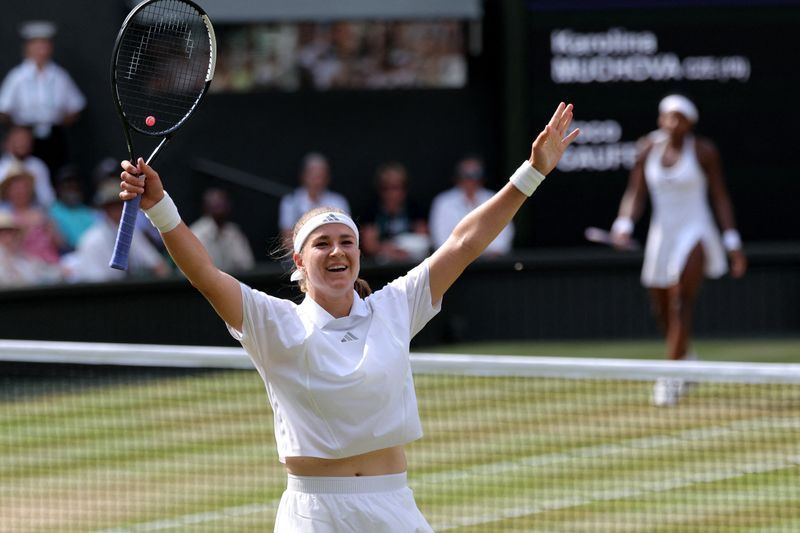
Karolina Muchova has secured her first Grand Slam final appearance by overcoming American seventh seed Coco Gauff in a pulsating Wimbledon semi-final that stretched to three hours and nearly 35 minutes. The Czech player's 6-2 1-6 7-6 (12-10) triumph came after she saved a crucial match point in the third set, demonstrating the resilience that has defined her grass-court campaign in London. The win keeps alive the possibility of an all-Czech final on Saturday, a scenario that would represent the first time two players from the same nation have contested the Wimbledon singles championship in recent memory.
Muchova's journey to the final carries added significance for Czech tennis, which has established itself as a formidable force at the All England Club. If she claims the title, she would become the third Czech winner in four years, following in the footsteps of Marketa Vondrousova, who triumphed in 2023, and Barbora Krejcikova's victory in 2024. This remarkable run underscores the depth of talent emerging from a relatively small tennis nation and reflects the development pathways established over recent years. The potential for a Czech final was further strengthened when fellow compatriot Linda Noskova reached Thursday's second semi-final against Ukrainian Marta Kostyuk, setting the stage for a potentially historic conclusion to this year's championship.
Muchova's path to victory began promisingly as she seized control in the opening set, breaking Gauff's serve on two separate occasions during the early stages of play. The Czech player's dominance during this period was underscored by her ability to dictate points with aggressive grasscourt tactics, culminating in an impressive 111 mph ace that secured the first set. Such a dominant start suggested Muchova might be heading toward a straightforward victory, but her American opponent had other plans.
Gauff's resilience proved instrumental in shifting momentum during the second set, demonstrating the competitive character that has defined her professional trajectory. After struggling initially with break points—failing to convert her first eight opportunities—Gauff finally secured the breakthrough on her ninth attempt to establish a 3-1 advantage. She subsequently extended this lead to 5-1, prompting visible celebrations from her mother in the player's box. The American's aggressive tennis and unwillingness to yield under pressure forced the match into a deciding set, evening the contest at one set apiece.
The third set encapsulated the essence of modern women's tennis at its highest level, with both competitors exchanging blistering forehands and exquisitely crafted backhands in an enthralling battle of shot-making and mental fortitude. The set progressed toward a tiebreak, where Muchova demonstrated her superior composure under the most intense pressure imaginable. Gauff secured two break point opportunities at 4-5, either of which would have positioned her favorably in the match, but Muchova's experience and tactical intelligence allowed her to escape that precarious situation.
The decisive tiebreak showcased the technical brilliance and competitive instincts both players possess. Muchova produced an array of outstanding tennis, including an audacious diving volley winner and a perfectly executed lob that left Gauff stranded at the baseline. These spectacular shots delivered her the first match point, though Gauff managed to extend the drama further. However, Muchova capitalized on her second opportunity when Gauff misfired a forehand into the net, bringing an end to the 2 hour 35 minute contest.
Remarkably, Muchova has accomplished this achievement despite a significant physical challenge that confronts her every time she competes on grass courts. The Czech player suffers from an allergy to grass that necessitates substantial pharmaceutical support, requiring her to rely on multiple medications, nasal sprays, and eyedrops simply to participate safely on the surface. This makes her success at Wimbledon all the more remarkable, as she has overcome a genuine physiological disadvantage to reach the final of one of tennis's most prestigious tournaments.
Gauff's campaign, while ultimately unsuccessful in reaching the final, nonetheless demonstrated the characteristics that have made her one of the sport's most exciting rising talents. She navigated four consecutive three-set matches to reach the semi-final stage, showcasing the durability and competitive instincts required to sustain deep runs at major championships. Her refusal to surrender when facing elimination throughout this tournament, including in the moments before her semi-final defeat, reflects a maturity that promises continued success in future championships.
Muchova's ascent to the Wimbledon final carries particular resonance for Southeast Asian tennis followers who have observed the Czech Republic's growing prominence in international competition. The success of Central and Eastern European players in recent years has reshaped the global tennis landscape, demonstrating that tennis excellence extends far beyond the traditional powerhouses. For Malaysian tennis enthusiasts and those across the region monitoring the development of the sport, Muchova's achievement serves as an instructive reminder that sustained institutional commitment and player development can yield consistent results at the highest level of professional tennis, providing valuable lessons for nations seeking to elevate their standing in international competition.

