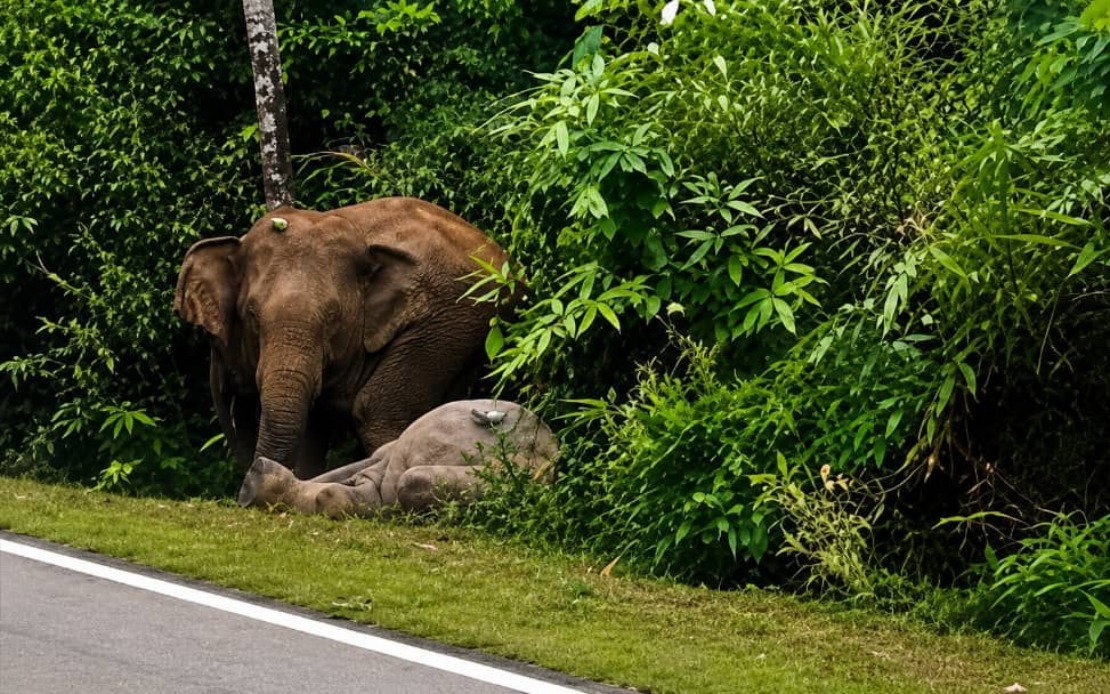
A deeply distressing scene unfolded along a jungle road in Mersing this morning when a mother elephant refused to abandon her lifeless calf for seven hours, moving observers and renewing focus on the escalating human-elephant conflict that threatens both species across Malaysia. The young elephant, estimated at five years old, was fatally struck by a Perodua Bezza at 2.28 am on Jalan Felda Nitar in an incident that wildlife authorities said demonstrated the perils facing the country's remaining wild pachyderm populations in increasingly fragmented habitats.
The tragic episode gained urgent attention only after video recordings circulated widely across social media, prompting the Johor Department of Wildlife and National Parks (Perhilitan) to receive an official report at approximately 8.30 am. The department subsequently mobilised four personnel to investigate the collision site. Upon arrival, officers documented a female calf measuring approximately 150 centimetres in body length with characteristic footprints and no tusks, determining her age at around five years. The adult elephant remaining at the scene was identified as the mother and belonged to the Jamaluang-Mersing elephant group that roams that region.
The driver of the vehicle, a 31-year-old man, sustained leg injuries when his car collided with the young elephant and veered into a five-metre ravine, according to statements issued by the Fire and Rescue Department. The motorist required emergency assistance to escape the wrecked vehicle. Remarkably, despite the catastrophic impact that proved fatal to the calf, the adult elephant remained at the location for an extended period, exhibiting behaviour interpreted by observers as maternal grief or a protective vigil over her offspring. The elephant's unwillingness to depart the scene highlighted the complex social structures and emotional bonds that characterise elephant family units, characteristics well documented in scientific literature.
Perihilitan personnel were compelled to undertake efforts to guide the grieving mother back into forest areas before the carcass could be recovered. The Elephant Capture Unit from the Johor Elephant Sanctuary joined the operation to safely relocate the distressed animal away from the roadside. The calf's remains were subsequently buried near the accident location. Wildlife officials have scheduled additional patrols for the following night and following day to monitor the mother elephant's movements and discourage her from potentially returning to the accident site, where she might face further danger from vehicular traffic.
The incident carries painful echoes of the Gerik tragedy that occurred on May 11 of the preceding year, an event that captured national attention and catalysed discussions about the fragility of elephant populations in Malaysia. In that incident, another young elephant became trapped beneath a container lorry after being struck, while an adult elephant—presumably the mother—was observed attempting to push the heavy vehicle in what observers interpreted as a desperate attempt to free her trapped offspring. The Gerik incident achieved significant social media circulation and galvanised public consciousness regarding the mounting pressures that wild elephants endure as human development encroaches upon their natural habitats.
These recurring tragedies underscore a critical conservation challenge confronting Southeast Asian nations: the collision between expanding human infrastructure and the spatial requirements of large terrestrial megafauna. Malaysia's three elephant subspecies—the Asian elephant populations found in Peninsular Malaysia, and separate populations in Sabah and Sarawak—face increasingly restricted movement corridors as agricultural expansion, logging operations, and road construction fragment their traditional ranges. Wildlife corridors that once allowed safe passage between feeding grounds have been severed by highways and developed areas, forcing elephants to cross dangerous roads during their daily foraging activities.
Authorities had previously positioned warning signage in the Mersing area alerting drivers to potential elephant crossings, yet such measures have proven insufficient to prevent collisions. The region's nocturnal lighting conditions compound the hazard, as darkness limits driver visibility and reaction time while simultaneously obscuring elephant presence until vehicles draw perilously close. The 2.28 am timing of this morning's collision suggests the calf was traversing the road during darkness, a period when both visibility and driver alertness decline markedly.
The Perhilitan spokesman specifically cautioned members of the public to exercise heightened vigilance when travelling through designated elephant crossing zones, emphasising that the Mersing corridor constitutes an active elephant transit area despite its status as an established road. This advisory acknowledges the inherent tension: while roads serve essential human economic and social functions, they simultaneously bisect critical wildlife habitat and movement patterns that elephants cannot readily abandon without forsaking access to water sources, feeding grounds, and social units distributed across their range.
The mother elephant's seven-hour vigil carries profound implications for understanding elephant cognition and emotional complexity. Elephant herds exhibit sophisticated social hierarchies and demonstrable grief responses when members perish. The mother's refusal to depart her deceased offspring aligns with documented behaviour patterns suggesting that elephants process loss and may engage in mourning-like rituals. This behaviour, while heartbreaking for observers, underscores the intelligence and emotional depth of creatures increasingly vulnerable to human activity.
Conservationists and wildlife management authorities face mounting pressure to implement comprehensive solutions addressing human-elephant conflict beyond reactive responses to individual tragedies. Proposed interventions include establishing and maintaining functional wildlife corridors that permit safe passage, installing more effective barriers or deterrent systems along high-traffic roads, and potentially redesigning transportation infrastructure to accommodate megafauna movement. However, implementing such solutions demands substantial financial investment and political commitment from multiple government agencies and stakeholders with competing interests.
The incidents in Gerik and now Mersing collectively underscore that Malaysia's remaining wild elephants exist in increasingly precarious circumstances. Their survival depends not merely on protected reserve areas, but on the ability to move safely between reserves and resources across a landscape profoundly altered by human activity. Until comprehensive measures addressing habitat fragmentation and road safety are implemented systematically, similar tragedies will likely recur with disturbing regularity, each one representing both the loss of irreplaceable wildlife and a sobering reminder of humanity's outsized impact on other species.

