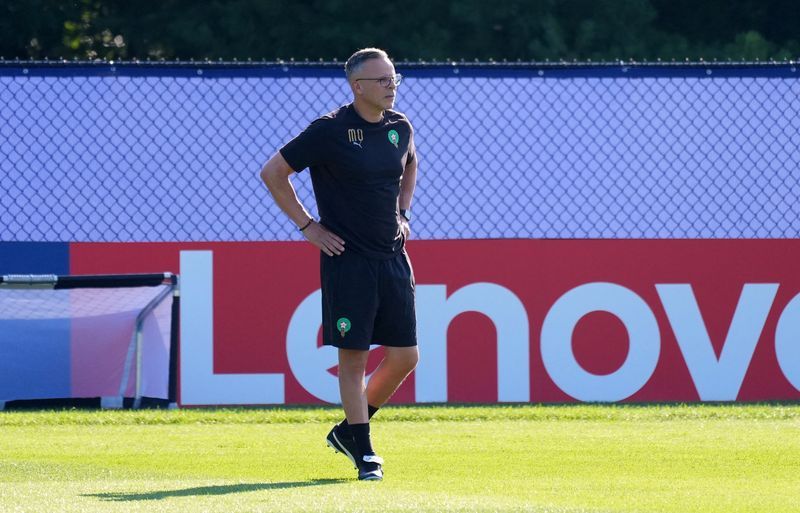
Morocco's coaching staff are moving swiftly past the accolades that have accumulated during their World Cup campaign, with head coach Mohamed Ouahbi making clear that his squad's appetite extends far beyond the quarter-final stage. Speaking at a press conference in Foxborough, Massachusetts on Wednesday, Ouahbi firmly rebuffed suggestions that Morocco should take satisfaction from their progress thus far, signalling instead that comprehensive evaluation of the tournament will occur only when the competition concludes.
The North African nation faces a formidable task on Thursday when they encounter France in a direct rematch of the 2022 Qatar semi-final, an encounter that ended Morocco's maiden World Cup deep run and crowned France as finalists. The contextual landscape has shifted considerably since that encounter, however. Where Morocco once carried the underdog narrative and the weight of competing beyond expectations, they now arrive as calculated title contenders who have methodically dismantled successive opponents and established themselves as serious championship aspirants.
Ouahbi's messaging to his players underscores a fundamental philosophical shift in how the Moroccan camp approaches the remaining fixtures. Rather than allowing external narratives of achievement to permeate the squad's mentality, the coach is channelling focus exclusively toward the championship objective. His declaration that "the bonus is to win the World Cup" encapsulates this ruthless mentality, positioning everything achieved to date as merely prologue to the ultimate prize rather than a destination worthy of celebration.
France, meanwhile, represents an opponent of exceptional pedigree and contemporary form. The two-time defending finalists and 2018 champions dispatched Paraguay in a tightly contested round-of-16 encounter decided by a Kylian Mbappe penalty, maintaining their trajectory toward another deep tournament run. Mbappe's personal tally of seven goals places him second in the tournament's scoring charts, trailing only Argentina's Lionel Messi by a single strike, and the Paris Saint-Germain forward anchors an attacking constellation that includes Ousmane Dembele, Michael Olise and Bradley Barcola.
The quality embedded within France's forward line stands as arguably the most formidable attacking ensemble assembled at a modern World Cup, presenting Morocco with a defensive examination of the highest order. Yet Ouahbi's assessment of the matchup, whilst acknowledging France's favourite status, avoided the trap of deferential respect that might undermine his team's confidence. Instead, the Moroccan coach emphasised the necessity of executing a maximalist approach, one that demands his players perform at absolute capacity without entertaining the psychological comfort of merely overachieving.
Morocco's trajectory through the tournament has been methodical rather than fortunate. The squad navigated their group stage undefeated before systematically overcoming the Netherlands and Canada in knockout stages, results that demonstrated technical competence rather than luck. This sequence of performances established the Moroccan side as legitimate contenders rather than beneficiaries of a favourable draw or opportunistic outcomes. The distinction matters considerably when addressing pre-match psychology and the internal expectations governing team preparation.
Ouahbi's insistence that the squad must perform at "2,000%" rather than rest upon previous accomplishments reflects a coaching philosophy grounded in relentless self-improvement and institutional ambition. By refusing to permit his players the psychological release of dwelling on achieved milestones, the coach maintains internal pressure that historically correlates with sustained competitive performance across tournament formats. This approach contrasts with the satisfied narratives that sometimes emerge around national teams whose participation at specific stages itself constitutes historic breakthrough.
The rematch dimension adds layers of complexity to Thursday's encounter. France's semi-final victory two years prior might suggest psychological advantage, yet Morocco's improved standing and expanded experience since that encounter could neutralise any residual advantage accruing from previous success. Modern football's contingency means that prior meetings between opponents offer limited predictive value, particularly when substantial personnel evolution has occurred on both rosters and respective tactical frameworks have undergone refinement.
Ouahbi's public stance regarding premature praise serves broader communicative purposes beyond immediate pre-match messaging. By articulating his team's championship ambitions so directly, the coach establishes a performance standard that transcends tournament participation and focuses stakeholders on ultimate outcomes. For Malaysian readers and Southeast Asian observers, the Moroccan approach offers instructive contrast with how regional football cultures sometimes approach international competition, where participation itself occasionally receives disproportionate celebration relative to competitive objectives.
The quarter-final clash represents a pivotal moment determining whether Morocco can advance beyond the psychological and tactical ceiling that France previously imposed. Success would require neutralising the considerable offensive threats France presents whilst manufacturing sufficient attacking momentum to trouble a French defensive unit defending two consecutive World Cup final appearances. Ouahbi's clarity regarding his team's intentions and refusal to accept modest achievement benchmarks suggests a squad approaching this examination with resolve undiminished by their previous disappointing encounter with the same opposition.

