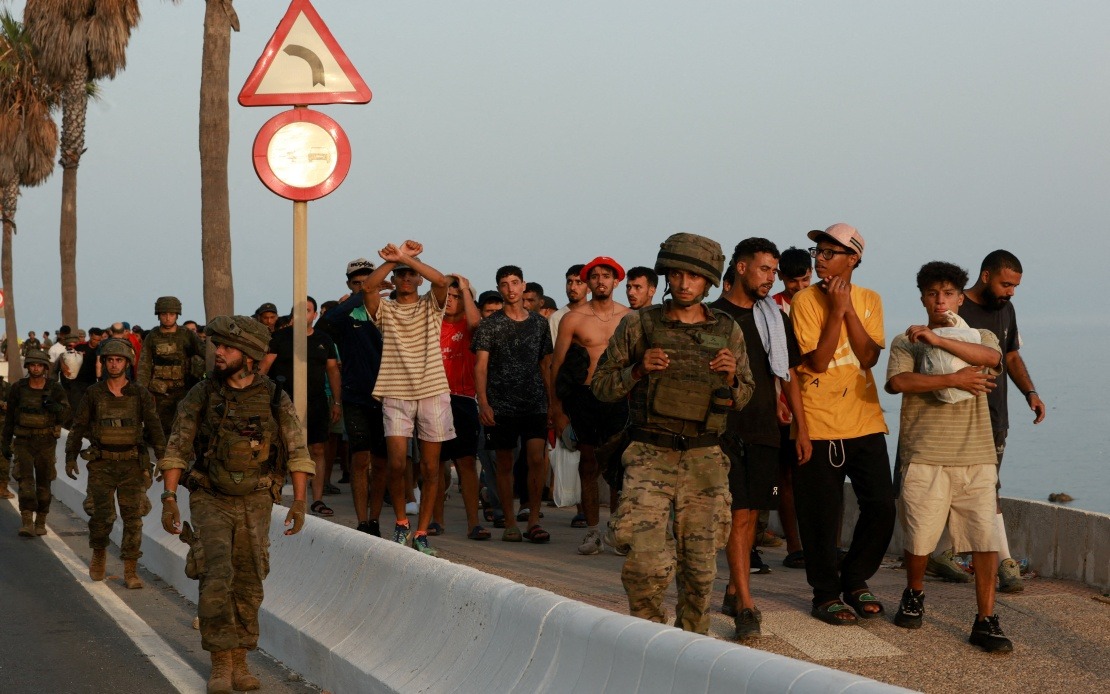
Morocco's government has attributed the unprecedented wave of migration into the Spanish enclave of Ceuta to a combination of deliberately spread falsehoods on social media platforms and the activities of organised human trafficking networks. The Interior Ministry pointed to these factors as the primary drivers behind the arrival of tens of thousands of migrants in the tiny territory over the course of just a few days, a surge that overwhelmed local infrastructure and raised tensions between Rabat and Madrid.
According to Moroccan officials, a significant element of the crisis stemmed from widespread misinformation circulating across social media channels. This false information, deliberately propagated by traffickers seeking to profit from vulnerable migrants, suggested that recent court decisions in Spain had effectively opened a pathway for migrants to enter Europe without facing immediate deportation. The exploitation of this judicial development by criminal networks demonstrates how distorted legal interpretations, amplified through digital platforms, can have profound real-world consequences for border security and migration patterns across the Mediterranean region.
The divergence in casualty figures between Morocco and Spain reveals the chaotic nature of the crisis and the difficulty authorities faced in establishing accurate data amid the humanitarian emergency. While Moroccan authorities documented eleven deaths, Spanish officials reported a significantly higher toll of at least seventy-two fatalities, suggesting that many migrants perished during the perilous sea crossing that many undertook in makeshift vessels. This disparity underscores the tragic human cost of irregular migration and the desperation driving people to risk their lives for the prospect of reaching European territory.
Official estimates of the scale of the incursion vary depending on the source. Spanish observers suggested between fifty and sixty thousand migrants successfully reached Ceuta during the crisis period, transforming the demographic composition of a territory home to approximately eighty-five thousand residents. Morocco's own count stood considerably lower at around forty thousand arrivals in Ceuta, with an additional eleven hundred and thirty-five individuals attempting to reach the nearby Spanish enclave of Melilla. The rapid accumulation of migrants—arriving within a compressed timeframe of merely several days—strained existing reception facilities and prompted urgent coordination between both governments to manage the emergency.
Authorities in Melilla proved more effective in preventing settlement, with Spanish officials immediately returning all migrants who arrived at that particular enclave. This contrasted sharply with the situation in Ceuta, where the sheer volume of arrivals overwhelmed the capacity of security forces to process and remove people expeditiously. The differential response highlighted both the varied resources available at different border points and the challenges Spain faced in managing simultaneous pressure across multiple fronts of its North African territories.
The crisis carries particular significance for Southeast Asian observers given the region's own experience with irregular migration patterns and trafficking networks. The Moroccan government's diagnosis of the problem—blaming misinformation campaigns and organised criminal networks rather than solely attributing the surge to economic desperation—resonates with understanding how migration crises develop in the modern digital age. Traffickers exploit information asymmetries and distort legal developments to encourage migrants to undertake dangerous journeys, generating substantial profits in the process while bearing none of the human cost.
Coordination between Morocco and Spain became essential following the initial crisis, with both nations working to verify reports of additional deaths and to identify the nationalities and identities of those who perished. This bilateral cooperation, despite underlying tensions, reflected recognition that managing irregular migration effectively requires cross-border partnership and information sharing. For Malaysia and other Southeast Asian nations grappling with similar challenges, the Ceuta incident illustrates why international cooperation on trafficking disruption and counter-misinformation efforts cannot be overlooked.
The incident raises broader questions about social media platform responsibility in disseminating information that fundamentally shapes migration decision-making. Traffickers have become increasingly sophisticated in their use of digital channels to manipulate potential clients, leveraging legitimate news events and court decisions to construct persuasive narratives about opportunity. The speed and reach of false information across platforms makes traditional border management strategies insufficient without accompanying efforts to combat the misinformation that motivates irregular departure in the first place.
For policymakers across the Mediterranean and beyond, including those in Malaysia navigating similar transnational challenges, the Moroccan analysis points to the necessity of a multifaceted approach combining enhanced border security, improved legal clarification to counteract misinterpretation, disruption of trafficking networks, and media literacy initiatives. The Ceuta crisis demonstrated that migrants' decision-making is increasingly influenced by information environments shaped by criminal actors, requiring responses that extend beyond traditional enforcement into the information domain itself.

