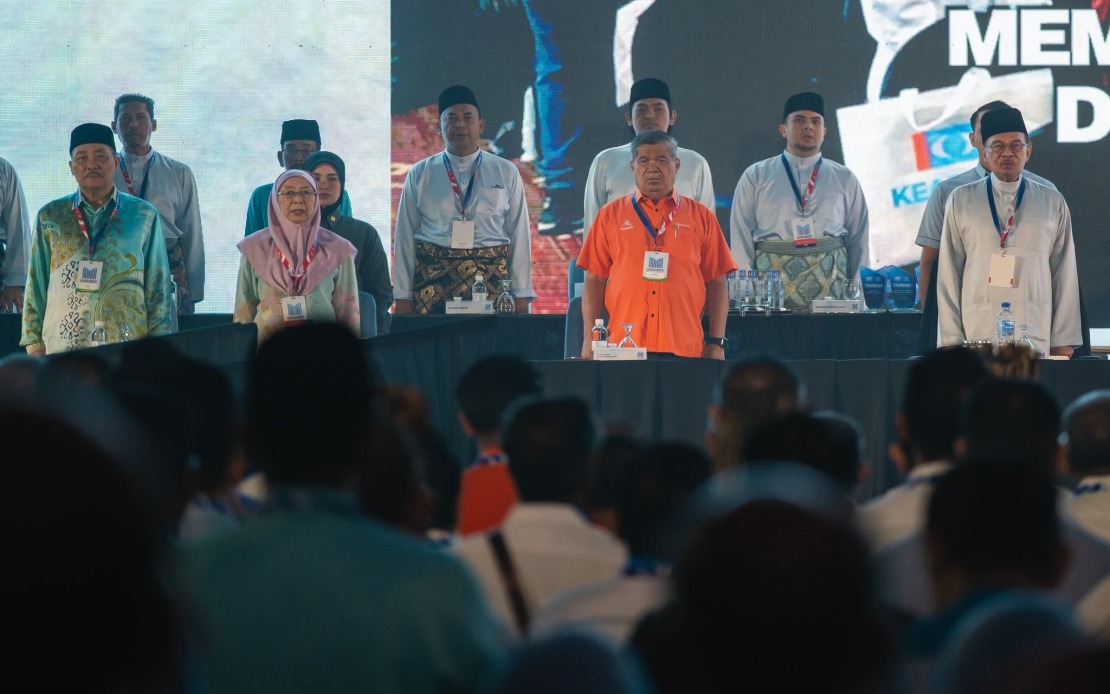
Datuk Seri Mohamad Sabu, president of Parti Amanah Negara, has underscored that institutional reform and anti-corruption drives must remain central to the government's mission even after coming to power, cautioning against complacency and the normalisation of governance lapses. Speaking at the 2026 PKR National Congress held at the Melaka International Trade Centre in Ayer Keroh on August 15, the Agriculture and Food Security Minister stressed that the public mandate granted to the ruling coalition carries with it an implicit responsibility to demonstrate tangible results through sustained action rather than rhetorical commitment.
The veteran politician's remarks come as coalition partners, including PKR president Datuk Seri Anwar Ibrahim, have reiterated their dedication to deepening reforms across Malaysia's institutional landscape. Mohamad Sabu's intervention signals that Amanah, as a coalition member, intends to maintain internal pressure on governance standards and accountability mechanisms even when such scrutiny might prove politically inconvenient. His emphasis on action over sloganeering suggests a recognition that reform agendas, once politically activated, require continuous renewal to avoid calcification or selective application.
A defining aspect of Mohamad Sabu's message centres on the refusal to grant immunity based on political position or factional allegiance. He explicitly stated that those engaged in the misappropriation of public resources would face action regardless of their standing within government or party structures. This principled stance, if operationalised consistently, would represent a departure from Malaysia's historical pattern wherein high-ranking officials have often benefited from informal protection networks and political considerations that supersede institutional accountability. For Malaysian observers, the question remains whether such rhetorical commitments will translate into prosecutions that implicate sitting or retired ministers and officials without regard to their political utility.
The minister's framing of the reform mandate as a long-term endeavour rather than a fixed electoral promise also carries significance for Southeast Asian governance more broadly. Malaysia's experience with cyclical reform cycles—wherein successive governments promise institutional overhauls that rarely survive changes in political fortune—has made regional analysts sceptical of such declarations. However, Amanah's positioning as a coalition partner rather than dominant force may provide structural incentives to champion accountability measures that larger parties might sideline once electoral pressures subside.
Parallel to anti-corruption priorities, Mohamad Sabu highlighted the government's commitment to implementing the Malaysia Agreement 1963, a constitutional instrument addressing the constitutional relationship between the federal government and the East Malaysian states of Sabah and Sarawak. The invocation of MA63 reflects ongoing tensions surrounding federal-state resource distribution and autonomy that remain unresolved after six decades. For Malaysian policymakers and business stakeholders in the peninsula, the prioritisation of MA63 implementation signals that coalition governments recognise the necessity of consolidating political support among East Malaysian constituents through tangible constitutional concessions and resource transfers.
The minister's observation regarding economic statistics and lived experience represents another dimension of his intervention. He argued that while growth figures merit attention, their utility as governance metrics diminishes if ordinary citizens fail to experience corresponding improvements in purchasing power or reductions in cost-of-living burdens. This distinction, often overlooked in official economic discourse, acknowledges the persistent gap between macroeconomic performance and household financial wellbeing that has characterised Malaysian economic policy for the past decade. The proliferation of cost-of-living anxieties across Southeast Asia, exacerbated by inflation and wage stagnation, suggests that Amanah's focus on translating growth into household welfare reflects awareness of electoral vulnerabilities that purely numerical economic success cannot address.
Amanah's welcome for the government's announcement regarding repeal of the Universities and University Colleges Act 1971 further underscores the coalition's commitment to liberalising institutional spaces, particularly those affecting younger constituencies. The AUKU, which restricts student political activity and expression, has long been identified by civil society organisations and opposition coalitions as symbolically representative of state paternalism and overreach. The mooted repeal, while constrained by competing concerns about campus stability and extremism prevention, signals that reform agendas encompass civil liberties considerations alongside more traditional anti-corruption measures.
Moving beyond Mohamad Sabu's immediate remarks, his intervention occurs within a broader context of coalition management challenges. The federal coalition governing Malaysia comprises ideologically heterogeneous parties with conflicting interests in pursuing or restraining certain reform initiatives. Amanah's repeated emphasising of reform continuity may partly reflect concern that dominant coalition partners, once electoral cycles conclude and organisational consolidation occurs, might deemphasise transparency and accountability measures that generate friction with entrenched bureaucratic interests. By anchoring reform rhetoric to the ruling coalition's legitimacy itself, Amanah attempts to foreclose opportunities for selective abandonment of reform commitments.
The sustainability of Malaysia's reform agenda also intersects with regional patterns observable across Southeast Asia. Thailand, Myanmar, and Cambodia have all witnessed reform narratives deployed during political transitions before subsequent abandonment or weaponisation against opposition forces. The Malaysian experience, marked by the earlier transition following the 2018 elections and subsequent setbacks including leadership changes, has demonstrated that institutional reforms remain vulnerable to political reversals and factional contestation. Mohamad Sabu's insistence on continuous renewal acknowledges these vulnerabilities and attempts, through rhetorical commitment, to establish constituencies for accountability that transcend individual officeholders or electoral cycles.
For foreign investors and regional businesses operating within Malaysia, the emphasis on sustained anti-corruption efforts and institutional strengthening carries practical implications for operational risk assessment and stakeholder engagement strategies. Enhanced accountability mechanisms, if implemented, could marginally increase compliance costs whilst potentially reducing exposure to sudden policy reversals driven by factional conflicts within government. Conversely, sustained rhetorical commitment without substantive institutional transformation would reinforce perceptions of governance fragility that already characterise Malaysia's business environment relative to some regional peers.
Looking forward, Mohamad Sabu's remarks establish a baseline against which future government performance regarding reform implementation can be measured. His explicit rejection of selective or time-limited accountability creates political space for civil society organisations and opposition coalitions to hold the government accountable against publicly articulated standards. Should the coalition government subsequently restrict anti-corruption investigations to political opponents whilst protecting allies, or should reform initiatives prove narrowly cosmetic, such deviations from stated principles become subject to political mobilisation by coalition critics. In this sense, Amanah's rhetorical commitment, while imperfect as a guarantor of actual reform, establishes political constraints that differ from patterns observable when governments make more ambiguous declarations regarding institutional change.

