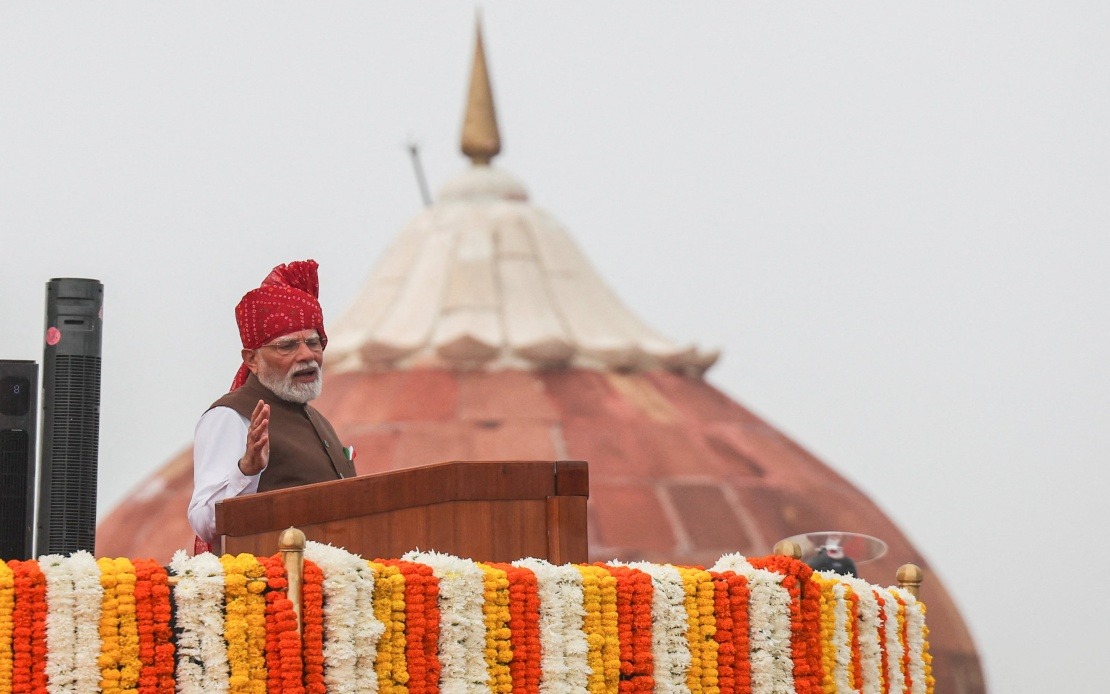
Indian Prime Minister Narendra Modi has charted an ambitious trajectory for his nation's transformation into a developed economy by 2047, anchored on reducing dependence in critical sectors and building domestic industrial capabilities. Delivering his Independence Day address from the Red Fort in Delhi on Saturday, Modi articulated a vision grounded in strategic self-sufficiency across defence, semiconductors, and energy—sectors he argues are fundamental to long-term prosperity and security. This push towards what he termed a "self-reliant India" represents a significant shift in economic policy, reflecting New Delhi's broader strategy to insulate itself from global supply chain vulnerabilities while strengthening domestic manufacturing ecosystems.
The semiconductor industry featured prominently in Modi's address, underscoring India's recognition of the sector's criticality in the modern economy. He announced that three semiconductor fabrication plants have already commenced operations, with expectations that five to eight additional facilities will become operational within the next seven to eight years. This expansion signals India's determination to compete in a domain historically dominated by Taiwan, South Korea and the United States. For Malaysia and the broader Southeast Asian region, India's semiconductor ambitions carry significant implications, potentially reshaping the competitive landscape and creating both opportunities and challenges for existing regional players in electronics manufacturing.
On the nuclear energy front, Modi's government has set a striking target of achieving 100 gigawatts of nuclear power capacity by 2047, substantially increasing the nation's clean energy portfolio. The Prime Minister highlighted India's mastery of fast-breeder reactor technology this year as a watershed moment, representing progress towards indigenous fuel production and reducing reliance on external nuclear suppliers. Beyond this technological achievement, India plans to commission five new nuclear reactors before 2030, marking an acceleration in nuclear deployment compared to historical timelines. This expansion addresses India's dual imperatives of meeting surging electricity demand driven by industrial growth and population expansion whilst simultaneously reducing carbon emissions in line with global climate commitments.
Renewable energy capacity has already demonstrated remarkable expansion under Modi's watch. Solar power generation has grown explosively from two gigawatts a decade ago to 160 gigawatts currently, a transformation that positions India among the world's renewable energy leaders. This trajectory reflects investments in grid infrastructure, manufacturing capacity and policy frameworks that have catalysed private sector participation. The renewable energy push complements India's nuclear strategy, creating a diversified clean energy mix that can support industrial development without perpetuating fossil fuel dependency. For Southeast Asian nations grappling with energy transition challenges, India's experience offers valuable lessons in scaling renewable capacity whilst maintaining grid stability.
Energy security extends beyond electricity generation into hydrocarbon exploration. Modi revealed that India is allocating 850 billion rupees, equivalent to approximately US$8.9 billion, towards exploring offshore oil and gas reserves in areas previously considered commercially unviable. By opening regions classified as "99 per cent no-go zones," India seeks to discover reserves that could substantially reduce its petroleum import bill, which remains a significant strain on the current account balance. This exploration push reflects pragmatism about India's medium-term energy needs, acknowledging that the transition away from hydrocarbons, whilst inevitable, will extend across several decades.
Defence and military manufacturing represent another pillar of Modi's self-reliance agenda. The Prime Minister called for expanding domestic production capabilities across drones, counter-drone systems and hypersonic defence technologies, sectors that remain concentrated among advanced military powers. India's push for indigenous defence manufacturing addresses both security and economic objectives: reducing expenditure on imported weaponry whilst building a domestic defence industrial base capable of creating high-skilled employment. This strategy gains heightened significance given China's growing military capabilities and the strategic competition unfolding across Asia.
Beyond sectoral initiatives, Modi articulated a broader philosophical position on domestic consumption and protectionism. He urged Indians to prioritise purchasing locally manufactured goods, arguing that whilst cheaper foreign alternatives exist, buying domestic strengthens industrial capabilities and tests domestic competitiveness. This messaging balances nationalist sentiment with economic pragmatism, though it carries implicit tensions with international trade obligations and competition principles. The emphasis on domestic purchasing power reflects pressure on India's balance of payments and aims to channel consumer spending towards supporting domestic manufacturers, particularly in industries seeking to establish competitive advantage.
The 2047 timeline itself carries symbolic weight, marking the centenary of Indian independence. By anchoring self-reliance goals to this date, Modi frames economic transformation as part of India's national destiny and progress narrative. For policymakers across Southeast Asia observing India's trajectory, the self-reliance model presents both instructive elements and cautionary insights. India's investments in semiconductors, renewable energy and defence technology represent rational responses to structural vulnerabilities. Yet the model also raises questions about efficiency, innovation incentives and the comparative advantages India might sacrifice through inward-looking policies.
The implications for Malaysia and the Southeast Asian region warrant careful consideration. India's semiconductor expansion could alter regional supply chains and potentially create competition for expertise and investment. Similarly, India's energy push—both renewable and nuclear—will shape regional energy markets and technology partnerships. The defence manufacturing emphasis could reshape military procurement patterns across Asia. Simultaneously, India's growth trajectory presents opportunities for regional economies, particularly in supplying components, expertise and services to Indian industries undertaking this transformation.
Modi's address reflects a pragmatic acknowledgment that developed-nation status demands mastery of advanced technologies and reduced vulnerability to external supply disruptions. The comprehensiveness of his self-reliance agenda demonstrates that economic transformation requires coordinated action across multiple sectors rather than piecemeal reforms. Whether India can sustain the investments, innovation and policy consistency necessary to achieve these objectives across the next two decades remains uncertain. Nevertheless, the articulated vision signals India's determination to reshape its economic foundations and leverage its scale, demographic dividend and technological capacity to achieve substantially enhanced prosperity and strategic autonomy by mid-century.

