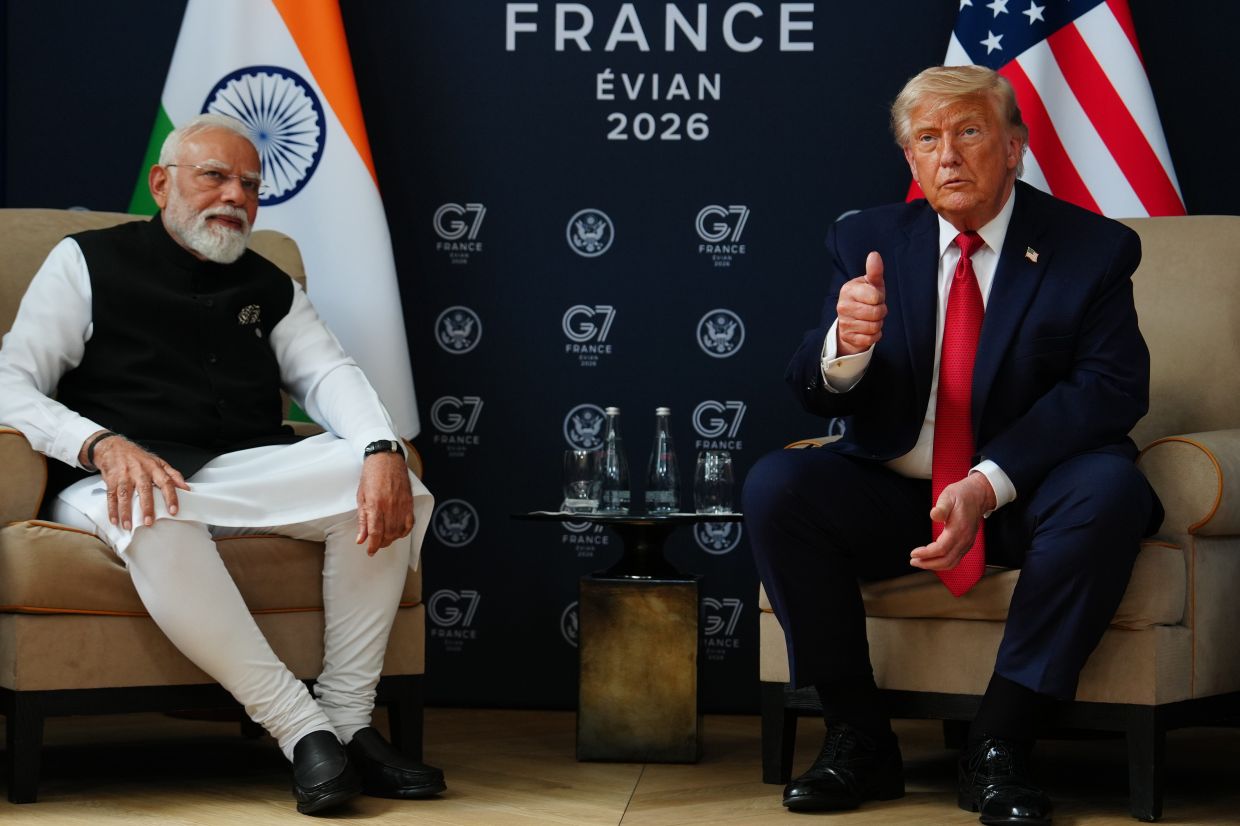
Indian Prime Minister Narendra Modi announced Thursday that discussions with the United States on a comprehensive trade agreement had reached a critical juncture, describing the progress as "significant" following his meeting with President Donald Trump during the G7 summit in Evian, France. The two leaders convened on the sidelines of the gathering, marking their first in-person encounter since their February 2025 visit to Washington, where preliminary ground had been laid for broader commercial discussions.
According to India's foreign ministry, both leaders expressed particular satisfaction with the trajectory of ongoing negotiations toward an interim bilateral trade pact. Trump reinforced this optimistic assessment when speaking to journalists in Evian, characterising the two nations as being "very close" to reaching a deal. The American president elaborated on his assessment of Modi as a negotiator, offering colourful observations about the Indian premier's approach to commerce discussions.
The formal statement emanating from New Delhi reflected an intensified commitment from both capitals, with Modi and Trump directing their respective officials to accelerate work on producing a "commercially meaningful agreement at the earliest" opportunity. This directive signals both the political will and the practical urgency underpinning these trade negotiations, which have consumed considerable diplomatic bandwidth over recent months. The establishment of such a timeline reflects mutual recognition that further delays could undermine the commercial opportunities both nations hope to unlock.
US Trade Representative Jamierson Greer is scheduled to visit India in the coming week to participate in the next round of substantive talks, indicating that negotiations are moving from the rhetorical phase into focused technical discussions. This visit will provide an opportunity to address specific tariff schedules, rules of origin, and market access provisions that have historically complicated US-India trade relationships. The presence of such a high-ranking American negotiator demonstrates Washington's commitment to expediting the process.
The broader context involves an ambitious bilateral target that both countries have embraced: elevating the total value of trade between them to US$500 billion by 2030, a roughly fivefold increase from current levels. This aspiration has motivated multiple negotiating rounds aimed at dismantling longstanding barriers to commerce, including disputes over intellectual property protections, agricultural tariffs, and pharmaceutical pricing. The interim agreement now being negotiated represents the first major milestone toward this transformative goal.
Progress on these discussions, however, has not been linear. An initial framework agreement reached in February created momentum, but the pace slowed considerably after the US Supreme Court struck down some of Trump's previous tariff initiatives. Subsequently, the Trump administration commenced investigations targeting purported unfair trade practices by several countries, including India, whilst simultaneously implementing a blanket 10 percent tariff on imports. These moves created uncertainty and complicated the negotiating environment, prompting both sides to recalibrate their expectations and timelines.
India's Commerce Minister Piyush Goyal provided additional colour to the negotiations in early June, asserting that the countries had resolved approximately 99 percent of the first phase of the proposed agreement. This characterisation suggests that outstanding contentious issues are now narrowed to a handful of technical matters, potentially explaining Trump's confidence that finalisation is imminent. The remaining one percent, however, likely involves the thorniest issues that have proven most resistant to compromise.
Beyond trade mechanics, Modi raised a distinct humanitarian concern during his discussions with Trump, petitioning the American president to prioritise the safety of Indian maritime workers in the context of broader Middle East tensions. The request gained urgency following the deaths of three Indian sailors aboard a commercial vessel off Oman on June 10, killed in a US military strike. This tragic incident underscored the vulnerability of Indian seafarers navigating increasingly volatile waters and brought home the human costs of regional geopolitical instability.
The Middle East conflict has imposed substantial economic costs on India and other Global South nations, creating vulnerabilities in critical supply chains. Iran's decision to restrict passage through the Strait of Hormuz, a vital artery for global energy commerce, has curtailed oil and gas deliveries to regions dependent on those supplies. India, heavily reliant on energy imports to fuel its economy, has experienced tangible consequences from these disruptions, with implications for inflation and growth.
Modi used the G7 platform to articulate the broader development impact facing emerging economies, warning that dislocations in fuel, fertiliser, and food markets precipitated by Middle East instability would generate ripple effects across the Global South for an extended period. This framing reflects India's attempt to position itself as an advocate for developing nations whilst simultaneously advancing its bilateral interests with Washington. The dual messaging—pursuing aggressive trade expansion whilst highlighting vulnerability to external shocks—reflects India's balancing act in an increasingly multipolar world where economic and security interests frequently intersect.
The convergence of these discussions at the G7 summit provided a setting where Modi and Trump could address multiple dimensions of the US-India relationship simultaneously. The progress on trade, combined with conversations about seafarer safety and broader regional stability, demonstrated the multifaceted nature of modern great-power diplomacy. For Malaysia and other Southeast Asian economies, the acceleration of US-India commercial ties carries implications for regional supply chains, investment flows, and the broader architecture of economic relationships in the Indo-Pacific.
The timeline for finalising an interim agreement remains fluid, but the signals emanating from both capitals suggest that political momentum is building toward a breakthrough. Should negotiations succeed in producing a meaningful agreement in coming weeks, it would represent a significant achievement in US-India relations and potentially unlock further expansions in bilateral economic engagement. For regional observers, the success or failure of these negotiations could establish important precedents for how the Trump administration approaches commercial relationships with major Asian economies.