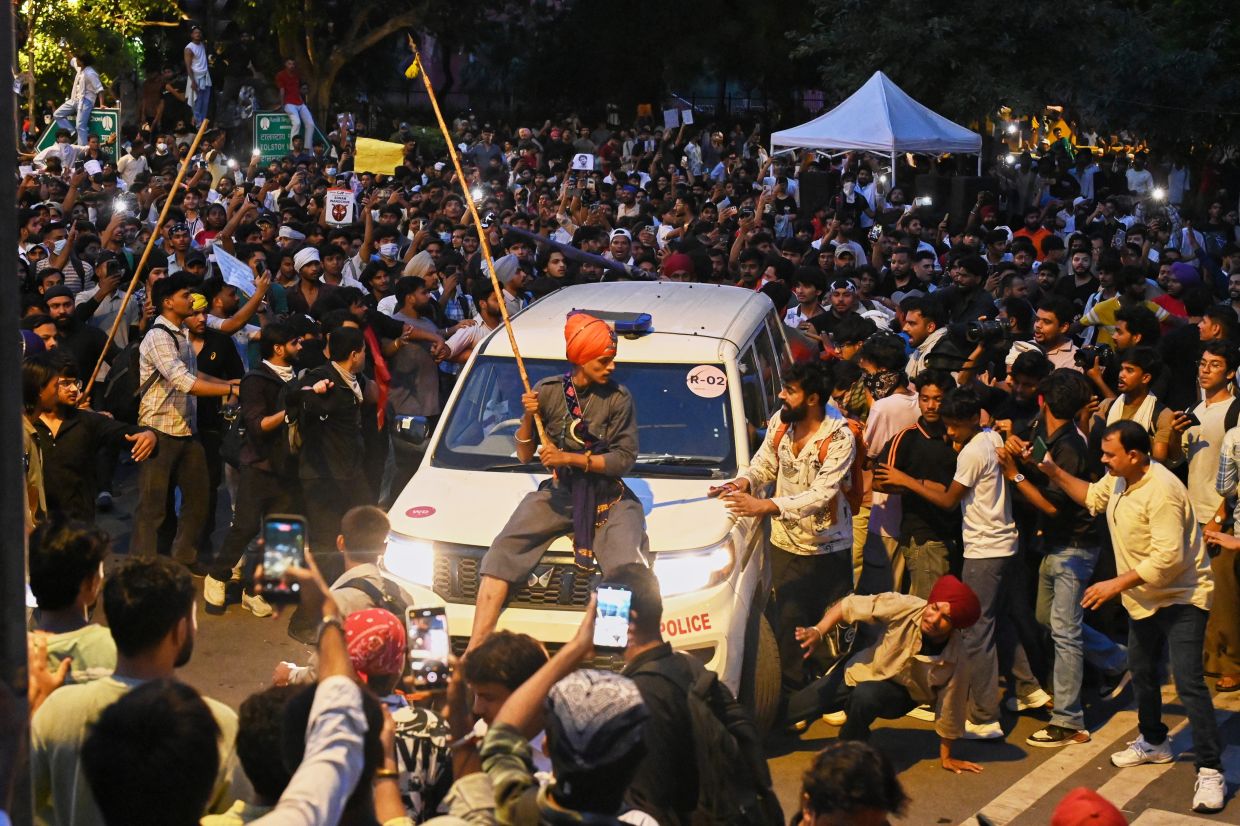
Indian Prime Minister Narendra Modi moved to contain a burgeoning crisis of public confidence in his government's stewardship of education on Thursday, pledging "stringent punishment" for those involved in widespread examination fraud. The undertaking came in the form of a social media statement, representing his first substantive engagement with unprecedented street demonstrations that have swept through New Delhi and beyond, mobilising thousands of students demanding accountability for systemic failures in the nation's testing infrastructure.
The protests have escalated dramatically over recent days, with a watershed moment arriving on Monday when tens of thousands attempted to march toward parliament as lawmakers convened for the monsoon session. Police response was forceful, deploying tear gas canisters and resorting to baton charges as demonstrators tried to breach security cordons. The confrontation rapidly deteriorated into stone-throwing clashes that left at least 178 people injured, including security personnel, marking New Delhi's most significant street mobilisation in approximately five years. What began as isolated anger over education system vulnerabilities has metastasised into a broader movement challenging governance itself.
The Cockroach Janta Party, a decentralised movement that originated in May as a satirical commentary on perceived judicial overreach, has emerged as the organisational force galvanising these demonstrations. The CJP draws its peculiar nomenclature from remarks allegedly made by Chief Justice Surya Kant during court proceedings, when he reportedly characterised young people using dehumanising language. What started as internet-based mockery has evolved into a substantive political movement with millions of social media adherents and an increasingly ambitious policy agenda encompassing youth unemployment, economic opportunity, and accusations of authoritarian governance expansion.
Wednesday brought renewed confrontations at Jantar Mantar, New Delhi's historic protest epicentre, where crowds swelled beyond designated demonstration areas as evening descended. Police actions intensified in response, prompting CJP spokesman Ashutosh Ranka to characterise the response as brutal suppression accompanied by internet shutdowns. Delhi Police countered with assertions that officers faced stone and plastic bottle attacks causing significant injuries. This cycle of escalating provocations and responses has become the pattern defining the current political moment in the Indian capital.
Modi's response emphasised that "nothing is more important than the welfare and future of our youth," a rhetorical positioning that attempts to reframe his government as youth-oriented despite accumulating evidence of systemic education sector dysfunction. His commitment to establish fast-track courts specifically tasked with prosecuting examination fraud represents an attempt at concrete, visible action meant to satisfy protester demands. However, the movement has explicitly called for the resignation of the education minister, a demand Modi has conspicuously avoided addressing in his statement, potentially limiting the political salve his promises might provide.
Opposition parties have seized upon the moment with vigour, disrupting parliamentary proceedings to demand both an apology for Monday's police conduct and systemic education reforms. Congress politician Rahul Gandhi leveraged social media to directly counter the Prime Minister's claims, asserting that Modi himself bears ultimate responsibility for educational system degradation through passive acquiescence and protection of corrupt officials. This opposition articulation represents a calculated effort to position the government as fundamentally culpable rather than responsive, framing Modi's statements as belated and insufficient damage control.
The examination system itself has descended into genuine crisis. A leaked medical entrance examination question paper forced over two million candidates to sit for replacement tests at enormous logistical and psychological cost. Simultaneously, controversies surrounding digital marking systems affecting nearly two million high school students have compounded public distrust in institutional integrity. These are not isolated incidents but rather symptomatic of deeper structural vulnerabilities that have eroded faith in educational administration across the subcontinent.
Geographically, the movement has transcended New Delhi's boundaries, materialising in significant demonstrations across Mumbai, Bengaluru, and Patna during Wednesday's coordinated actions. This dispersal suggests the movement possesses genuine pan-Indian resonance rather than representing merely localised discontent. The emergence of solidarity demonstrations in neighbouring Bangladesh, where student-led protests successfully toppled Sheikh Hasina's government during 2024, carries unmistakable symbolic weight. International observers have noted the structural similarities: youth mobilising via social media against perceived systemic corruption and governance failures.
For Southeast Asian observers, particularly those in Malaysia, these developments warrant close attention as demonstrations of how education sector mismanagement can catalyse broader political instability. The Indian experience illustrates the vulnerability of governments perceived as indifferent to youth employment prospects and institutional integrity. Bangladesh's experience demonstrates that student movements, once mobilised around tangible grievances, can expand into existential challenges to state legitimacy. Modi's attempt at de-escalation through promises of fast-track justice may prove insufficient if underlying structural problems persist without comprehensive reform.
The timing proves particularly sensitive given Modi's re-election to a third term in 2024, when his government received a popular mandate. Now, less than two years into that term, street mobilisation of this scale suggests fracturing support particularly among younger voters who expected substantive policy improvements. The CJP's expansion from satirical commentary into comprehensive critique of economic opportunity and governance style indicates metamorphosis from single-issue protest into something more fundamentally oppositional. Should these demonstrations persist or intensify, Modi may discover that procedural promises and institutional innovations prove inadequate substitutes for the comprehensive education sector reform that underlying conditions apparently demand.

