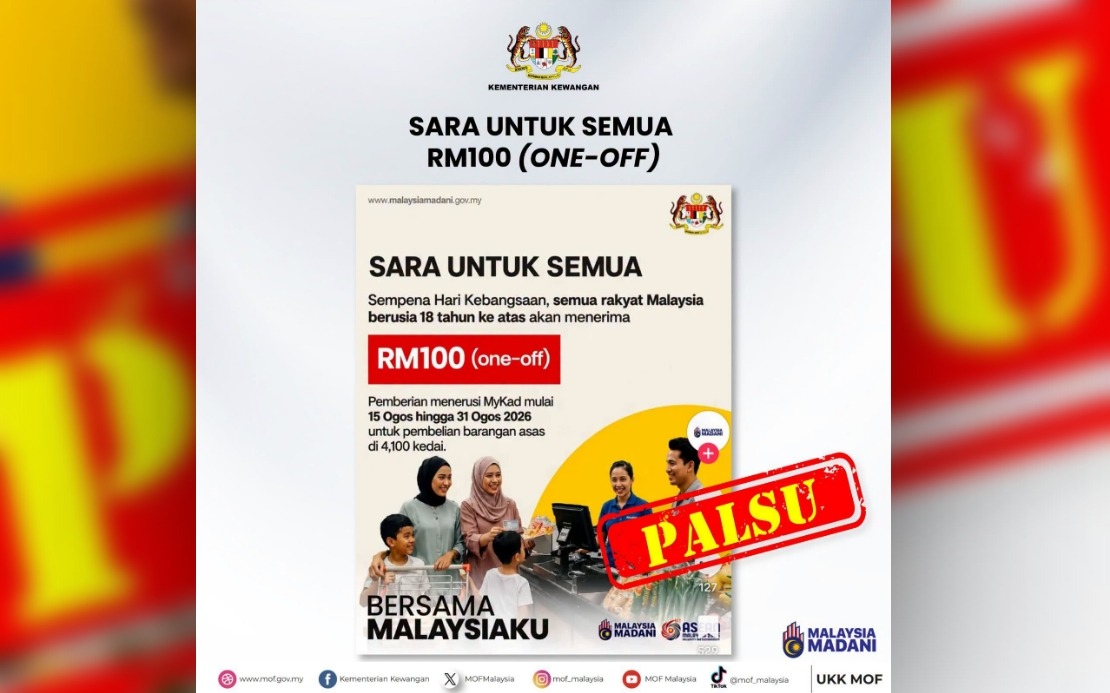
The Ministry of Finance moved swiftly on Tuesday to debunk a rapidly spreading claim across social media asserting that all adult Malaysians would receive an unexpected RM100 payment from the Sumbangan Asas Rahmah (SARA) initiative to mark the nation's independence celebrations. Through an official statement posted on its social media channels, the ministry characterised the poster circulating the claim as entirely fabricated and urged citizens to disregard and refrain from amplifying the misinformation.
False financial announcements carry particular potency in the Malaysian context, where households remain sensitive to cost-of-living pressures and economic uncertainty. The rapid viral spread of the claim underscores how quickly unverified financial promises can circulate through digital platforms, particularly WhatsApp and Facebook groups where verification mechanisms are minimal. Such episodes test public trust in official channels and the government's capacity to communicate clearly and swiftly with citizens seeking financial relief.
The ministry's response emphasised a crucial procedural point: no authorised announcement regarding SARA payments had been issued through legitimate government channels. This distinction matters because it signals that any genuine distribution from the government's social assistance schemes would be accompanied by formal ministerial declarations, media briefings, and detailed distribution mechanisms—not viral social media posts. The clarification serves as a reminder that official financial initiatives require substantiation through established communication protocols.
The SARA scheme itself represents a cornerstone of Malaysia's targeted assistance framework, designed to provide direct financial support to lower-income households. The government has previously announced various tranches of SARA payments, making the public familiar with how these programmes operate. This familiarity, paradoxically, may have contributed to the false claim's persuasiveness, as citizens recognised the scheme's name and operational reality, then extrapolated incorrectly.
The Ministry of Finance specifically cautioned Malaysians to rely exclusively on verified information from official government sources before accepting or disseminating claims about entitlements and financial support. This guidance reflects a broader acknowledgment that misinformation ecosystems thrive when citizens lack convenient access to authoritative sources. The statement implicitly encourages citizens to consult MOF's official website, verified social media accounts, or press statements from the main news agency before believing extraordinary financial announcements.
From a regional perspective, Malaysia is not alone in confronting sophisticated misinformation campaigns targeting economic anxieties. Across Southeast Asia, false claims about government assistance payments have proliferated during periods of economic pressure. The rapidity with which such claims spread in Malaysia demonstrates the vulnerability of digital information spaces to manipulation, particularly when messages tap into genuine public sentiment about needing financial assistance.
The timing of the false claim, arriving during the lead-up to National Day, suggests deliberate timing to exploit the festive season and heightened media attention. Whether the misinformation originated from malicious actors seeking to damage government credibility or from innocent misunderstandings remains unclear. Nevertheless, the episode highlights how quickly false narratives can gain traction when they address public aspirations and align with the nomenclature of existing government programmes.
Public sector communication faces an ongoing challenge in maintaining credibility while combating coordinated misinformation. The MOF's approach—swift denial coupled with guidance on accessing verified information—represents a standard responsive mechanism. However, the persistence of such false claims suggests that reactive denial may be insufficient without complementary strategies involving media literacy initiatives and proactive communication about actual government assistance schemes.
The National Day period itself deserves consideration as a context for this misinformation. Historically, the government has announced various initiatives and assistance packages coinciding with major national celebrations, creating precedent for special announcements. This backdrop may have rendered the false claim more credible to audiences unfamiliar with the specific mechanics of SARA distribution. Savvy citizens who follow government announcements would likely have recognised the claim's implausibility, yet numerous Malaysians may lack regular exposure to official financial communications.
For citizens genuinely seeking information about available assistance schemes, the ministry's direction remains valid: official announcements emerge through established channels including press conferences, ministerial statements, and dedicated government portals. The SARA scheme continues operating according to its published parameters, with eligible households receiving support according to predetermined assessment criteria rather than through unexpected National Day bonuses distributed universally.
This incident underscores a broader governance challenge confronting modern Malaysia: ensuring that accurate information reaches diverse populations more rapidly than misinformation can spread. As digital communication platforms continue reshaping how Malaysians learn about government initiatives, the ministry's commitment to maintaining clear, accessible official channels becomes increasingly critical. Citizens concerned about assistance eligibility should proactively consult authoritative sources rather than relying on social media claims, however appealing they may initially appear.

