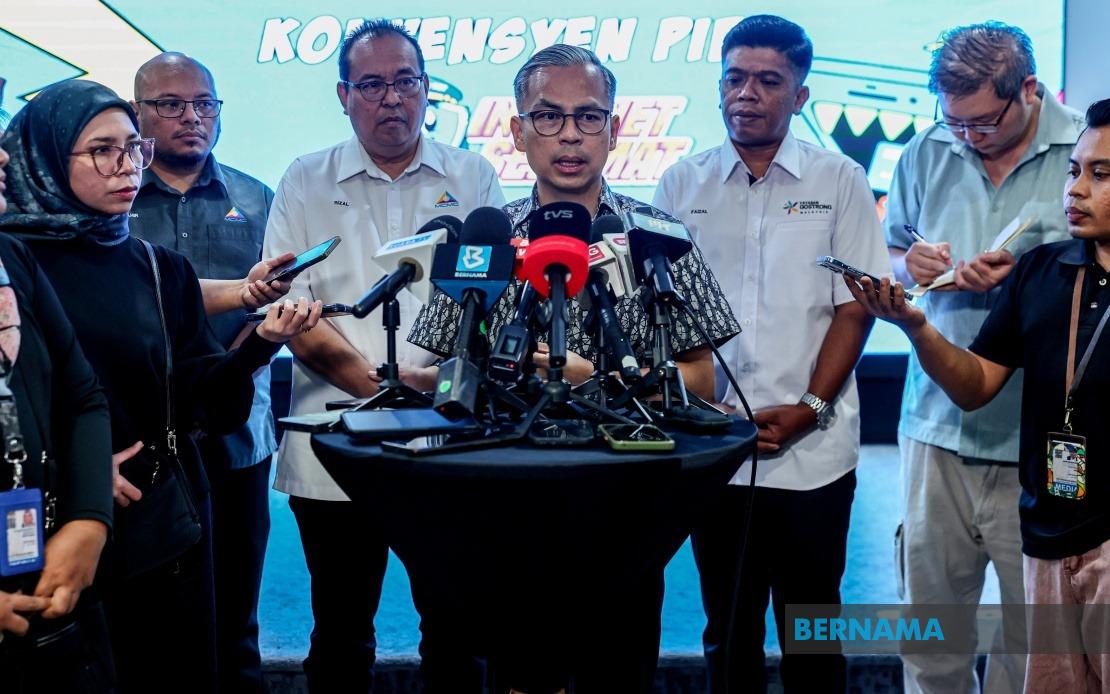
Malaysia's Communications Minister Datuk Seri Fahmi Fadzil has raised fresh concerns about children forming digital friendships with artificial intelligence, urging parents to maintain vigilant oversight of their offspring's online activities. Speaking at the Kuala Lumpur Federal Territory Safe Internet PTA Convention 2026, Fahmi emphasised that while AI tools offer legitimate benefits in education and information gathering, they fundamentally lack the capacity for genuine human connection and should never be positioned as substitutes for real relationships or romantic partners.
The minister's intervention addresses a growing phenomenon where young users increasingly rely on conversational AI systems for emotional support and companionship. Fahmi articulated a critical distinction that many parents may overlook: despite sophisticated language models producing human-like responses, these systems remain mathematical constructs trained on human-generated data rather than sentient beings capable of authentic care or understanding. This technological illusion of personality creates particular risks when children mistake computational pattern-matching for genuine friendship or emotional reciprocity.
A central concern Fahmi highlighted involves the unreliability of information generated by AI systems. These platforms frequently produce hallucinated or fabricated facts presented with confident authority, potentially misleading young users who lack the critical thinking skills to identify false claims. Moreover, the datasets training many AI systems contain outdated information, meaning advice or knowledge generated may be substantially out of sync with current reality. Parents must recognise that their children may be receiving guidance from systems operating with incomplete or corrupted information, yet presenting it with authoritative tone.
Rather than advocating blanket prohibition of internet access, Fahmi advocated a more sophisticated approach centred on informed parental oversight and control. He acknowledged that complete digital isolation is neither practical nor desirable in contemporary Malaysia, where internet access represents essential infrastructure for education and social participation. Instead, he encouraged parents to establish clear parameters around device usage, engage with their children about online experiences, and maintain ongoing awareness of which platforms and tools receive their attention.
The minister also flagged a secondary but serious issue: inadequate content moderation for non-English languages on major social platforms. Fahmi expressed particular concern about escalating cyberbullying within Tamil-speaking communities on TikTok, where live streaming sessions facilitated harassment extending into early morning hours. This problem exposes a fundamental limitation of automated AI-driven content moderation: these systems struggle to comprehend linguistic nuance, cultural context, and language-specific forms of abuse. What appears benign to an English-trained algorithm may constitute severe harassment in Tamil or other Malaysian languages, yet passes through moderation unchecked.
Acknowledging this gap, Fahmi stated he had engaged directly with TikTok management regarding their content governance framework. He explained that delegating moderation entirely to artificial intelligence proves inadequate when cultural and linguistic specificity matters for identifying harmful content. The platform must incorporate human moderators with genuine understanding of the languages and communities they serve, combined with culturally competent guidelines that recognise context-dependent meanings and community-specific harassment patterns.
The broader regulatory context involves two significant codes recently communicated to technology platforms: the Child Protection Code and the Risk Mitigation Code. These frameworks represent Malaysia's formal approach to establishing safety standards across social media environments. Fahmi indicated that platform operators have received several months to understand and integrate these requirements into their systems, with particular emphasis on preventing online gambling promotion, fraud schemes, cyberbullying, and other criminal activities that have proliferated on inadequately regulated platforms.
Malaysia's Communications and Multimedia Commission has undertaken direct engagement with major platforms including YouTube to facilitate implementation of these codes. This diplomatic approach reflects recognition that regulatory compliance requires ongoing dialogue rather than punitive action alone. However, Fahmi made clear that tolerance for non-compliance has limits: once the codes achieve full implementation, platforms failing to meet requirements face exposure to court proceedings and substantial financial penalties designed to align platform incentives with child safety objectives.
The convention itself brought together nearly 500 stakeholders including parents, educators, school leadership, government representatives, and community partners, indicating recognition that digital safety requires coordinated effort across institutional boundaries. The participation of the Malaysian Communications and Multimedia Commission alongside the GoStrong Malaysia Foundation suggests governmental acknowledgment that fragmented approaches prove inadequate. Parents, schools, platform operators, and regulators must develop shared understanding of risks and mutual responsibility for protecting vulnerable users.
For Malaysian families, the practical implications are substantial. Parents should initiate conversations with children about AI limitations rather than restricting access entirely. Teaching critical evaluation of information from any source, including AI, builds resilience against misinformation. Monitoring which services children use, understanding their functions, and establishing technology-free periods for face-to-face interaction all contribute to healthy digital development. Schools can amplify these efforts through digital literacy curricula that explicitly address AI risks alongside broader internet safety concepts.
The minister's warnings also carry implications for Malaysia's technology sector and investor community. As the region develops indigenous AI capabilities and platforms compete to capture young users, early establishment of safety-first design principles will prove more cost-effective than remedying harms and reputational damage later. Companies that integrate meaningful human oversight, language-specific content moderation, and child protection features from inception position themselves as trustworthy platforms worthy of parent and educator endorsement.
Fahmi's intervention represents a necessary recognition that rapid technological adoption has outpaced public understanding and regulatory frameworks in Malaysia. The country's diverse linguistic and cultural landscape creates specific moderation challenges that generic, globally-deployed AI systems cannot adequately address. Moving forward, success in protecting Malaysian children online will depend on sustained collaboration between government, platforms, educators, and parents—each accepting responsibility for their specific role in creating safer digital environments for younger generations.

