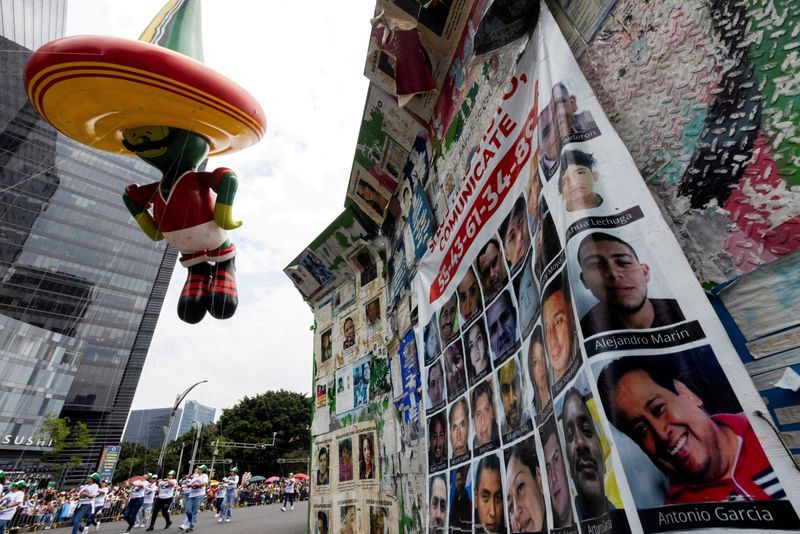
Mexico's passage into the World Cup knockout stages has painted Mexico City's Paseo de Reforma with festive colour and patriotic fervour, yet the nation's sporting joy sits uneasily alongside deeply entrenched social wounds. Even as massive screens broadcast the team's progress, posters depicting the country's more than 135,000 missing people line the same thoroughfare, a juxtaposition that encapsulates the competing narratives consuming Mexican public consciousness. This vast human tragedy has accumulated steadily since 2006, when then-President Felipe Calderon initiated what became a prolonged military campaign against drug trafficking organisations—a conflict whose humanitarian consequences continue to shape the national mood.
The football tournament has provided Mexican citizens with a rare collective escape, what some observers describe as a psychological respite from the grinding anxieties of contemporary life. Mexico's undefeated progression through the group stage, culminating in a first knockout-round victory in four decades against Ecuador, unleashed celebrations that briefly suspended the country's endemic preoccupations. Yet this euphoria operates within clear boundaries, and for many Mexicans the emotional compartmentalisation required feels increasingly exhausting. Carlos Mendoza, a journalist and podcaster, articulated this tension starkly, noting that while sports victories trigger a neurochemical rush that permits temporary forgetting, the underlying structural problems remain immutable, awaiting the moment when global attention shifts elsewhere.
Economic pressures have intensified the stakes surrounding this particular World Cup. Despite inflation moderating in early June, Mexico's core inflation remains stubbornly elevated above the Bank of Mexico's three percent target, constraining household budgets across income levels. The tournament's exorbitant ticket pricing—with attendance at matches requiring expenditures reaching thousands of dollars—has effectively priced ordinary Mexicans out of stadium experiences. This represents a qualitative departure from previous tournament cycles when logistical challenges, rather than pure affordability, determined fan access. The consequence is a World Cup experienced largely through screens rather than direct participation, a democratisation deficit that Mendoza identifies as perhaps the tournament's most profound injustice.
Violence has shadowed Mexico's football celebrations, demonstrating how thin the veneer of sporting joy truly is. Four deaths occurred during festivities surrounding Mexico's Ecuador victory, transforming Reforma into a scene of simultaneous celebration and tragedy. The incident underscores how even moments of national unity can fracture unexpectedly when underlying social tensions remain unresolved. Walls throughout the capital continue displaying anti-World Cup graffiti, residual evidence of sustained protest movements that predated the tournament and show no signs of abating.
Labour disputes have maintained a visible presence on Mexico City's streets, interrupting both traffic and civic normalcy. The CNTE teachers' union has deployed tent encampments blocking thoroughfares, pressing demands that the government honour campaign commitments to repeal a 2007 pension reform that radically restructured public-sector worker benefits. Concurrent salary increase demands reflect frustration that government rhetoric frequently outpaces concrete policy delivery. These protests illustrate how organised labour groups view the World Cup period as an opportune moment to maintain pressure on political actors who might otherwise deprioritise their grievances.
President Claudia Sheinbaum's administration enters this period of domestic turbulence from a position of relative political strength. An El Financiero poll registered her approval rating at 69 percent, reversing a modest downward trend that originated in March. The government has publicly designated the location and recovery of missing persons as a national priority, acknowledging the scale of the humanitarian challenge even as critics question the adequacy of resource allocation and investigative commitment. This approval rating suggests that the Sheinbaum government has successfully navigated the early months of her administration despite substantial inherited problems.
Yet Sheinbaum's supporters and opponents alike recognise a fundamental dynamic: major sporting events, by their nature, compress public attention onto a narrow domain, creating space for governing challenges to recede from active consciousness. This psychological phenomenon operates regardless of whether underlying problems actually diminish. When the tournament concludes, whether in triumph or elimination, Mexico will confront the same structural deficits that preceded the World Cup—unresolved violence, persistent inflation, income inequality, and political contradictions that no football victory can resolve.
The intellectual and emotional work required of engaged Mexican citizens has grown more demanding. Supporting the national team need not demand acquiescence to government failings or acceptance of unaddressed humanitarian catastrophes. Local politician Rodrigo Cordera articulated this possibility, observing that ninety minutes of football can coexist with simultaneous worry about national trajectory, anger at international bodies, and criticism of municipal governance. Life's complexities refuse binary categorisation, and mature citizenship requires holding multiple truths simultaneously—pride in athletic achievement coupled with clear-eyed assessment of institutional failure.
Mexico City resident Alejandra Gonzalez emphasised that while positive national moments triggered by sporting success contain intrinsic value, they cannot substitute for sustained critical scrutiny of governance performance. She advocated for a consciousness that maintains both celebratory capacity and analytical rigour, refusing the false choice between patriotic joy and civic accountability. This balance remains difficult to sustain, particularly when spectacle and emotion operate with such gravitational force.
The World Cup moment will inevitably conclude, leaving Mexican society to confront deferred decisions and accumulated challenges. Whether this tournament generates lasting positive momentum or merely postpones reckoning with systemic problems depends substantially on decisions made beyond football stadiums. The missing persons crisis, inflation pressures, labour disputes, and political contradictions that persist alongside World Cup celebrations will demand resolution long after this tournament's final whistle.

