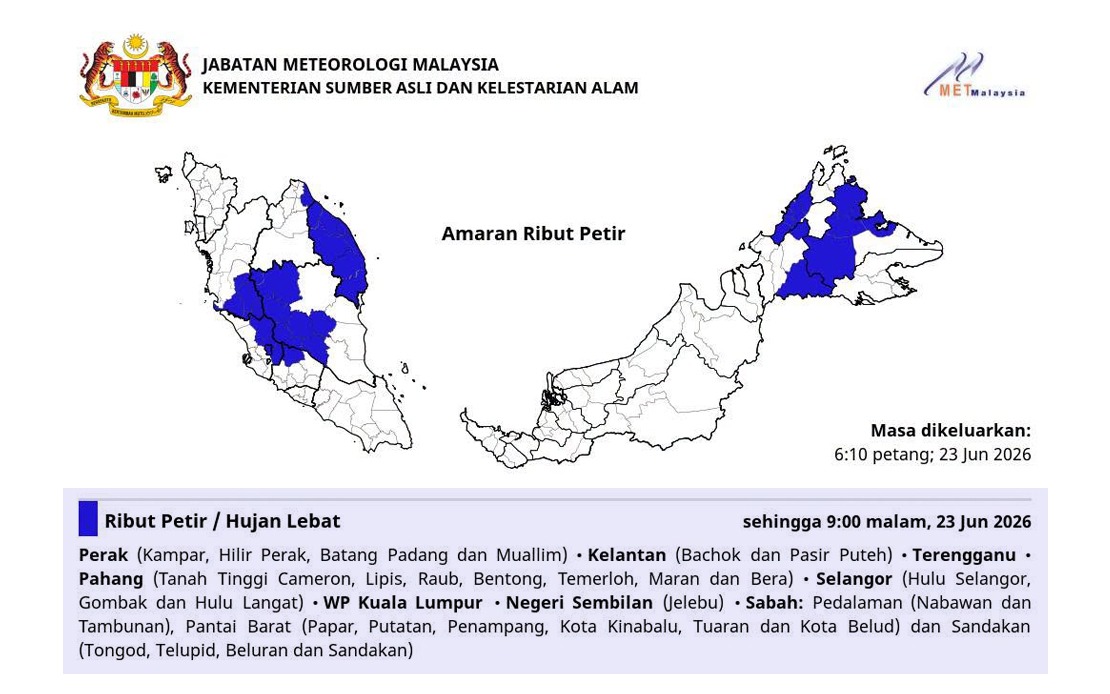
Malaysia's weather monitoring authorities have issued a routine advisory concerning Typhoon Mekkhala, which has been tracked at a considerable distance from Malaysian territory. The Malaysian Meteorological Department, through its National Weather and Geophysics Operations Centre, confirmed the tropical cyclone's position and trajectory following observations conducted on June 23, determining that no material danger exists for the nation.
At the time of the meteorological assessment, Typhoon Mekkhala was situated approximately 1,616 kilometres northeast of Kudat in Sabah, placing it well beyond the immediate vicinity of Malaysian airspace and territorial waters. The system's location positioned it roughly 460 kilometres northeast of Luzon in the Philippines, indicating that it remains firmly within the Philippine weather zone and within the broader Northwest Pacific typhoon belt where such systems regularly develop during the monsoon season.
The typhoon's prevailing conditions revealed a relatively measured movement pattern across the ocean. Data collected at 5 pm on June 23 indicated that Mekkhala was advancing in a northwesterly direction at a comparatively slow pace of 10 kilometres per hour. Despite this measured forward progress, the system maintained considerable intensity, with peak wind velocities reaching as high as 185 kilometres per hour, classification that places it within the realm of a significant tropical cyclone by international standards.
The MetMalaysia assessment explicitly stated that Malaysia would experience no significant impact from this weather system. This conclusion reflects the considerable distance separating the typhoon from Malaysian shores and the system's directional movement trajectory, which carries it further away from the Malaysian peninsula and the states of Sabah and Sarawak on Borneo. Such determinations by Malaysian authorities typically account for secondary effects including remote atmospheric disturbances, swell propagation, and indirect precipitation patterns that might theoretically reach Malaysian regions.
For Malaysian readers and regional observers, this advisory underscores the routine monitoring protocols maintained by MetMalaysia throughout the year, particularly during seasons when tropical cyclone activity peaks across the Northwest Pacific. The department's vigilance in tracking systems at considerable distances reflects standard meteorological practice and provides early warning capacity should any system's trajectory shift toward Malaysian territory or nearby regions.
The Philippines, by contrast, faces considerably greater exposure to Typhoon Mekkhala given the system's proximity and positioning. With Luzon lying only 460 kilometres away, Philippine meteorological authorities and emergency management agencies would typically maintain heightened alert status, coordinate evacuation protocols where necessary, and issue localized weather warnings for maritime operations and coastal communities. The northwestern trajectory suggests potential further advancement toward Taiwan and other territories in the Western Pacific region.
Typical typhoon behaviour during June reflects the Northeast Monsoon's gradual transition toward the Southwest Monsoon pattern across Southeast Asia, a period characterised by variable storm activity. Storms in this phase frequently develop in the central and western reaches of the Pacific basin and drift westward or northwestward, occasionally affecting the Philippines and territories further west. Malaysia's geographical position at lower latitudes generally provides protection from the most severe Northwest Pacific typhoon activity, though the country monitors all significant systems as a precautionary measure.
The issuance of such advisories by MetMalaysia serves multiple constituencies including maritime authorities, aviation regulatory bodies, fishing fleet operators, and the general public. Mariners in particular benefit from early awareness of distant typhoon systems, as such storms can generate substantial swell and rough sea conditions that propagate far beyond the immediate storm zone. The National Weather and Geophysics Operations Centre maintains continuous monitoring throughout the year and updates assessments as meteorological conditions evolve.
Regional cooperation in meteorological monitoring has strengthened considerably in recent decades, with agencies across Southeast Asia sharing real-time data and coordinated forecasting. This collaborative approach enables more accurate predictions of system movements and potential impacts across borders. MetMalaysia's advisory on Typhoon Mekkhala exemplifies this coordinated regional approach to tropical cyclone management and public safety communication.