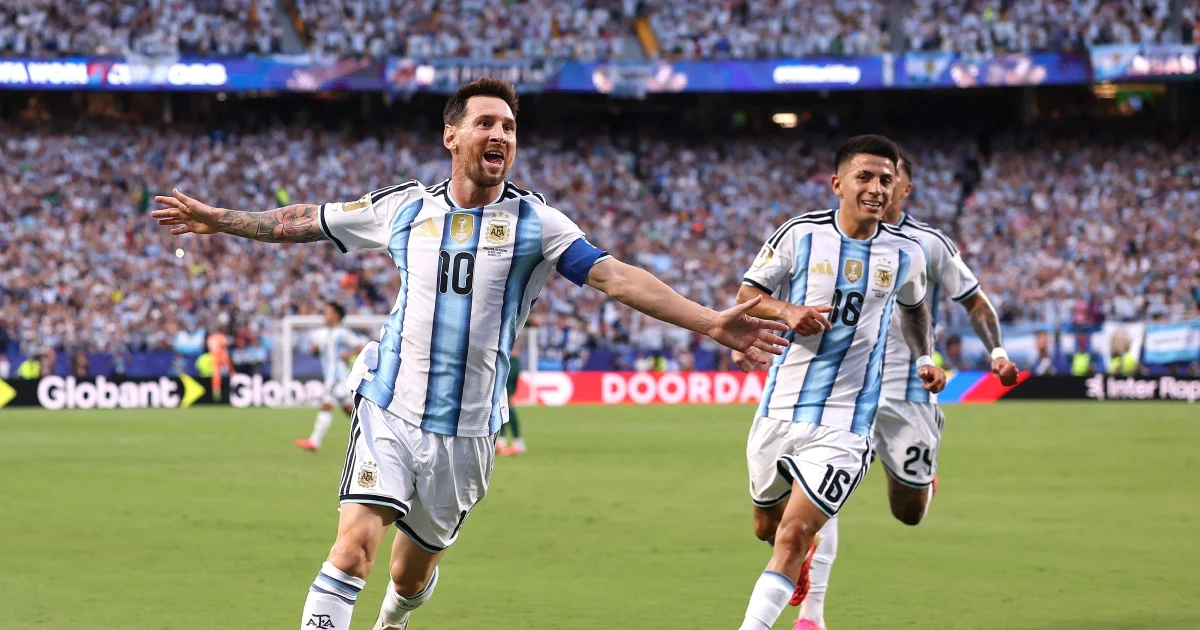
Lionel Messi has lifted the curtain on private struggles in his personal life, shedding light on the emotional weight he carried during Argentina's commanding 3-0 victory over Algeria in a World Cup encounter. The Argentine football icon, whose tears became a talking point among supporters and observers, disclosed that his vulnerability on the pitch was rooted in challenges he was facing away from the game.
The hat-trick itself marked a significant milestone for the seven-time Ballon d'Or recipient, representing his first three-goal haul in World Cup competition across his long international career. Such an achievement typically commands celebration, yet for Messi, the occasion carried deeper emotional resonance given the personal circumstances occupying his mind during the match. His openness about the situation provided insight into the human dimensions of elite sports performance, where psychological and emotional factors often operate beneath the surface of what spectators witness on the field.
Messi's willingness to discuss his difficulties contrasts with the typical reticence many professional athletes maintain regarding private matters. By choosing to share with the public, the Inter Miami forward has contributed to a broader cultural shift in football where discussing mental health and personal wellbeing is increasingly normalised. This transparency is particularly significant given his status as one of football's greatest performers, whose every action is scrutinised and analysed globally.
The timing of Messi's revelation holds particular weight in the context of his World Cup journey. Throughout his career, the tournament represented an unfulfilled ambition until Argentina's triumph in 2022, after which his personal relationship with the competition appeared to evolve. His continued participation in World Cup fixtures, despite his age and accumulated experience, underscores both his commitment to national duty and the possibility that lingering personal considerations might influence his outlook and emotional state during international duty.
For Malaysian and Southeast Asian football followers, Messi's disclosure resonates beyond the immediate narrative of a sporting performance. His experience illustrates that even the most accomplished athletes navigate complex human circumstances that can intersect with their professional responsibilities. This reality challenges the tendency to compartmentalise sportspeople as purely performance machines, instead recognising them as multidimensional individuals whose lives extend far beyond the stadium.
The 3-0 scoreline against Algeria represented a dominant display from Argentina, demonstrating their commanding presence in World Cup competition. Such decisive victories provide the context within which individual performances like Messi's hat-trick are situated, though the personal context he revealed suggests that even dominant team performances can coexist with individual emotional turbulence for key players.
Messi's openness about his personal challenges also carries implications for how football culture addresses player wellbeing at the highest levels. Modern football places unprecedented demands on elite performers, combining intense physical exertion with psychological pressure, media scrutiny, and the weight of national expectation. When world-class players like Messi acknowledge personal difficulties, it validates the necessity for comprehensive support systems within professional football organisations that extend beyond purely technical and tactical preparation.
The Argentine forward's career trajectory in recent years has encompassed significant transitions, from his long association with Barcelona to moves to Paris Saint-Germain and subsequently to Inter Miami. These substantial life changes, combined with whatever personal circumstances he has been navigating, create a complex backdrop against which his continued high-level performance remains noteworthy. His hat-trick against Algeria demonstrates that despite these pressures and difficulties, his fundamental capacity to deliver exceptional performances remains intact.
For aspiring footballers throughout Southeast Asia and beyond, Messi's example carries multiple layers of significance. Beyond the technical brilliance he displays on the pitch, his willingness to acknowledge vulnerability and discuss personal challenges models a more holistic approach to elite sport. It suggests that professional success and personal difficulty are not mutually exclusive, and that addressing mental and emotional wellbeing forms an essential component of sustained athletic excellence.
The broader implications of Messi's disclosure extend to how football organisations, media, and supporters approach conversations about players' lives beyond their professional commitments. Increasingly, the football community recognises that comprehensive player welfare—encompassing physical, mental, and emotional dimensions—ultimately serves the sport itself by enabling athletes to perform authentically and sustainably at the highest levels.