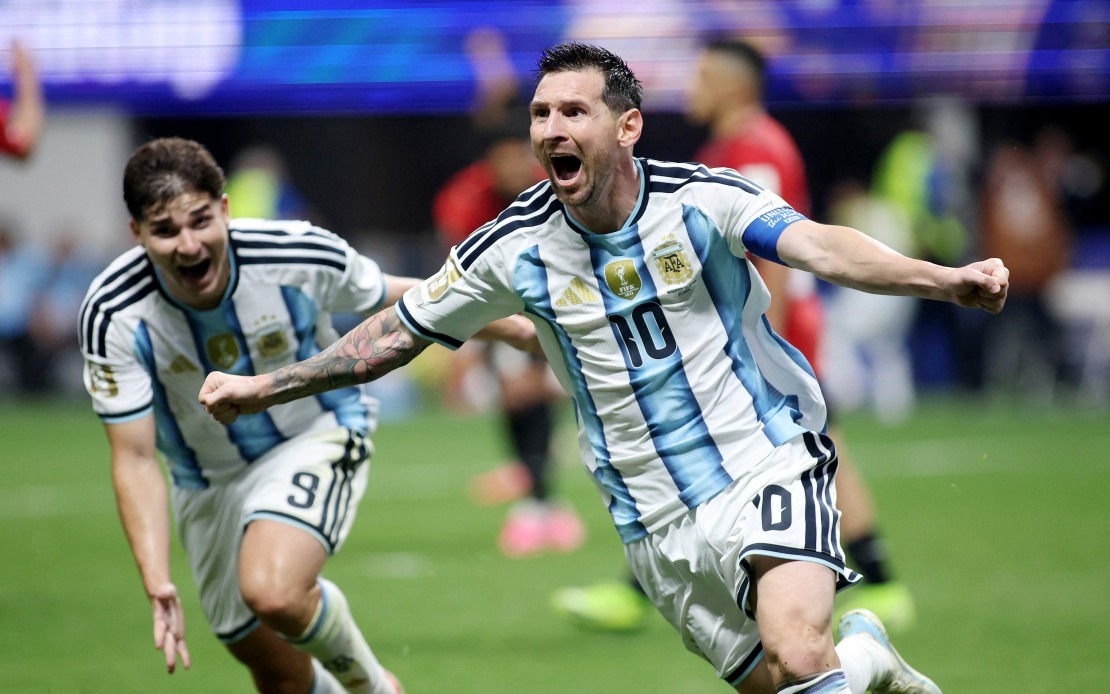
Lionel Messi continues to defy age and expectation at this summer's World Cup, standing as joint leading scorer with eight goals as Argentina pursues a second consecutive title. The 39-year-old footballer has already etched his name into the tournament's historical record books, and Wednesday's clash against England in Atlanta promises to add another chapter to his extraordinary World Cup narrative.
Messi's 2022 Qatar victory appeared destined to be his coronation moment. Leading Argentina to the trophy with seven goals, including two in the final during their penalty victory over France, the achievement seemed to provide the perfect sendoff for a player many assumed would retire as the sport's greatest. The entire squad had rallied around a shared mission: delivering the World Cup crown to their captain before time inevitably caught up with him. Yet nearly four years on, Messi remains not just present but performing at the highest level, once again driving his team's campaign from the front.
The competition for the Golden Boot remains intensely contested between Messi and Kylian Mbappé. While both players currently hold eight goals, Mbappé maintains a slight advantage through secondary tie-breaking criteria, including his superior assist record and superior minutes-per-goal ratio. England's Harry Kane and teenage sensation Jude Bellingham have closed the gap considerably at six goals each, though Norway's Erling Haaland, previously among the favourites, has been eliminated from contention. The Golden Boot would represent the final major individual award missing from Messi's extraordinary collection, a prize that narrowly eluded him four years ago when Mbappé's hat-trick in the final proved decisive.
Beyond immediate tournament accolades, Messi has rewritten the World Cup's all-time scoring record. His total of 21 goals now stands alongside the surging Mbappé, both players having decisively surpassed Miroslav Klose's previous benchmark of 16 goals. Their combined assault on the record books reflects the elevated level of international football in the twenty-first century. England's Kane has similarly climbed the historical rankings with 14 goals, positioning himself as a long-term threat to the record, though Mbappé's age and trajectory suggest the French striker may ultimately establish himself as the tournament's permanent leading goalscorer.
Messi's longevity in World Cup competition extends far beyond mere goal-scoring statistics. Aged 35 during the 2022 triumph, he became the oldest player to win the tournament's Golden Ball, the award for outstanding individual performance. This summer, playing at 39, he has claimed two additional all-time records that underline his unprecedented durability. Both he and Cristiano Ronaldo have become the first male players to appear in six separate World Cups, a distinction that speaks to their exceptional consistency across nearly two decades of international competition. Both men have now exceeded Lothar Matthäus's previous record of 25 World Cup appearances, with Messi positioned to make his 33rd appearance on Wednesday—an astonishing six matches ahead of his longtime rival.
Messi's World Cup journey commenced far less spectacularly. In 2006, he scored just once during his tournament debut in Germany, a understated beginning for what would become an iconic legacy. Four years later, in South Africa, he failed to register a single goal, suggesting at that point that international tournament football might not be his natural habitat. The 2014 tournament in Brazil, contested on Argentine soil across the border, saw him emerge as a crucial performer with four goals, though a final appearance against Germany ended in heartbreak on penalties. He managed one goal in 2018 before unleashing his most prolific tournament in 2022, when, remarkably, his seven-goal haul exceeded his combined output from the previous four World Cups.
The composition of Messi's goal-scoring record raises important nuances about his penalty-taking record. During the 2022 triumph, four of his seven goals came from the penalty spot, supplemented by additional successful conversions in earlier tournaments. However, his penalty record proves less reliable in open play, as evidenced by his misses against Austria during the group stage and against Egypt's goalkeeper Mostafa Shobeir in the knockout rounds. Across all World Cup matches excluding shootouts, Messi has converted only four of eight penalties, a conversion rate that highlights the psychological and technical demands of spot-kick execution at elite level.
Where Messi demonstrates complete mastery is in penalty shootouts, where the pressure intensifies exponentially. He has succeeded in all three shootouts he has featured in across World Cups: against the Netherlands in 2014, against the same opponents again in 2022, and crucially in the 2022 final against France. This distinction proves significant—while regular penalties have occasionally defeated him, the ultimate test of nerve in sudden-death situations has found him equal. A teenage Messi witnessed Argentina's shootout defeat to Germany in 2006 from the substitutes' bench, an experience that perhaps hardened his resolve for the dramatic moments his career would later demand.
The significance of Messi's continued excellence extends beyond personal achievement. For Argentina's football culture, which has invested decades in cultivating attacking talent and creative midfielders, Messi remains the standard against which all future generations will be measured. His World Cup performances—both the triumphs and the near-misses—have shaped national identity and expectations. The 2022 victory ended a 36-year drought dating to 1986, a void that defined an entire generation of Argentine supporters. Now, at an age when most athletes have long since retired, Messi continues to provide his country with opportunities for further glory, a narrative that transcends sport and speaks to persistence, excellence, and the power of individual determination.

